That distinction shapes everything a shop cares about. Finish hardness, defect rates, turnaround time, and long-term durability all hinge on whether paint cures in a controlled, heated environment or simply dries at room temperature. For auto body technicians and shop owners, choosing the right curing method isn't a minor technical detail — it directly affects job quality, throughput, and operating costs.
Key Takeaways
- Both spray painting and baking use a spray gun; the difference is how the paint cures, not how it's applied
- Baking uses controlled heat (typically 140°F/60°C) to chemically cure paint faster and harder
- Open-air painting cures at ambient temperature, which lowers cost but slows curing and increases contamination risk
- Full cure for ambient-dried clearcoat can take up to 7 days; a bake cycle takes 20–35 minutes
- Infrared (IR) curing systems cut compatible bake cycles to 8–15 minutes, bridging quality and speed
Baking vs. Spray Painting: At a Glance
Both methods share the same application phase. The table below breaks down where the two methods actually diverge:
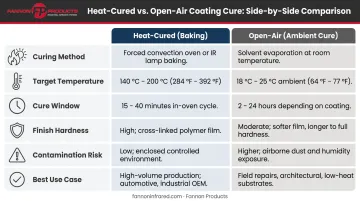
| Factor | Heat-Cured (Baking) | Open-Air (Ambient Cure) |
|---|---|---|
| Curing method | Controlled heat in spray booth | Room temperature, natural airflow |
| Target temperature | 120–140°F (49–60°C) typical | Ambient (ideally above 60°F) |
| Clearcoat cure window | 20–35 minutes at temperature | 8 hours to 7 days (product-dependent) |
| Finish hardness | Harder, chemically cross-linked film | Softer initially; full cure takes days |
| Contamination risk | Low — filtered, enclosed environment | Higher — dust, humidity, insects |
| Equipment cost | Significant upfront (booth + heat system) | Minimal |
| Best use case | Full repaints, insurance work, OEM repairs | Touch-ups, custom art, budget jobs |
What Does It Mean to Bake a Car's Paint?
"Baking" refers to the curing phase, not how paint is sprayed. After a technician applies paint with a spray gun inside a spray booth, the booth heats up to an elevated temperature — typically 140°F/60°C at the metal surface — and holds that temperature for a defined window. Most manufacturer technical data sheets (TDS) cluster around this target, though some low-bake systems allow curing at 120°F/49°C.
The Chemistry Behind Heat Curing
Modern automotive refinish systems — particularly 2K polyurethane clearcoats — rely on chemical cross-linking to cure. Heat accelerates this reaction, driving the paint polymers to bond more completely and faster than ambient temperatures allow. According to Axalta's technical data, chemical cross-linking can actually stop if temperatures drop to 60°F/15°C — meaning cold shops that skip heat curing risk incomplete film formation.
The practical result: a heat-cured film is harder, more chemically resistant, and more mechanically tough than the same coating left to air-dry.
Bake Cycle Times Vary by Product
Cycle times aren't universal — they're product-specific. A few published examples:
- PPG EC520: Force dry at 140°F for 15 minutes
- Axalta CH3050: 30 minutes at 140°F/60°C
- Spies Hecker 8035: 20–30 minutes at 140°F target metal temperature
- Sherwin-Williams CC637: Short-bake 10 minutes or full-bake 25 minutes at 140°F surface temperature
Always follow the paint manufacturer's TDS — not a generic shop rule.
Infrared Curing: A Faster Path to the Same Result
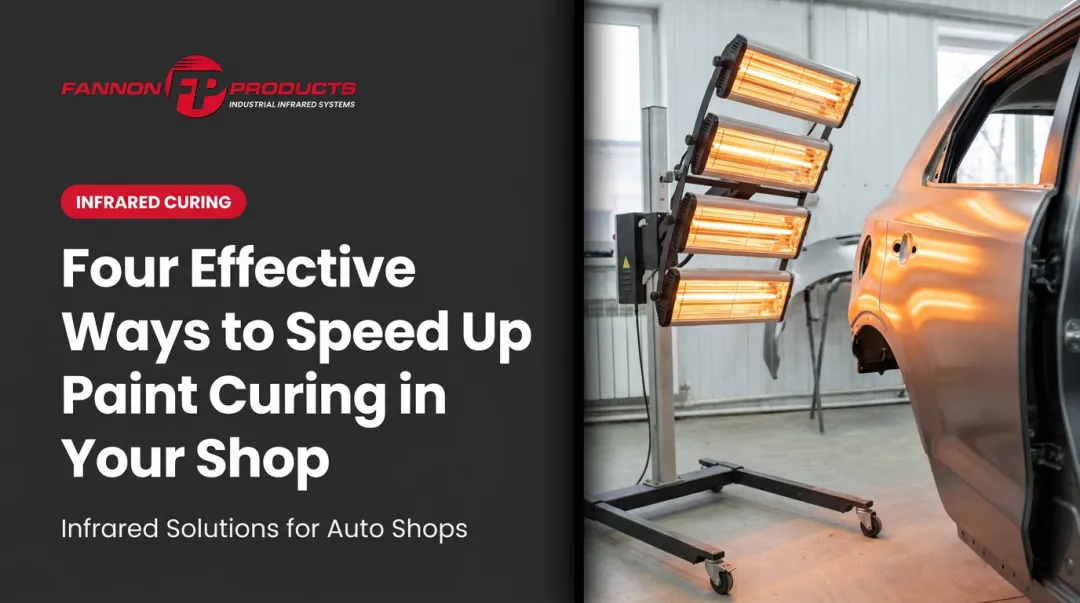
Conventional spray booths heat the entire enclosure through convection. Infrared (IR) systems target the paint surface directly, cutting compatible cure cycles sharply. The Spies Hecker 8035 TDS lists 8–12 minutes for short-wave IR versus 20–30 minutes for conventional baking — a significant time reduction on a production floor.
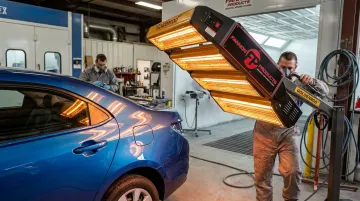
That precision matters in paint environments. Fannon Products manufactures short-wave, medium-wave, and twin-tube quartz infrared lamps for automotive paint curing across primer, color, clear coat, and powder coat stages. Their Goldenrod lamp design uses an integral 24K gold reflector to direct IR energy at the coated surface while keeping surrounding equipment cooler — a practical advantage where stray heat causes defects.
Where Baking Is the Standard
Heat curing is the default for:
- Full-panel and full-vehicle repaints at professional body shops
- OEM and dealership-level collision repairs
- Insurance work where warranty and durability standards apply
- Industrial and fleet vehicle coating where consistent results are non-negotiable
What Is Open-Air Spray Painting a Car?
Open-air (ambient-cure) spray painting uses the same spray gun application technique — the difference is entirely in what happens after. Paint is applied in an open or semi-enclosed environment and left to dry at room temperature without applied heat. Solvents evaporate naturally, leaving the paint film behind.
How Long Does Ambient Cure Actually Take?
Much longer than most people expect. Published manufacturer data shows a wide range:
| Product | Dust-free | Ready to deliver | Full cure |
|---|---|---|---|
| Axalta CH3050 | 45 minutes | 24 hours | 7 days |
| Spies Hecker 8035 | 30–40 minutes | 12 hours | — |
| PPG JC7200 | — | 12 hours or overnight | — |
That 7-day full cure window matters for shops. A panel that looks dry may still be vulnerable to chipping, chemical damage, and polishing marks until the paint has fully hardened beneath the surface.
Practical Advantages of Open-Air Painting
- No spray booth or curing oven required — lower equipment investment
- Greater flexibility for on-site repairs or custom artistic work
- Faster setup for small-scale spot jobs
The Trade-Offs
Open-air curing exposes wet paint to variables a booth eliminates:
- Dust, pollen, and insects settling into wet film
- Humidity fluctuations that cause blistering or matting
- Temperature drops below 60°F that can halt cross-linking entirely
Axalta's Paint Defects Manual directly links high ambient humidity to blistering and matting, and attributes dirt inclusions to inadequate air filtration — problems that a filtered, enclosed booth prevents.
Where Open-Air Painting Makes Sense
- Minor spot repairs and touch-ups
- Custom or artistic paintwork where booth access isn't available
- Lower-budget jobs where finish longevity isn't the primary concern
For full-panel repairs, insurance work, or any job where color match and long-term durability matter, open-air painting is the wrong tool for the job.
Baking vs. Spray Painting: How Do They Compare?
Finish Quality and Durability
Heat-cured paint forms a harder, more chemically resistant film than ambient-cured paint — not because of better materials, but because heat drives the cross-linking reaction to completion faster and more thoroughly. The American Coatings Association notes that 2K polyurethanes are used precisely because of their weatherability, toughness, and chemical resistance — properties that depend on complete cross-linking.
Ambient-cured clearcoat can reach comparable hardness within 7 days — Axalta's CH3050 reaches full cure on that schedule — but a panel leaving the shop the same day it was painted hasn't reached that threshold.
Process Time and Shop Throughput
According to 3M's collision repair workflow analysis, efficient shops average 4–6 booth cycles per day, with about 48–72 refinish hours per day per booth. A 20–30 minute bake cycle means a booth can turn over multiple times daily.
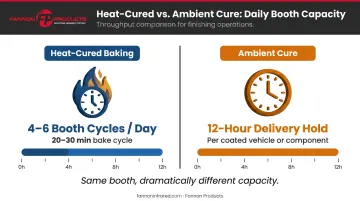
Ambient cure doesn't have that capacity. A clearcoat that needs 12 hours before delivery effectively occupies a workspace for half a day — or means the car leaves before the paint has properly hardened.
Equipment and Operating Costs
Spray booth investment involves more than the unit price. Installation alone — concrete work, permits, gas lines, electrical — can match the booth cost itself. Ongoing expenses add up from there:
- Fuel consumption per bake cycle
- Intake and exhaust filter replacements
- Periodic booth maintenance and recertification
For high-volume shops doing full repaints and insurance work, that capital commitment is justifiable: faster cycle times mean more jobs per week, and a harder finish means fewer rework calls. Open-air painting avoids those costs entirely, which makes it workable for occasional touch-ups — but not for shops that prioritize throughput or finish consistency.
Situational Recommendation Guide
Choose heat-cured (baking) when:
- Completing full-panel or full-vehicle repaints
- Working on insurance or warranty-backed repairs
- Running a high-volume shop where throughput matters
- Quality, color consistency, and durability are non-negotiable
Choose open-air spray painting when:
- Doing minor spot repairs or touch-ups
- Working on custom or artistic projects where precision finish isn't the goal
- Booth access isn't available and the job scope is limited
- Budget constraints make booth investment impractical
Conclusion
Both methods apply paint the same way. The real difference is what happens after the gun stops — the cure stage determines whether a shop delivers a panel that's hard, contamination-free, and ready to leave the booth, or one that needs days to reach working strength.
For professional body shops handling full repaints, insurance repairs, or high-volume work, heat curing is the practical standard. The investment in a spray booth pays back through faster throughput, harder finishes, and fewer rework cycles.
Infrared curing systems push that further, cutting compatible cure cycles to under 15 minutes while maintaining the quality benefits of heat-accelerated cross-linking. Companies like Fannon Products, with nearly 70 years manufacturing infrared lamps for automotive applications, build the precision curing equipment that makes those throughput gains real.
Open-air painting has its place — touch-ups, custom work, budget-constrained jobs. But when durability, finish hardness, and cycle time are on the line, controlled heat curing isn't just better — it's the standard shops rely on to stay competitive.
Frequently Asked Questions
How long does car paint need to bake?
The active bake window is typically 20–35 minutes at target metal temperature (around 140°F/60°C), depending on the specific paint product. Total process time (prep, flash-off, bake, and cool-down before polishing) can run 2–5 hours per job.
Does car paint have to be baked on?
No — paint can air-dry at ambient temperature. But heat curing produces a significantly harder, more durable finish and is the professional standard for collision repair and full repaints. Ambient cure can take up to 7 days to reach full hardness.
At what temperature do you bake car paint?
Most automotive refinish TDS documents use 140°F/60°C at the metal or surface as the target. Some low-bake products allow curing at 120°F/49°C. Always follow the specific paint product's data sheet, as there is no universal shop setting.
Is oven-baked paint more durable than air-dried paint?
Yes. Heat accelerates the cross-linking of paint polymers, producing a harder film that resists chipping, UV exposure, and chemical damage better than ambient-cured paint. The same coating left to air-dry can reach similar hardness, but the process takes days rather than minutes.
Can you bake car paint at home?
In practice, no. Professional spray booths control temperature, airflow, and contamination simultaneously, and a home garage can't replicate all three conditions. Heat lamps can speed surface drying, but they don't deliver the controlled, even cure that a professional booth provides.
What is the main advantage of a spray booth over open-air painting?
A spray booth provides a filtered, enclosed environment that eliminates dust, humidity, and temperature variables — the primary causes of contamination defects. Combined with controlled heat curing, it delivers a faster, harder, and more consistent finish than any open-air setup can match.