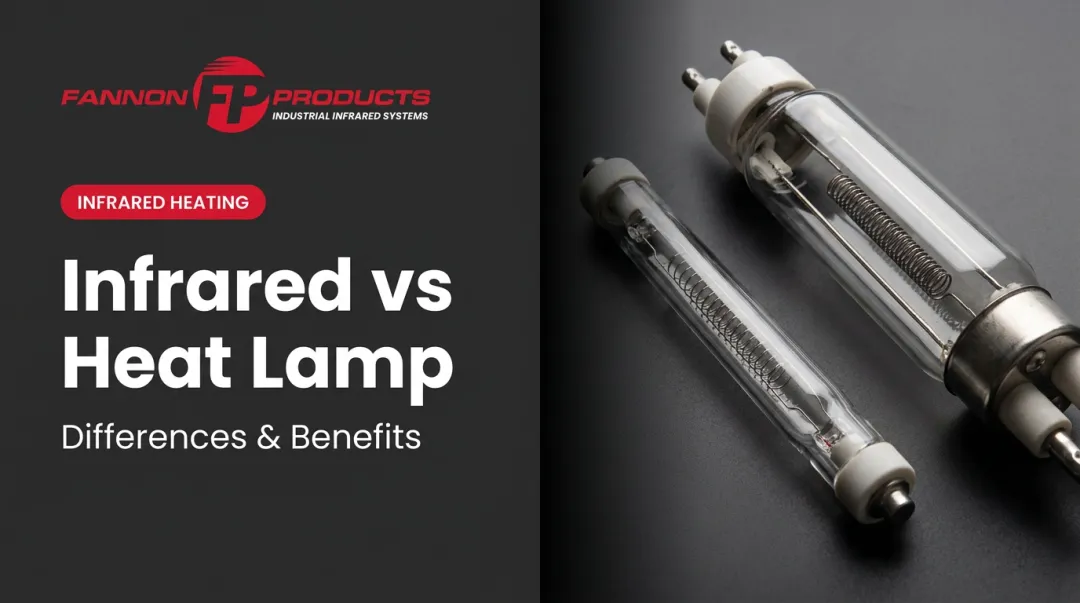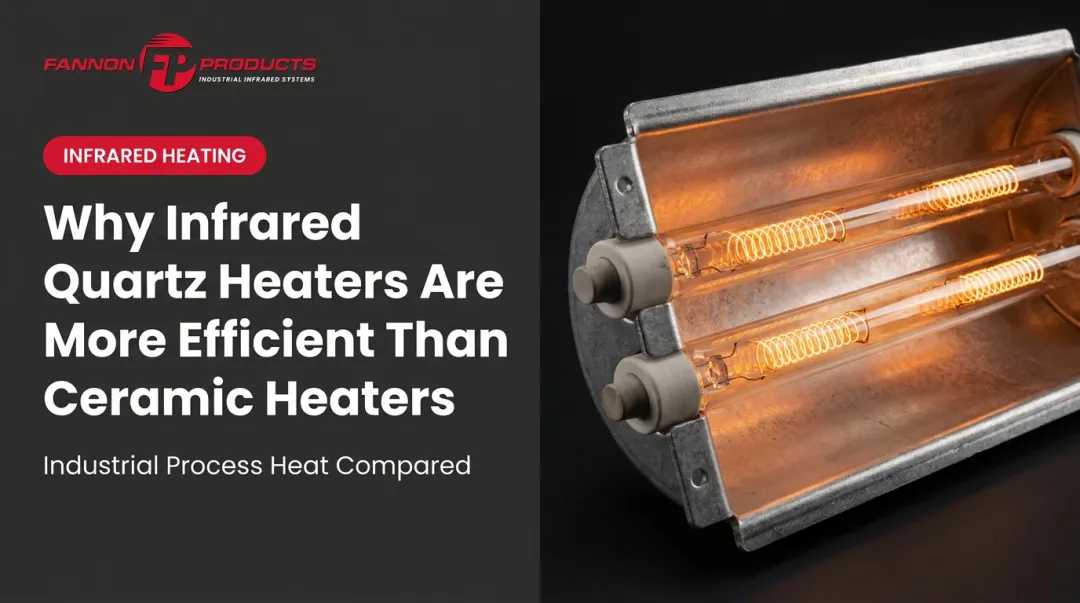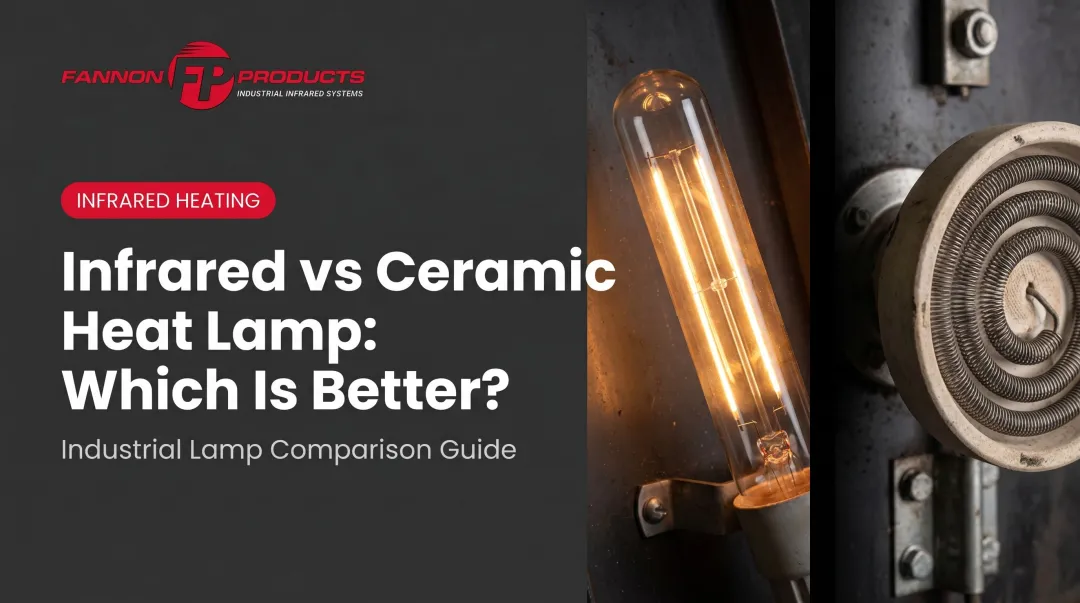
This comparison covers infrared heat lamps (short- and medium-wave quartz or tungsten filament devices) versus ceramic heat lamps (long-wave IR-C radiant emitters). It does not cover ceramic space heaters, which use convection fans to warm air and are an entirely different technology.
The goal here is practical: help industrial buyers understand the technical differences and select the right lamp for their specific process.
Key Takeaways
- Short/medium-wave infrared lamps hit operating temperature in 1–2 seconds; ceramics take 10–12 minutes
- Wavelength matching — fitting the lamp's emission peak to what the material absorbs — is the single most important selection factor
- Infrared heat lamps outperform ceramic in speed, throughput, and process control for industrial applications
- Ceramic lamps serve a specific role: sustained, low-intensity warming where visible light cannot be present
- The right lamp follows from the process and material first — not price or familiarity
Infrared vs Ceramic Heat Lamps: Quick Comparison
Use this table to compare both lamp types across the specs that matter most for your application:
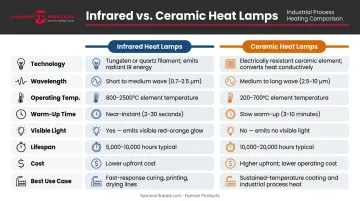
| Attribute | Infrared Heat Lamps | Ceramic Heat Lamps |
|---|---|---|
| Technology | Tungsten/carbon filament in sealed quartz tube | Coiled alloy resistance wire embedded in ceramic body |
| Wavelength | IR-A (780 nm–1.4 μm) or IR-B (1.4–3 μm) | IR-C (2–10 μm practical range) |
| Operating Temp | Filament: 800–2,400°C depending on wave type | Surface: 300–700°C (max 750°C) |
| Warm-Up Time | Short-wave: 1–2 seconds; standard medium-wave: 60–90 seconds | 10–12 minutes to steady state |
| Visible Light | Yes, at full operating intensity | None at typical operating temperatures |
| Rated Lifespan | Short-wave: ~5,000 hrs; medium-wave: up to 20,000 hrs | Up to 20,000 hrs (condition-dependent) |
| Upfront Cost | Higher (quartz/tungsten construction) | Lower (simpler resistance wire and ceramic body) |
| Best Use Case | Industrial drying, curing, printing, automotive paint, food processing | Animal husbandry, vivaria, light-sensitive overnight warming |
What Is an Infrared Heat Lamp?
Infrared heat lamps transfer energy directly to objects and surfaces through electromagnetic radiation — no contact, no air medium required. That direct transfer is what makes them highly controllable for industrial process heating: the energy goes where it's aimed, not into the surrounding air.
The Three Wavelength Classifications
Most industrial infrared lamps operate in IR-A or IR-B:
- IR-A (short-wave, ~780 nm–1.4 μm): Highest intensity, fastest response (1–2 seconds), filament temperatures reaching 1,800–2,400°C. Best for processes requiring rapid, high-density heat delivery.
- IR-B (medium-wave, 1.4–3 μm): Broader material absorption, filament at 800–950°C for standard types. The 60–90 second warm-up of standard medium-wave limits it on rapid-cycling lines, though fast-response medium-wave variants close that gap considerably.
- IR-C (long-wave, 3 μm–1 mm): Lower intensity, overlaps with ceramic emitter output. Most industrial quartz lamps do not operate in this range.
Why Wavelength Matching Determines Real Efficiency
A powerful lamp aimed at a material that's partially transparent to its wavelength wastes energy and slows cycle times. According to Heraeus, the better the emitter spectrum and material absorption spectrum match, the faster and more efficiently the material heats.
Material absorption varies significantly:
- Water-based coatings absorb most strongly above 2 μm, with peak absorption at 2.5–3.3 μm — making medium-wave a better fit than short-wave for water removal
- Plastics and polymer coatings absorb broadly across 2.5–6 μm
- Bare polished metals can reflect significant IR energy; oxidized or coated surfaces absorb far more effectively (stainless steel emissivity rises from 0.17 polished to 0.85 oxidized)
Wattage-matched lamps can still underperform if the spectral alignment is wrong. This is where many buyers go wrong — chasing power ratings rather than spectral fit.
Industrial Applications for Infrared Heat Lamps
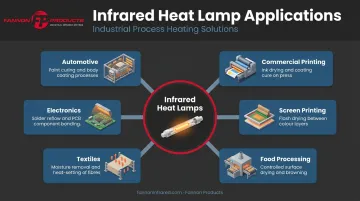
Infrared heat lamps have established use across a wide range of process-heating applications:
- Automotive: Primer, color coat, clear coat, and powder coat curing
- Commercial printing: Offset ink drying, inkjet drying on glossy and non-glossy substrates
- Screen printing: Plastisol ink curing with fast-response medium-wave lamps
- Food processing: Baking, browning, dehydrating, pasteurizing
- Textiles: Web drying, fabric finishing, pre-shrinking
- Electronics: Reflow soldering and PCB processing (note: most modern reflow ovens use convection as the primary heat mode, with IR as a secondary element)
Fannon Products has served these sectors for nearly 70 years. Common replacement configurations include Heidelberg press lamps (1,800W–6,950W across Speedmaster 52, 72, 74, 102, and XL105 models), M&R flash dryer lamps (1,000W–2,000W medium-wave star coil), and custom-engineered systems for automotive and food processing lines. The replacement lamp catalog lists direct-fit options by OEM model, wattage, and voltage — useful if you're sourcing a drop-in replacement rather than redesigning a system.
What Is a Ceramic Heat Lamp?
Ceramic heat lamps, also called ceramic heat emitters (CHEs), use a coiled alloy resistance wire embedded in a ceramic body. That wire heats the ceramic, which then radiates long-wave infrared energy in the IR-C range (2–10 μm).
Because operating surface temperatures are much lower than quartz infrared lamps (typically 300–700°C, with a maximum of 750°C), ceramic emitters produce no visible light at normal operating settings. That makes them the default choice for applications where darkness is a requirement.
One important qualification: at the upper end of the operating range (above ~525°C), some CHEs can produce a faint dull-red glow. The no-visible-light claim holds for most standard operating conditions, not universally across every setting.
Physical Limitations of IR-C Radiation
Long-wave IR-C penetrates surfaces shallowly, heating the outer layer rather than transmitting energy deeper into the material. Short- and medium-wave infrared lamps penetrate more deeply into the target. For processes where surface heating is sufficient, this isn't a problem. For curing thick coatings or heating through materials, it is.
Where Ceramic Heat Lamps Fit — and Where They Don't
Well suited:
- Reptile enclosures and vivaria
- Animal husbandry and agricultural brooding
- Veterinary warming environments
- Any application requiring extended operation without visible light
Poor fit:
- High-throughput industrial drying or curing
- Stop-start production lines requiring fast temperature cycling
- Precision spot heating of specific surface zones
- Any process where energy efficiency scales with response time
Each of those poor-fit scenarios traces back to the same root issue: ceramic emitters take 10–12 minutes to reach steady state. Any production environment with variable throughput — lines that stop and start — cannot absorb that delay. It's what excludes ceramic emitters from most industrial process-heating applications.
Infrared vs Ceramic Heat Lamps: Which Is Better?
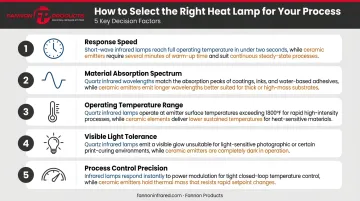
Neither lamp wins universally. The right choice follows from five specific factors tied to the process and material.
The Five Decision Factors
1. Required response speed If the process stops and starts, the lamp must reach operating temperature in seconds. Short-wave infrared: 1–2 seconds. Standard medium-wave: 60–90 seconds. Ceramic: 10–12 minutes. For any cycling production line, that warm-up time makes ceramic a non-starter.
2. Target material's absorption spectrum The emission peak must align with where the material actually absorbs energy. A correctly sized infrared lamp in the wrong wavelength range will consistently underperform a lower-wattage lamp that's spectrally matched to the substrate.
3. Operating temperature range Short-wave infrared filaments reach 1,800–2,400°C. Ceramic elements max out at 750°C surface temperature. For high-intensity process heating, infrared operates at intensities ceramic physically cannot reach.
4. Visible light tolerance Overnight animal care, certain agricultural settings, and some light-sensitive manufacturing environments require a no-light solution. Ceramic provides that; quartz infrared does not.
5. Process control precision Industrial lines with feedback controls and variable power settings need lamps with fast, predictable response. Infrared's near-instant response enables tighter process control and faster corrections when process conditions change.
When to Choose an Infrared Heat Lamp
Choose infrared when:
- The process requires sub-2-second heat response
- High throughput is an operational priority
- Consistent temperature control is needed for repeatable quality
- The application is in automotive finishing, commercial printing, plastics forming, food processing, or textile drying
The energy case is strong. Advanced Energy's industrial case data documents a textile booster oven retrofit that saved 65,000 kWh and 6,500 dekatherms annually — a 12% energy intensity reduction. In a separate documented example, powder-coated engine blocks cured in 6 minutes with infrared versus 75 minutes in a gas convection oven — and the IR oven's footprint shrank from 7,200 sq ft to 258 sq ft. For facilities running gas-fired ovens, Heraeus documents energy savings above 70% after switching to infrared, though results depend on application match and system design.
When to Choose a Ceramic Heat Lamp
Choose ceramic when:
- Visible light cannot be present during operation
- The application runs continuously without stop-start cycling
- Diffuse, even long-wave IR distribution is specifically needed
- The use case is non-industrial: animal husbandry, vivaria, food warming, agricultural brooding
Real-World Application: Infrared in a Commercial Printing Environment
Consider a high-speed commercial printing operation running Heidelberg Speedmaster presses. Ink drying between passes is a throughput variable — if the lamp can't keep pace with press speed, either the line slows or wet ink causes adhesion failures on subsequent colors.
The selection criteria for this type of application are concrete:
- Response time: The lamp must respond to press speed changes immediately
- Wavelength selection: Printing ink drying typically calls for medium-wave or fast medium-wave infrared, which aligns with the absorption profile of water-based and oil-based ink carriers
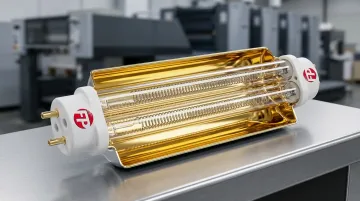
- Configuration: Twin-tube quartz lamps with gold reflectors, matched to the press model's dryer system geometry
Fannon's Heidelberg replacement lamps address exactly this scenario — fast medium-wave lamps in the 4,200W–6,950W range with 23K gold reflectors, engineered to OEM specifications for Speedmaster 74, 102, and XL105 presses. The 96% radiant efficiency and near-instant response of these configurations mean the heating element doesn't become the bottleneck in a high-speed press run.
The same precision applies in screen printing, though the variables differ. For M&R flash dryer applications, medium-wave is the preferred choice over short-wave — it's less color-sensitive, which matters when curing plastisol inks across light and dark substrate colors in a multicolor screen printing process.
In both cases, the lamp specification is a production decision — one that directly affects cycle time, energy cost, and output consistency.
Buyers evaluating infrared lamp configurations for their process can explore Fannon Products' replacement lamp catalog to find direct-fit options by equipment model. For custom-engineered solutions built around specific process requirements, contact the team at 810-794-2000 or sales@fannonir.com.
Conclusion
Infrared heat lamps are the stronger choice for industrial applications demanding fast response, spectral precision, and repeatable process control. Ceramic heat lamps serve a distinct role in low-intensity, no-light-required warming scenarios — and they serve that role well. Mismatches happen when buyers apply one where the other belongs.
Start with the process requirement. Ask:
- What material are you heating, and what is its absorption profile?
- Does the line cycle on and off frequently?
- What response time does your throughput require?
- Are visible light emissions a constraint for the application?
The hardware selection follows directly from those answers.
For applications in automotive finishing, commercial printing, food processing, or textile drying, quartz infrared lamps are built for the work — their spectral range and response characteristics match what these processes actually demand. Ceramic emitters are not designed for that workload.
Fannon Products has engineered infrared process-heating systems for these industries for nearly 70 years, with replacement quartz IR lamps in every size, wattage, and voltage available factory-direct. If you're selecting or replacing lamps for an industrial line, contact the team at sales@fannonir.com or call 810-794-2000.
Frequently Asked Questions
Which is better, ceramic heat lamps or infrared heat lamps?
It depends entirely on the application. Short- and medium-wave infrared lamps are better for fast, high-intensity industrial processes where response time and throughput matter. Ceramic lamps are better for sustained ambient warming in scenarios where no visible light can be present, such as overnight animal care or agricultural brooding.
What heat lamp puts out the most heat?
Short-wave infrared heat lamps reach the highest filament temperatures (1,800–2,400°C) and the highest power densities. Ceramic heat lamps operate at surface temperatures of 300–700°C and produce gentler, more diffuse output that cannot match short-wave infrared intensity.
What is the difference between infrared and ceramic heat lamps?
Infrared lamps use a tungsten or carbon filament in a quartz tube to emit short- or medium-wave radiation, producing fast response times, high intensity output, and visible light. Ceramic lamps use a resistance wire embedded in a ceramic body to emit long-wave IR-C at lower temperatures, with no visible light and a much slower warm-up time.
Are ceramic heat lamps the same as ceramic space heaters?
No. Ceramic heat lamps are radiant devices that emit infrared radiation directly to objects and surfaces. Ceramic space heaters use convection — a fan blows air over a heated ceramic plate to warm the surrounding room. The heating mechanism is completely different.
How long do infrared heat lamps last compared to ceramic heat lamps?
Ceramic heat emitters are rated for up to 20,000 hours under normal continuous use. Short-wave quartz infrared lamps typically run around 5,000 hours; medium-wave quartz lamps reach up to 20,000 hours, though frequent on/off switching and thermal cycling reduce service life in both cases.
Can infrared heat lamps be used outdoors?
Yes. Infrared lamps heat objects directly through radiation and are not significantly affected by moving air the way convection heaters are. Ceramic lamps can function in sheltered outdoor settings, but their lower output and slow warm-up make them less practical in open or exposed environments.