Convection and infrared ovens both solve the same fundamental problem — transferring heat to a product — but through completely different mechanisms. Those differences matter enormously depending on your part geometry, substrate type, coating, and throughput targets.
This article compares both technologies across speed, energy efficiency, geometry suitability, and maintenance to help you match the right oven to your specific process.
Key Takeaways
- Convection ovens circulate heated air and excel with complex 3D geometries and mixed-batch production
- Infrared ovens deliver heat directly to product surfaces — faster startup, lower energy waste, smaller footprint
- Infrared systems reach full output in seconds; convection systems take minutes to stabilize
- Hybrid IR-plus-convection setups cut cure times while handling varied part geometries and coating types on the same line
- When infrared is the right fit, emitter wavelength and lamp construction directly determine cure consistency and system lifespan
Convection vs. Infrared Ovens: Quick Comparison
The table below breaks down the core differences across five decision-making factors.
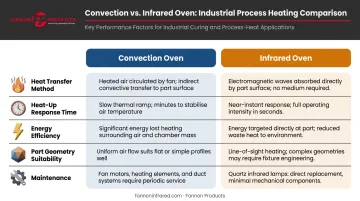
| Attribute | Convection Oven | Infrared Oven |
|---|---|---|
| Heat Transfer Method | Fans circulate heated air around the product | Electromagnetic radiation absorbed directly by the product surface |
| Heat-Up / Response Time | Minutes to reach operating temperature | Full output in seconds (short-wave: under 1 second) |
| Energy Efficiency | Heats entire oven cavity, including surrounding air | Targets the product directly — up to 95% of electrical input transferred to the material |
| Part Geometry Suitability | Complex, recessed, and irregular 3D shapes | Flat or line-of-sight-accessible surfaces |
| Maintenance | Regular fan, filter, and duct upkeep required | Fewer moving parts — no fans or motors in the heating circuit |
What Is a Convection Oven?
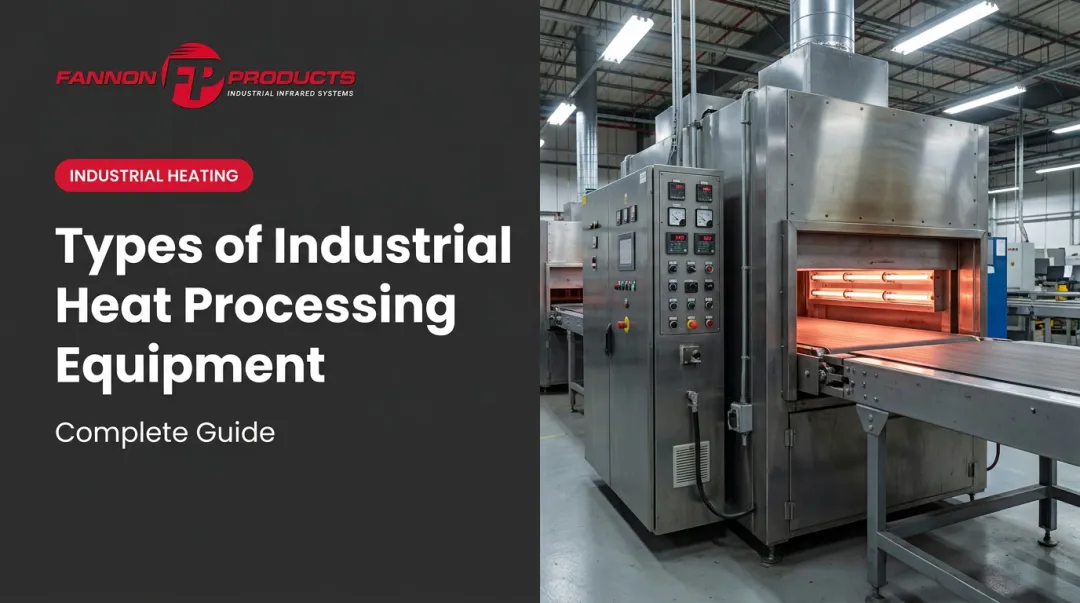
Convection ovens are enclosed heating chambers that transfer heat by circulating hot air around a product. Forced convection — the industrial standard — uses fans to accelerate airflow, producing more consistent temperature distribution than gravity convection, which relies on natural air movement alone. They're available in benchtop, cabinet, walk-in, and conveyor configurations, and are used across automotive, aerospace, pharmaceutical, electronics, and food and beverage manufacturing.
The core advantage: hot air reaches every exposed surface, including recesses, cavities, and irregular contours. That makes convection less sensitive to part orientation and more adaptable for diverse product runs.
The tradeoffs are real, though:
- Longer heat-up times before reaching operating temperature
- Higher energy consumption from heating the full oven cavity
- Fan noise and airflow that can disturb uncured coatings or powder
- Finishing ovens typically operate at 6 to 8 air changes per minute, and high air velocities can literally blow powder off parts before it gels
Those limitations matter most in high-sensitivity finishing applications — which is why understanding the right use cases for convection is worth getting specific about.
Where Convection Ovens Are the Right Choice
Convection is the dominant technology for:
- Annealing, sterilizing, and composite curing — processes requiring a uniform temperature soak across the entire part
- Burn-in testing to MIL-STD-883 standards in electronics
- Multi-component assemblies and mixed-batch production where part geometry varies significantly between runs
- Regulated applications (aerospace, pharma) that require documented temperature uniformity — AMS2750/CQI-9 standards define uniformity classes from ±5°F (Class 1) to ±50°F (Class 6), and convection systems are well-suited to meeting those tolerances across complex loads
For parts with deep recesses or internal cavities that can't face a heat source directly, convection is the more reliable choice.
What Is an Infrared Oven?
Infrared ovens transfer heat through electromagnetic radiation (typically in the 780 nm to 1 mm wavelength range) absorbed directly by the product surface. The surrounding air temperature is largely irrelevant; the energy goes into the material itself.
The Three Wavelength Categories
Wavelength selection determines how quickly energy transfers and which materials respond best:
| Wavelength | Range | Response Time | Best Applications |
|---|---|---|---|
| Short-wave | 0.76–2.0 microns | Under 1 second | Metals, substrates requiring deep penetration, fast start/stop |
| Medium-wave | 2.0–4.0 microns | 30–60 seconds | Coatings, paints, plastics, moisture-bearing surfaces |
| Long-wave (far IR) | 4.0–1000 microns | 5–15 minutes | Surface moisture removal, organic materials, selected food applications |
The operational advantages of infrared are significant:
- Near-instant startup and shutdown
- Direct energy delivery to the product — not the surrounding air
- Multi-zone control capability for different process stages
- Compact footprint relative to equivalent convection capacity
- Quieter operation with minimal moving parts
The key limitation is line-of-sight. Areas of a part shielded from emitters (recesses, internal cavities, complex 3D undercuts) receive less energy. Conduction within dense materials like metal can partially compensate, but it's not a complete solution for highly contoured geometries. Rotation fixtures, multi-zone configurations, and hybrid setups address this in practice.
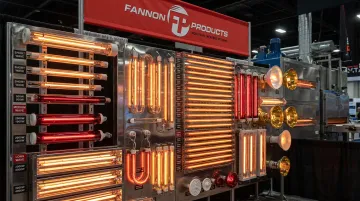
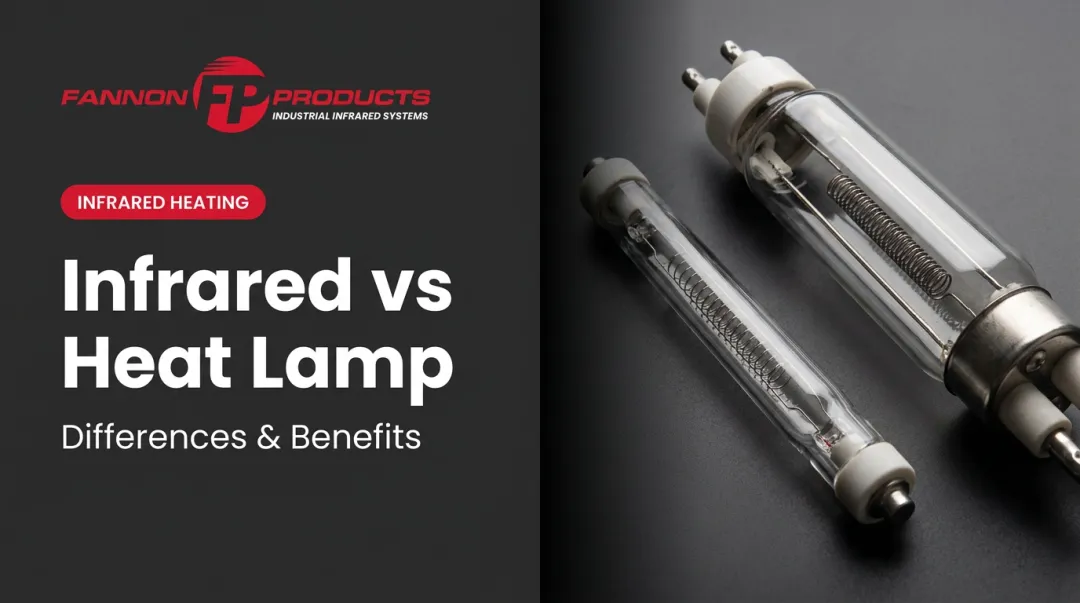
Lamp design plays a direct role in how efficiently those wavelengths reach the product. Fannon Products manufactures replacement infrared lamps across all three wavelength categories — every size, wattage, and voltage — and builds custom infrared fixtures and systems for automotive paint curing, commercial printing, food processing, and more. The Goldenrod directional lamp, for instance, incorporates an integral gold reflector that eliminates the need for a secondary reflector and saves 23.5% in energy costs compared to standard lamp designs.
Where Infrared Ovens Are the Right Choice
Infrared consistently outperforms convection for:
- Powder coating cure and paint/varnish drying
- Ink drying in commercial printing
- Automotive seat de-wrinkling and headliner forming
- Heat shrink tubing applications
- Composite preheating
- Moisture removal from food products
- Wood finishing
Industries where infrared is the dominant technology include automotive manufacturing, commercial printing, plastics forming, electronics (including PCB reflow), textile processing, and food processing lines prioritizing high throughput.
Convection vs. Infrared: Which One Performs Better?
Neither technology is universally superior. The right answer depends on your specific combination of part geometry, production goals, substrate type, and facility constraints.
Speed and Throughput
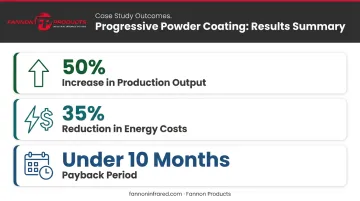
Infrared wins on cycle time — consistently. A DOE-documented case at Progressive Powder Coating showed that adding an infrared curing oven increased production by 50% and cut energy costs by 35%, with payback in under 10 months. In powder coating specifically, electric infrared can cure up to 10 times faster than convection.
For operations where minimizing cycle time is the primary constraint, infrared is the clear choice.
Energy Efficiency
Infrared delivers energy directly to the product rather than heating the oven cavity. Electric infrared systems can transfer up to 95% of electrical input energy to the target material. Convection heats the surrounding air first, then relies on that air to heat the part — a less direct path that loses more energy to the environment.
Efficiency is application-dependent, however. In coated-paper drying, for instance, high-intensity air dryers can outperform infrared systems under certain line conditions. Infrared's efficiency advantage is strongest in direct-surface heating applications, particularly at high production volumes.
Choosing by Application Type
| Application | Recommended Technology |
|---|---|
| Complex 3D geometries, recessed parts | Convection |
| Mixed-batch production with varied shapes | Convection |
| Regulated processes requiring ±5°F–±15°F uniformity | Convection |
| Flat or uniform surfaces, direct-view coatings | Infrared |
| Temperature-sensitive substrates (such as certain plastics) | Infrared |
| Fast-turnaround lines where air movement disturbs finishes | Infrared |
| High-volume production focused on energy cost reduction | Infrared |
The Hybrid Option
A hybrid process line pairs infrared and convection to capture the strengths of each. A common approach: IR gels the powder coating in the first stage (fast, direct heat to the surface), then convection completes the cure across the full part geometry, including areas the emitters couldn't reach directly.
This delivers faster cycle times than convection-only, and better geometric coverage than infrared-only. For manufacturers running varied part geometries or mixed coating types, hybrid is often the optimal configuration — not a fallback, but a deliberate performance choice.
Real-World Applications: Seeing Both Technologies in Action
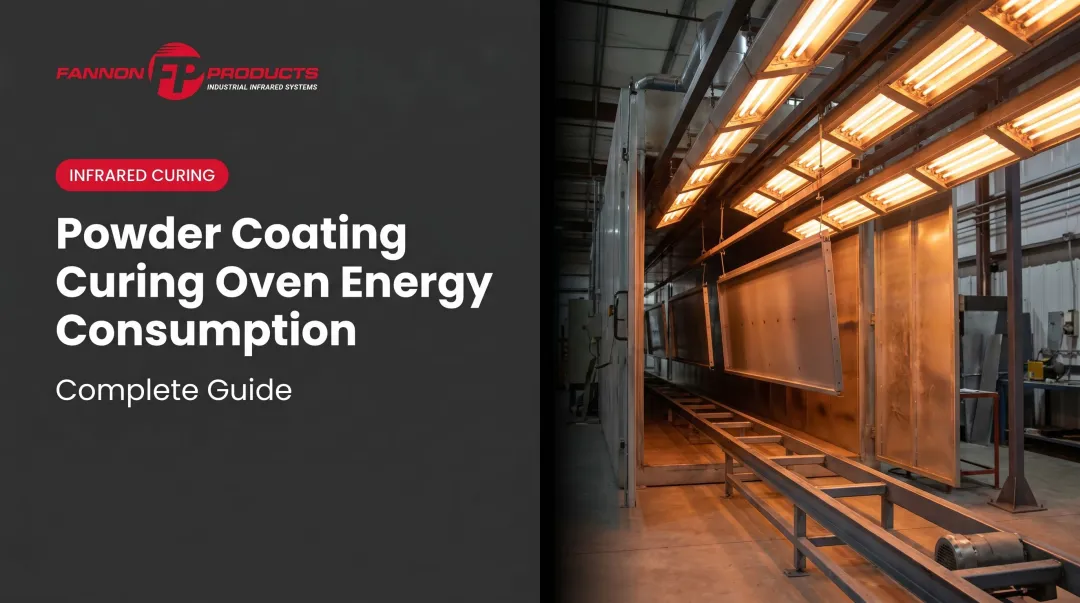
Progressive Powder Coating's finishing line is a textbook case of convection failing a powder coat application. Turbulence from fans and conveyor vibration caused powder to shift and detach before it could gel — producing defects, rework, and throughput losses that compounded over every shift.
The root problem wasn't process chemistry. It was airflow. Convection ovens running at 6 to 8 air changes per minute create enough air movement to physically disturb loosely adhered powder before it stabilizes — a documented limitation of convection for powder coating applications.
Adding an infrared curing oven solved the problem at the source. IR heats the powder directly, gelling it almost instantly without exposing it to airflow. The results were clear:
- 50% increase in production output
- 35% reduction in energy costs
- Full payback in under 10 months
A similarly dramatic result came from the electronics sector. A manufacturer curing foam on polycarbonate speaker baskets switched to a 42 kW long-wave infrared tunnel oven using ceramic elements. Cure time dropped from 15 minutes to 90 seconds — a 90% reduction in cycle time for a single process step.
If your finishing or curing line uses convection and you're seeing surface defects from airflow, high energy bills from heating a large oven cavity, or cycle times that cap your throughput, infrared or hybrid heating is worth a direct evaluation.
Fannon Products designs and manufactures custom infrared lamp systems and process-heating fixtures for facilities at exactly this crossroads — from replacement lamps for existing equipment to fully engineered custom systems built around your process requirements. Reach their team at fannoninfrared.com or call 810-794-2000 to talk through your application.
Conclusion
Convection ovens remain the right tool for complex geometries, mixed batches, and processes requiring whole-chamber temperature uniformity. Infrared ovens deliver clear advantages in speed, energy efficiency, footprint, and process control for direct-surface applications — and the documented performance differences are measurable and consistent across applications.
For facilities where infrared is the right fit, one detail that's easy to overlook: the lamp and emitter quality matter as much as the oven design. Those outcomes depend on correctly specified infrared emitters — but they only materialize when the emitters are right for the job:
- Faster cycle times increase throughput, but only if the wavelength matches the material's absorption profile
- Lower energy draw cuts operating costs, but only if wattage is sized to the process — not over- or under-specified
- Fewer moving parts reduce downtime, but emitter lifespan still depends on build quality and correct voltage rating
Getting the oven selection right is half the equation. Specifying the correct emitter — wavelength, wattage, configuration — is what makes that selection perform.
Frequently Asked Questions
Convection oven vs. infrared oven: which is better?
Neither is universally better — the right choice depends on your application. Convection excels for complex 3D shapes and mixed-batch production where uniform air circulation is needed. Infrared is faster and more energy-efficient for direct-surface applications like powder coating, ink drying, and paint curing.
Can convection ovens handle heat-sensitive substrates or coatings?
Convection ovens heat indirectly through air circulation, which makes them slower to reach target surface temperatures. For heat-sensitive substrates — thin plastics, delicate coatings, or electronics — this prolonged dwell time can cause warping or degradation before the cure completes. Infrared delivers energy directly to the surface, reducing total heat exposure time.
Can infrared and convection ovens be used together?
Yes — hybrid systems combining infrared (for rapid initial heat-up or surface gelling) with convection (for uniform temperature soak) are a common and effective solution. They offer faster cycle times than convection alone and better geometric coverage than infrared alone.
Are infrared ovens more energy-efficient than convection ovens?
In most direct-surface heating applications, yes. Infrared systems can transfer up to 95% of electrical input energy directly to the target material, whereas convection heats the surrounding air first. The efficiency advantage is most pronounced in high-volume production.
What industries benefit most from infrared ovens?
Automotive manufacturing, commercial printing, food processing, powder coating, electronics (PCB reflow), and textiles all benefit significantly from infrared's speed, precision, and direct-heat efficiency.
How do I know which oven type is right for my application?
Start by evaluating your part geometry, substrate heat sensitivity, coating type, production volume, and available floor space. For mixed materials or complex part shapes, an infrared process engineer can assess your specific line requirements — Fannon Products offers custom design and engineering consultation to help match the right system to your process.