The right wait time isn't a single number. It depends on clear coat type, ambient temperature, coat thickness, and how the curing process is managed. This guide covers each variable so you can buff with confidence — and avoid a costly recoat.
Key Takeaways
- Air-cured clear coat needs a minimum of 24–48 hours before buffing; rushing that window risks tearing, peeling, or an uneven finish
- Full chemical cure typically takes 7 days at 77°F — buffing in the early window is possible but demands care
- Temperature, humidity, coat thickness, and clear coat type all shift the safe buffing window
- Infrared lamp heat-curing compresses the timeline from hours to minutes in professional shop settings
- Time alone isn't enough — verify with elapsed time, a visual check, and a surface hardness test before buffing
Why Curing Time Matters Before Buffing
"Dry to Touch" vs. Chemically Cured
Manufacturer technical data sheets treat dryness as a staged process — dust-free, handle-ready, hard dry, polish-ready, and full cure are distinct milestones. For example, Axalta's Challenger CH3050 clearcoat TDS lists light polishing at 8 hours but places full cure at 7 days at 77°F. That 7-day window exists because crosslinking reactions continue long after the surface feels solid.
When solvents are still off-gassing through the film, the coating remains softer underneath than it appears on top. Applying a machine buffer to that film generates heat and mechanical force, which are precisely the conditions that deform an under-cured clear coat.
What Buffing Too Soon Actually Does
- The compound and pad pull at soft material instead of cutting it cleanly, leaving swirl marks that go below the surface film
- Buffer heat can cause under-cured material to flow, creating low spots and hazing
- If the pad cuts through to the color coat, the repair requires full sanding back and reapplication
BodyShop Business notes that tipping a polisher on an edge or running very high speeds on fresh paint can cause immediate buff-through — even when the technician assumes the surface is ready.
The Risk on the Other End
Waiting too long carries its own cost. AutoRestorer documents that the longer a finish cures, the harder it becomes — improving longevity, but making sanding and compounding progressively more difficult. Some fast-curing products make this window extremely short: PPG's D8177 Rapid Performance Clearcoat warns that polishing can become more difficult if left longer than 90 minutes after air dry. Most standard products give you more room, but the principle applies regardless of the product you're using.
How Long to Cure Clear Coat Before Buffing: Timing by Scenario
No universal answer exists. The correct wait time is determined by clear coat type, environmental conditions, number of coats applied, and curing method. Here's how each variable affects the timeline.
Based on Clear Coat Type
| Clear Coat Type | Light Polish | Heavy Compound | Full Cure |
|---|---|---|---|
| Standard 2K (Axalta CH3050) | 8 hours at 77°F | 24 hours | 7 days at 77°F |
| High-solids 2K (Axalta Metalux 9354) | 16 hours at 77°F | 24 hours | 7 days at 77°F |
| Overall clear (Sherwin FC720) | After 24-hour air dry | Within 48 hours | — |
| Standard collision clear (PPG DC4000) | After 4–6 hour air dry | — | — |
| Aerosol 2K (SprayMax Glamour) | 8–24 hours assembly cure | — | — |
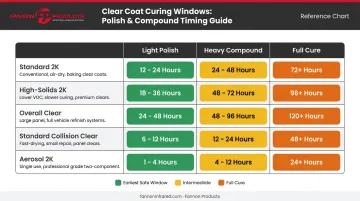
Always pull the product's TDS before estimating your window — manufacturer-specified times vary significantly and should override general rules of thumb.
Aerosol-applied clears cure in thinner layers and may feel ready sooner, but they're more vulnerable to burn-through due to thinner film build. The SprayMax 2K Glamour TDS notes "very good polish ability" without specifying a precise buff window, so erring toward the longer end of the assembly cure time is the safer call.
Based on Environmental Conditions
Temperature is the most critical variable:
- PPG's cold-weather curing guidance states that urethane curing slows significantly and may stop entirely below 60°F (15°C)
- The Axalta CH3050 TDS carries the same warning — crosslinking stops below 60°F
- A cold garage in winter can push the safe buffing window well beyond 48 hours, even if the surface feels firm
- At 70–77°F, curing progresses at the rates listed in manufacturer TDSs
Humidity extends cure time independently of temperature:
- High humidity, poor airflow, and improper film thickness are documented contributors to clearcoat gloss loss and defects per Axalta's Paint Defects Manual
- High humidity traps solvent vapor and extends cure time; ensure adequate ventilation regardless of season
Based on Coat Thickness and Application
More coats mean more trapped solvent in lower layers — and a longer pre-buff wait. Flash time between coats matters: PPG DC4000 specifies a 5–7 minute flash, Axalta CH3050 specifies 5–10 minutes. Skipping or shortening that flash traps solvents under upper layers.
PPG identifies solvent popping — open-topped blisters up to 1mm caused by vapor trapped under a fast-skinning surface — as a direct result of excessive film thickness, insufficient drying between coats, or heat applied too soon. Buffing heat on an under-cured multi-coat system can trigger the same mechanism.
Based on Curing Method
Infrared curing compresses timelines dramatically. Product TDSs that authorize IR cycles show consistent results:
- PPG DC4000: 4–6 hours air dry vs. 5–9 minutes IR
- Glasurit 923-460: 3 hours at 68°F vs. 8–10 minutes short-wave IR
- SprayMax 2K Glamour: 8–24 hours assembly cure vs. 15 minutes IR
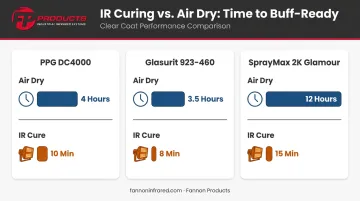
IR works by penetrating through the finish to the substrate, curing from the bottom up rather than relying on surface-down heat transfer. This reduces shrinkage and repair mapping compared to conventional forced-air drying.
That bottom-up penetration is what makes lamp selection and positioning matter. Fannon Products, a Michigan-based IR systems manufacturer with nearly 70 years in the industry, builds custom automotive paint-cure systems in both short-wave and fast medium-wave configurations. Short-wave lamps deliver rapid cure cycles; medium-wave provides more controlled, penetrating heat suited to sensitive coating systems. Their systems are rated at 96% radiant efficiency with instant thermal response — relevant specs when minimizing booth time is the objective.
Important: Only use IR curing when the product's TDS explicitly lists an IR cycle time. Applying IR heat to a product not rated for it — or positioning the lamp too close — can cause solvent entrapment defects rather than preventing them.
Air dry baseline (70°F, moderate humidity):
- 24 hours: safe to begin wet sanding and light compounding
- 48 hours: recommended before aggressive machine buffing
- 7 days: full chemical cure, when the finish reaches maximum hardness
Signs Your Clear Coat Is Ready to Buff
Don't rely on time alone. Use a combination of visual, tactile, and situational checks before touching a buffer.
Visual inspection — scan every panel for consistent sheen with no soft or tacky patches. Orange peel texture should look uniform and dry throughout. Any area that differs from adjacent panels warrants more time before buffing.
Surface hardness check:
- Press a fingernail gently into an inconspicuous spot — a door jamb works well
- An imprint means curing is incomplete; no imprint means the surface has hardened enough to proceed
- Keep in mind: this confirms surface hardness, not full-depth cure
Timing based on conditions: If the car was sprayed at 70–75°F with proper flash times and correct coat build, a 48-hour wait is a reliable baseline. Suboptimal conditions — cold temperatures, high humidity, or heavy builds — call for a longer wait and heavier reliance on the physical check.
When to Avoid Buffing and What Can Go Wrong
Clear "Do Not Buff" Conditions
- Within the first 24 hours, regardless of how firm the surface feels
- When ambient temperature was below 60°F during application or the curing period
- When the clear was applied in high humidity without adequate ventilation or heat assist
- Immediately after force-dry: BodyShop Business warns that buffing paint while it's still hot from a 170°F force dry cycle may mar or stain the finish — allow it to cool completely first
Consequences of Buffing Too Early
- Compound pulls soft clear rather than cutting it cleanly → swirl marks below the film surface
- Buffer heat causes under-cured material to flow → low spots, hazing, deformation
- Pad cuts through to the color coat → full recoat required
Consequences of Waiting Too Long
A fully cured high-solid clear coat resists standard compounds, which forces you toward more aggressive cutting pads. That raises the risk of edge burn-through and uneven material removal. Once the early cure window closes, the chemistry that made the coating workable is gone — and no amount of product switching gets it back.
Best Practices for Getting the Cure Right
Environment and planning:
- Spray in a temperature-controlled space at 65–75°F with controlled humidity and adequate airflow
- Allow proper flash time between coats — 5 to 30 minutes depending on the product and film build
- Keep a spray log: note temperature, humidity, number of coats, and application time to calculate your actual safe buffing window for each job
Monitoring readiness:
- Combine elapsed time, visual inspection, and a surface hardness check — don't use any single indicator in isolation
- If any panel looks or feels different from the others, treat the whole job as unready until you understand why
Once you've confirmed the surface is ready, the sanding sequence matters as much as timing.
Progressive sanding sequence:
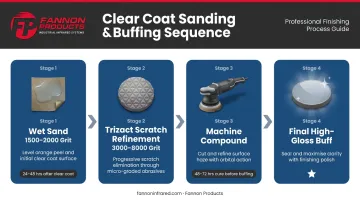
- Sherwin FC720 and similar overall clears specify 1500-grit or finer before compounding
- Sherwin CC645HS explicitly calls for 1500 then 2000 grit
- 3M's Paint Shop Solutions Guide recommends P1200–P2000 for initial defect removal followed by Trizact 3000–8000 for scratch refinement before final polishing
- A practical professional sequence: begin wet sanding at 24–48 hours, complete the final high-gloss buff pass at 48–72 hours — this balances workability with cure integrity
For shops running production volume: IR curing systems take environmental timing out of the equation. Fannon Products manufactures complete custom infrared systems and replacement lamps for existing automotive curing equipment in short-wave and fast medium-wave configurations. Their contoured fixture designs distribute heat evenly across curved body panels, where uneven cure is a real risk with standard setups.
Contact their team at 810-794-2000 or sales@fannonir.com for application-specific guidance.
Conclusion
The right buffing window depends on clear coat type, temperature, humidity, film build, and curing method combined — not a single number. Skipping the evaluation step, whether because the surface looks ready or because "24 hours" sounds close enough, causes most buffing failures.
A finish that survives years of washing, polishing, and UV exposure is built on controlled conditions and proper timing — not guesswork. Verify ambient conditions, check your product's TDS, and confirm surface hardness before picking up the buffer.
Frequently Asked Questions
How long do you let clear coat dry before buffing?
"Dry" and "ready to buff" are different stages. Most standard 2K clear coats allow light polishing at 8–16 hours, but 24 hours is the minimum for safe buffing and 48 hours is recommended before aggressive machine compounding. Full chemical cure takes approximately 7 days at 77°F — always check your product's TDS for exact timing.
How long does clear coat take to fully cure?
Air-cured 2K clear coats typically reach full chemical cure in 7 days at 77°F, based on multiple Axalta TDSs for products including CH3050 and Metalux 9354. IR-cured systems can achieve comparable cure in as little as 5–15 minutes, depending on the product and lamp setup.
Are two coats of clear coat enough?
Two coats are standard across most major manufacturer TDSs — PPG DC4000, Sikkens Autoclear PC, Sherwin FC720, and Glasurit 923-460 all specify two. Custom work with heavy color sanding may warrant three coats to preserve enough film thickness without cutting into the color coat.
Can you buff clear coat after 24 hours?
Light buffing and wet sanding can begin at 24 hours under good conditions — 70°F+, proper flash times, and standard film build. Aggressive machine compounding is safer at 48 hours. Confirm with a surface hardness check before starting, and pull back if any area feels different from the rest.
What happens if you buff clear coat too soon?
The compound and pad pull soft clear coat rather than cutting it, leaving swirl marks below the surface film. Buffer heat can deform under-cured material, creating low spots, hazing, or — in severe cases — buff-through to the color coat that requires full recoat.
Does temperature affect how long clear coat needs to cure before buffing?
Yes — significantly. Both PPG and Axalta specify that crosslinking slows and may stop entirely below 60°F (15°C). In a cold shop, the safe buffing window can extend well beyond 48 hours even if the surface feels firm. At 70–77°F, curing progresses at the rates listed in manufacturer TDSs.