The stakes are real. Power supply selection directly affects energy consumption, lamp lifespan, output consistency, and how well your system keeps pace with line speed. Getting it right is a technical decision, not a purchasing one — and the two are not the same thing.
This guide walks through what UV power supplies actually do, the key specification factors that determine compatibility, and how to evaluate total cost of ownership so you're choosing the right unit, not just the cheapest or most powerful one.
Key Takeaways
- A UV power supply (ballast) converts facility power into the precise electrical output needed to ignite and sustain a UV lamp or drive a UV LED array
- Two main types: iron core ballasts (durable, fixed output) and electronic/solid-state supplies (variable output, energy-efficient, heat-sensitive)
- Power output must align with your material's energy density (J/cm²) and irradiance (W/cm²) requirements — not just lamp wattage
- Compatibility with lamp technology, cooling setup, and line speed control are non-negotiable spec requirements
- Total cost of ownership — including energy, maintenance, and downtime risk — matters more than upfront purchase price
What Is a UV Power Supply and How Does It Work?
A UV power supply (often called a ballast) converts incoming facility power into the precise voltage, current, and frequency a UV lamp needs to ignite and sustain its arc during curing. As Alpha-Cure states, the supply provides "a means to ignite the lamp and also control the power required for the process." Without it, the lamp either won't start or won't maintain stable output.
Most modern UV lamp systems use variable power ballasts capable of operating across a range of roughly 20% to 100% of a lamp's rated capacity. Some electronic models extend that range further — Hoenle's eUV series, for example, offers stepless adjustment from 5% to 100%. For operations running different substrates or varying line speeds on the same system, that range is a direct production advantage.
Iron Core vs. Electronic Power Supplies
These two technologies represent genuinely different trade-offs, and the right choice depends heavily on your production environment.
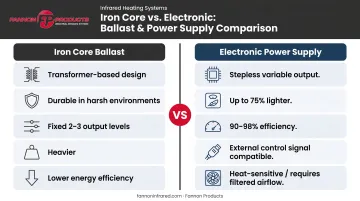
Iron core (electromagnetic) ballasts:
- Traditional transformer-based design
- Highly durable in harsh, dirty, or high-temperature environments
- Lower upfront sensitivity to environmental conditions
- Typically offer only two or three fixed output levels — limited adjustment flexibility
- Heavier and less energy-efficient than electronic alternatives
Electronic (solid-state) power supplies:
- Stepless power adjustment across a wide range
- Significantly lighter — Excelitas reports its LightHammer Mark III is up to 75% lighter than ferro-resonant designs
- Higher efficiency: Hoenle's eUV series runs at 97–98%; Excelitas LightHammer Mark III reaches approximately 90% with 20%+ energy savings over iron core
- Accepts automated external control signals for line integration
- More heat-sensitive; require clean, filtered airflow and are rated for ambient temperatures up to 40°C
- Shorter operational lifespan than iron core units in demanding environments without proper cooling
The efficiency advantage of electronic supplies is real, but so is the maintenance requirement. In high-dust or high-heat environments, inadequate cooling can shorten electronic supply lifespan significantly — factor that into your total cost of ownership before selecting.
Key Factors When Choosing a UV Power Supply
UV power supply selection isn't one-size-fits-all. It varies by lamp technology, substrate chemistry, line speed, and production volume. The factors below connect technical specs to measurable operational outcomes.
Power Output and Wattage Requirements
Start by matching the power supply's output to your material's energy requirements. Underpowering causes incomplete cure; overpowering damages heat-sensitive substrates and shortens lamp life.
Your ink or resin supplier's technical data sheet is the baseline. Look for two specific values:
- Energy density (J/cm²): The total UV dose the material needs to fully cure
- Irradiance (W/cm²): The intensity required at the substrate surface
For arc and medium-pressure mercury lamp systems, LightSources reports many high-pressure curing lamps operate at 200–600 W/in. IST METZ lists UV lamp outputs from 40 W/cm to 330 W/cm depending on lamp type. UV LED systems, by contrast, are rated in irradiance at the working surface — UV+EB Technology describes air-cooled UV LED units delivering 16 W/cm² and liquid-cooled units reaching 24 W/cm².
Thicker coatings and adhesives need higher energy density to achieve through-cure. Thin surface coatings often cure at lower power levels. When in doubt, consult your supplier before sizing the power supply.
Power Supply and Lamp Technology Compatibility
The power supply must be selected to match the UV lamp technology in your system. Each lamp technology requires a matched power supply type:
| Lamp Technology | Required Power Supply |
|---|---|
| Arc lamp (medium/high pressure mercury) | Magnetic or electronic ballast with arc ignition circuit |
| Microwave/electrodeless | Magnetron-based power supply |
| UV LED | LED-specific OEM driver/power architecture |
Arc lamp systems require high open-circuit voltage and specific waveform output to ignite and sustain the arc — standard hardware won't substitute. Microwave UV systems use magnetron power that's continuously adjustable from 35% to 100% of full power (Noblelight). UV LED systems require LED-specific OEM power and control architecture.
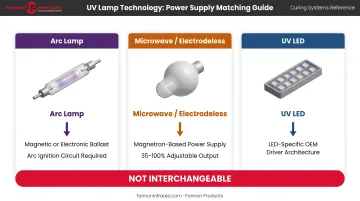
One practical note: some OEM systems are explicitly designed as hybrid exceptions. GEW's RHINO power supplies, for example, are engineered to run both arc and LED lamps through their ArcLED architecture. This is an OEM-designed exception, not a general rule — treat standard arc ballasts and LED drivers as non-interchangeable unless the manufacturer explicitly rates the supply for both.
Variable Power Control and Line Speed Integration
On automated production lines, the power supply must accept an external control signal — typically a 0–10 VDC or 4–20 mA input — so lamp power scales automatically as conveyor speed changes. Excelitas LightHammer Mark III supports both input types with 1% or 5% power steps depending on control mode.
Why this matters: as line speed increases, exposure time under the lamp decreases. To deliver the same total energy dose (J/cm²) at higher speed, you need higher irradiance (W/cm²). A power supply without variable output capability creates a direct mismatch between exposure time and energy delivered — undercured product at high speeds, substrate damage at low speeds.
Operations running multiple SKUs or varying substrates on the same line should treat wide-range variable control as a non-negotiable specification.
Cooling Requirements and Thermal Management
Both the UV lamp and the power supply generate significant heat during operation. Electronic ballasts are particularly heat-sensitive — rated for ambient temperatures up to 40°C and requiring clean, filtered airflow. Excelitas documentation confirms that filtered, directional airflow extends power supply life in production areas exposed to dirt.
Their LightHammer Mark III, for example, requires 305 mm (12 inches) of clearance at the front and rear for cooling airflow and cable connections.
A restricted or dirty cooling path is one of the most common causes of premature power supply failure. Internal components — capacitors, transformers — degrade faster when operating in overheated conditions, increasing unplanned downtime.
Key cooling considerations:
- Verify the power supply's ambient temperature rating against your facility conditions
- Ensure adequate clearance and clean, filtered intake air
- For high-power LED systems, liquid cooling may be required — match cooling infrastructure to the system spec before installation
- Size the cooling capacity to your duty cycle, not just peak output
Spectral and Wavelength Compatibility
UV power supplies and their lamp or LED arrays are optimized for specific wavelength outputs. As Dymax notes, it's essential to match the curing lamp wavelength with the absorption spectrum of the light-curable material. A mismatch means the correct wavelength isn't delivered at sufficient intensity — even if total wattage appears adequate.
Standard high-pressure mercury lamps emit multiple UV lines (primarily 254 nm UVC, 313 nm, 365 nm, 404 nm, and 436 nm). UV LED systems are monochromatic, typically emitting peak UVA wavelengths at 365, 385, 395, or 405 nm within a band of roughly ±20 nm.
This is especially critical when transitioning from arc lamp to UV LED systems. Photoinitiators in your ink or resin are activated by specific wavelength ranges — if the LED system's narrow-band output doesn't overlap with those activation peaks, cure will be incomplete regardless of power level. Confirm wavelength compatibility with your material supplier before specifying an LED driver.
Duty Cycle and Total Cost of Ownership
Duty cycle — how many hours per day and days per week the supply runs at full load — must be verified against the manufacturer's rated continuous operating capacity. A supply rated for intermittent use will fail prematurely under 24/7 industrial operation.
Environmental factors compound this: ambient temperature, airborne particulates, and humidity all stress internal components. GEW notes its RHINO supplies are proven to run for years in harsh environments with safe shutdown protection against common electrical issues — that kind of proven reliability matters when downtime costs are part of the calculation.
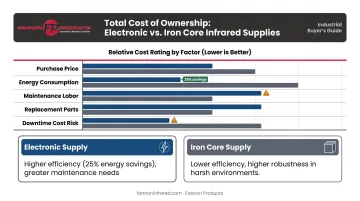
Purchase price is only the starting point. Factor in:
- Energy consumption over the unit's operational life
- Replacement parts (capacitors, filters, cooling components)
- Maintenance labor and service intervals
- Cost of downtime if the unit fails unexpectedly
Electronic power supplies typically offer better energy efficiency — Miltec reports its microwave UV curing system uses 25% less energy compared to standard alternatives — but require more diligent maintenance in harsh environments. Iron core ballasts sacrifice efficiency for robustness. The right choice depends on your production environment and how hard the system runs.
When evaluating suppliers, verify parts availability, technical service response time, and whether the unit can be repaired on-site or requires return shipping. These details have an outsized impact on actual cost of ownership once the system is in daily production.
How Fannon Products Can Help
Fannon Products has been designing and manufacturing UV and infrared lamp solutions for nearly 70 years, with UV LED curing systems built for printing industry applications including screen printing, inkjet, and paint curing processes.
Fannon's UV LED curing systems ship as complete integrated units: lamp, driver, fixture, and controls in a single optimized package. Available in three configurations (3-inch, 6-inch, and 9-inch modules), all systems operate at 395–405 nm and deliver 16 W/cm² power intensity.
Each unit includes a 0–100% output adjustment control system with safety interlock and emergency stop — so every component is matched, tested, and ready to run.
Why buyers work with Fannon:
- Nearly 70 years of infrared and UV lamp expertise
- UV LED curing systems designed and manufactured in the US, with 99% secure global shipping
- Complete systems with integrated power management: no separate driver sourcing required
- Direct technical support from specialists serving printing, automotive, plastics, electronics, and textile industries
- Custom configurations available across a range of wattages, voltages, and form factors
Contact Fannon's team directly to identify the right power and system specifications for your application: 810-794-2000 or sales@fannonir.com.
Conclusion
Selecting the right UV power supply is a technical decision with direct production consequences. The right match between power output, lamp technology, cooling infrastructure, and control capability determines curing consistency, lamp longevity, and line efficiency. Getting it wrong doesn't just affect product quality — it affects throughput, maintenance costs, and unplanned downtime.
The goal isn't the most powerful or most expensive unit. It's the one precisely aligned with your substrate, material chemistry, line speed, and operating environment.
UV power supply performance should also be reviewed periodically. As production volumes shift, materials change, or line configurations are updated, the original supply selection may no longer be the optimal fit. Treating it as a set-and-forget component is how small efficiency losses compound into larger operational problems. Manufacturers like Fannon Products — with decades of experience in UV LED curing systems — can help you evaluate whether your current setup still matches your production demands.
Frequently Asked Questions
What wattage do I need for UV curing?
Required wattage depends on coating thickness, substrate type, line speed, and the energy density specified by your ink or resin supplier. Arc and medium-pressure mercury lamp systems commonly operate at 200–600 W/in. UV LED systems are rated by irradiance (W/cm²) at the working surface. For UV resin specifically, check the technical data sheet — it will list a required energy density (mJ/cm²) and acceptable irradiance range that your lamp and power supply must meet at operating line speed.
What is the difference between a ballast and an electronic power supply for UV curing?
An iron core ballast is a transformer-based unit built for durability in harsh environments. An electronic (solid-state) power supply offers variable output and a smaller footprint but requires careful thermal management to achieve comparable service life.
Can the same power supply be used for arc lamps and UV LED systems?
Standard arc lamp ballasts and UV LED drivers are not interchangeable — they use fundamentally different power conditioning approaches. Arc lamps require high-voltage ignition circuits; LED systems require dedicated driver architecture. A small number of OEM-engineered hybrid systems support both lamp types, but these are purpose-built exceptions rather than a general rule.
How does line speed affect UV power supply selection?
Higher line speeds reduce exposure time under the lamp, so irradiance (W/cm²) must increase to maintain the same total energy dose (J/cm²). A power supply with variable output and external control signal compatibility allows lamp power to scale automatically with conveyor speed.
How often should a UV power supply be serviced?
Inspect and replace air filters regularly, and clean internal components with dry compressed air on a set schedule. Verify output against baseline measurements periodically — gradual performance decline typically appears before a unit fails completely.