That decision carries real weight. According to Mordor Intelligence, the UV-curable adhesives market sits at $5.43 billion in 2026, growing to $7.09 billion by 2031 at a 5.48% CAGR. As volumes scale, so do the consequences of choosing the wrong curing system.
This guide evaluates five leading UV curing equipment suppliers for 2026 — covering technology types, industry focus, and what actually differentiates them for adhesive applications.
Key Takeaways
- UV curing equipment converts liquid adhesives to hardened bonds in seconds using controlled UV or UV LED light
- LED and mercury vapor systems serve different adhesive chemistries — wavelength matching is non-negotiable
- Top 2026 suppliers — Dymax, Phoseon (Excelitas), Noblelight (Excelitas), Miltec UV, and Fannon Products — each serve distinct market segments
- Irradiance output, system footprint, and after-sale support matter as much as upfront cost
- Matching equipment to adhesive formulation outweighs brand name or price in determining bond quality
What Is UV Curing Equipment and Why Does It Matter?
UV curing equipment delivers controlled UV energy to activate photoinitiators in liquid adhesive formulations, triggering rapid polymerization. Form factors range from handheld spot systems and benchtop flood lamps to fully inline conveyor units built for continuous production.
The Two Dominant Technologies
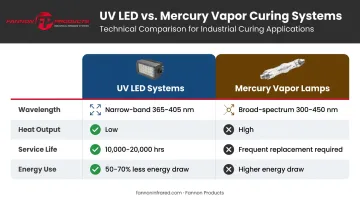
Mercury vapor UV lamp systems produce broad-spectrum output from 300–450 nm, generating 50–1,000 mW/cm² UVA at the curing surface. They're widely compatible with older adhesive formulations but produce significant heat, require more frequent bulb replacement, and consume more energy.
UV LED curing systems emit narrow-band wavelengths — typically at 365 nm, 385 nm, 395 nm, or 405 nm — with far lower heat output, longer service life, and better energy efficiency. As RadTech notes, effective curing requires the lamp's output to overlap the photoinitiator's absorption spectrum — a mismatch here means incomplete cure regardless of power or exposure time.
Key considerations when choosing between the two:
- Narrow LED wavelengths may not match adhesives formulated for broad-spectrum mercury lamps — verify photoinitiator compatibility before switching
- Heat-sensitive substrates and components typically require LED systems, which run far cooler at the curing surface
- Mercury lamps need periodic bulb replacement; LED arrays commonly last 10,000–20,000 hours with minimal maintenance
- LED systems consume up to 50–70% less power than mercury equivalents at similar irradiance output
Top UV Curing Equipment Suppliers for Adhesives in 2026
Selection here is based on technology range, wavelength versatility, documented industry application experience, and depth of support — not market size alone.
Dymax Corporation
Dymax, headquartered in Torrington, Connecticut, is one of the most integrated names in this space. They manufacture both light-curable adhesives and the curing equipment used to activate them. That combination gives Dymax an application depth most pure equipment suppliers can't match.
Their BlueWave product line covers spot curing, flood curing, and conveyor systems in both UV LED and broadband mercury configurations. BlueWave LED systems are available at 365 nm, 385 nm, and 405 nm, while broadband systems cover the full 300–450 nm range. Irradiance output varies widely across product lines; the BlueWave MX-150 spot system lists up to 40 W/cm².
| Feature | Details |
|---|---|
| Technology Type | UV LED and broadband UV (mercury) systems |
| Key Industry Applications | Medical device bonding, electronics assembly, industrial and aerospace adhesive applications |
| Notable System Features | Programmable exposure controls, integrated radiometry, conveyor and spot/flood configurations, CE marked |
If you're running Dymax adhesives, their equipment is engineered specifically to cure them. For multi-chemistry production environments, that closed-loop integration cuts down on qualification testing overhead.
Phoseon Technology (Excelitas)
Phoseon, based in Hillsboro, Oregon, was acquired by Excelitas Technologies in February 2023. It now operates alongside OmniCure and Noblelight under the Excelitas UV curing portfolio, and describes itself as the inventor of UV LED curing. All systems are solid-state LED-based.
Their hardware centers on high-irradiance LED arrays built for high-speed production. The TargetSure monitoring system delivers real-time UV irradiance feedback; the VeriCure platform adds real-time uniformity optimization for wide-format applications. Both matter in adhesive curing, where dose variation translates directly to inconsistent bond strength.
| Feature | Details |
|---|---|
| Technology Type | Exclusively UV LED-based systems |
| Key Industry Applications | Flexographic and label printing, adhesive curing, industrial coatings, life sciences manufacturing |
| Notable System Features | High-irradiance LED arrays, real-time process monitoring, modular configurations for varied line widths |
Phoseon is the right call for manufacturers committed to LED-only infrastructure who need verified dose consistency at production speeds.
Noblelight (Excelitas)
Heraeus announced the sale of Noblelight to Excelitas in September 2023. Now operating as an Excelitas brand alongside Phoseon and OmniCure, Noblelight remains a significant supplier of UV curing lamp technology with a particularly broad mercury lamp range.
Their Amba UV curing lamps are available in arc lengths from 12 mm to 3.9 m, covering 80–400 W/cm power classes, with metal halide variants using gallium or iron iodides to shift spectral output. This product depth makes Noblelight the go-to for manufacturers running legacy broadband UV equipment or high-power industrial adhesive curing lines.
| Feature | Details |
|---|---|
| Technology Type | Mercury arc UV lamps (medium-pressure, high-pressure); UV LED systems via Excelitas portfolio |
| Key Industry Applications | Industrial adhesive curing, automotive coatings, flexographic printing, glass and plastic coating |
| Notable System Features | Custom lamp geometries, high-power output configurations, ISO 9001 certified, global service locations |
For high-wattage, large-format adhesive curing lines that still rely on broad-spectrum output, Noblelight's lamp range covers more configurations than almost any single-brand alternative.
Miltec UV
Miltec UV, headquartered in Stevensville, Maryland, manufactures arc lamp and microwave-powered UV curing systems for industrial coating, adhesive, and printing applications. Their "Made in the USA" positioning and application development lab are notable for buyers who want domestic manufacturing and pre-deployment testing support.
| Feature | Details |
|---|---|
| Technology Type | UV arc lamp and microwave-powered UV curing systems |
| Key Industry Applications | Industrial coatings, adhesive bonding, flooring, metal decorating |
| Notable System Features | American-manufactured systems, application development lab for production-condition testing, inline integration |
The application development lab is a practical differentiator: buyers can run production-condition trials before committing to a full system deployment, which reduces integration risk on high-throughput adhesive lines.
Fannon Products
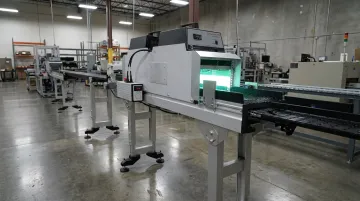
Fannon Products, based in Algonac, Michigan, brings nearly 70 years of lamp and process-heating engineering to the UV LED curing market. The same engineering discipline that defines their infrared lines carries directly into their UV LED systems: precise energy targeting, minimal waste, and hardware built for continuous industrial use.
Their proprietary LED reflector system directs UV light precisely at the substrate, a carryover from the Goldenrod infrared lamp design's 24K gold integral reflector. The systems are air-cooled and include a transport interlock (24 VDC or dry contact) for production-line safety.
Three module sizes are available:
| Model | Module Size | Wavelength | Wattage | Voltage | Irradiance |
|---|---|---|---|---|---|
| FP-120-80x40-395 | 3 inch | 395–405 nm | 540 W | 120 V | 16 W/cm² |
| FP-120-160x40-395 | 6 inch | 395–405 nm | 1,080 W | 120 V | 16 W/cm² |
| FP-220-240x40-395 | 9 inch | 395–405 nm | 1,620 W | 220–230 V | 16 W/cm² |
| Feature | Details |
|---|---|
| Technology Type | UV LED curing systems; infrared lamp solutions for adjacent heating and drying applications |
| Key Industry Applications | Printing (screen printing, inkjet), automotive paint curing, custom manufacturing systems |
| Notable System Features | Custom-engineered configurations, transport interlock, LED reflector precision targeting, American-manufactured with global shipping |
Fannon has supplied replacement lamps and systems to major equipment names including Heidelberg, M&R, and HP. Their UV LED systems operate at 395–405 nm, a standard activation range for UV-reactive inks, coatings, and adhesives, with 16 W/cm² output across all three module sizes. For manufacturers needing custom-width configurations or application-specific engineering, Fannon's technical support team is reachable at sales@fannonir.com or 810-794-2000.
How We Chose the Best UV Curing Equipment Suppliers
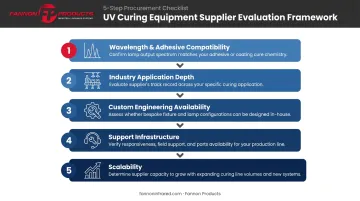
A common mistake in equipment selection is prioritizing brand recognition or upfront cost over the factors that actually determine bond quality. The evaluation framework here focused on:
- Wavelength range and adhesive compatibility — does the system's output match common photoinitiator absorption peaks?
- Industry application depth — is there documented experience in the specific bonding environment (medical, automotive, electronics, printing)?
- Custom engineering availability — can the supplier adapt system geometry, power output, or integration specs to a specific line?
- Support infrastructure — spare parts availability, technical consultation, and after-sale service are non-negotiable for minimizing production downtime
- Scalability — the supplier must support both spot systems and inline conveyor integration as production volumes grow
All five criteria hinge on one prerequisite. Assembly Magazine notes that LED systems' narrow wavelength output may not match adhesives formulated for broad-spectrum lamps — a mismatch that can prevent proper curing entirely. Start every supplier evaluation with the adhesive's photoinitiator absorption range before considering any equipment features.
Conclusion
Choosing a UV curing equipment supplier for adhesive applications is a materials compatibility and production engineering decision. Wavelength matching, irradiance output, system footprint, and long-term support should drive the decision — not just who offers the lowest quote.
Before committing to any supplier, request an application-specific trial or sample curing run using your actual adhesive formulation. Factor total cost of ownership into the comparison — upfront price rarely captures:
- Lamp replacement cycles and consumable costs
- Energy consumption over the system's service life
- Unplanned downtime and its real production impact
For manufacturers looking for American-made UV LED curing systems backed by nearly 70 years of lamp and process-heating engineering, Fannon Products designs and manufactures UV LED curing conveyor systems from their Algonac, Michigan facility, with direct engineering support on application-specific configurations. Contact the team at sales@fannonir.com or call 810-794-2000 to discuss your specific curing application.
Frequently Asked Questions
How much does a UV curing system cost?
Entry-level spot curing units start in the hundreds to low thousands of dollars. A Dymax BlueWave 200 spot lamp lists near $8,069 through distributors; a BlueWave AX-550 LED flood system runs approximately $8,314. Inline conveyor systems require RFQ pricing — configurations vary widely by line width and output requirements.
How much does UV adhesive cost?
UV-cure adhesives typically cost five to ten times more than conventional adhesives, according to Assembly Magazine. Single-unit distributor pricing ranges from roughly $76 for a 30 mL syringe to $481 for a 50 mL bottle of specialty formulations, depending on chemistry and volume.
What is the fastest-curing UV adhesive?
Many UV-cure acrylic and cationic epoxy adhesives achieve tack-free cure in one to five seconds with adequate UV irradiance. Some Dymax coatings cure tack-free in approximately one second at 4,000 mW/cm². Cure speed depends on both the adhesive formulation and the irradiance output of the curing equipment.
What is the difference between LED UV curing and mercury vapor UV curing?
LED UV systems emit narrow-band wavelengths (365–405 nm) with low heat output, long lifespan, and lower energy consumption. Mercury vapor lamps emit a broad UV spectrum (300–450 nm) that suits a wider range of adhesive formulations but generates more heat, requires more frequent replacement, and draws more power.
What wavelength do most UV adhesives require for curing?
Most UV-cure adhesives activate at 365 nm, 385 nm, 395 nm, or 405 nm. Matching the curing equipment's output wavelength to the adhesive's photoinitiator absorption range is essential — a mismatch can prevent full polymerization and leave a tacky bond surface.
Can UV curing equipment handle adhesives with shadow areas?
Standard UV curing cannot reach adhesive in shadowed or light-blocked areas. For assemblies with hidden joints or opaque substrates, dual-cure formulations — which combine UV initiation with a secondary moisture or heat cure mechanism — are the standard solution. Secondary cure in shadowed areas may take up to 72 hours to complete.