No single equipment type works for every application. The choice depends on material type, temperature range, heat transfer method, and production environment — making equipment selection a genuinely consequential decision, not a procurement formality. This guide covers the major types of industrial heat processing equipment, how each works, and what factors should drive the selection decision.
Key Takeaways
- Industrial heat processing equipment applies controlled thermal energy to materials during manufacturing — from drying and curing to forming and melting
- The five primary categories are furnaces and kilns, infrared radiation heaters, induction and resistance heaters, steam-based systems, and convection/forced air systems
- Each type transfers heat through a distinct mechanism — radiation, conduction, or convection — so understanding heat transfer physics is central to equipment selection
- Choosing the wrong equipment type leads to poor process control, wasted energy, product defects, and costly downtime
- Selection depends on material properties, required temperature range, throughput, energy source availability, and whether direct or indirect heating is needed
What Is Industrial Heat Processing Equipment?
Industrial heat processing equipment is the category of machinery used to supply, control, and apply thermal energy to materials in a manufacturing or production environment. The category spans a wide range — from industrial ovens and furnaces to infrared lamps, UV curing systems, and inkjet drying equipment.
Understanding why equipment types differ starts with heat transfer physics. There are three fundamental mechanisms:
- Conduction — heat moves through direct physical contact between the heat source and material
- Convection — heat transfers through a moving fluid or air medium circulated around the material
- Radiation — electromagnetic energy is absorbed directly by the material without requiring a physical medium
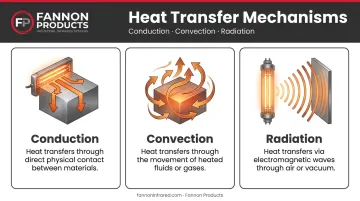
Different equipment types are built around one or more of these mechanisms. Choosing equipment is not simply a capacity or budget decision. The mechanism determines how heat physically reaches and penetrates the material — directly affecting process efficiency, product quality, and energy consumption.
Why Choosing the Right Heat Processing Equipment Matters
Process heating accounts for approximately 70% of process energy used in U.S. manufacturing, with average sector-wide energy losses of 36%. That loss isn't inevitable — it's a structural inefficiency that compounds across every operating hour when equipment is mismatched or poorly optimized for the application.
The financial stakes are significant. According to the U.S. Department of Energy, fuel costs can represent over 90% of total process-heating costs. That means the equipment selection decision — made once at capital procurement — shapes operating costs for the entire system's service life.
Mismatched equipment creates specific, measurable problems:
- Uneven heating causes product defects requiring rework, scrapping, or production halts
- Undersized systems create throughput bottlenecks under production load
- Oversized or overengineered systems consume excess energy while complicating process control
- Wrong heat transfer mechanism for the material results in poor absorption and wasted input energy
Well-matched equipment, by contrast, tightens cycle times, improves product consistency, and holds efficiency as production scales — rather than bleeding energy at every step. The sections below break down the main equipment types and what each one is actually suited for, so you can match the right technology to your process from the start.
Types of Industrial Heat Processing Equipment
Industrial heat processing equipment spans multiple distinct technologies, each built around a different heat transfer mechanism, energy source, and performance profile. Selecting the right type means understanding what each does well, where it falls short, and only then weighing cost, scale, or availability.
Industrial Furnaces and Kilns
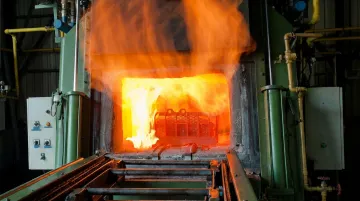
Furnaces and kilns are high-temperature enclosures that heat materials — metals, ceramics, glass, aggregates — using combustion (natural gas, oil) or electric resistance elements. The material is placed inside the chamber and exposed to sustained high heat for processes like annealing, sintering, calcining, or melting.
Unlike surface-level heating equipment, furnaces and kilns heat material in bulk through prolonged exposure to radiant and convective heat inside an enclosed chamber.
Operating temperature ranges (DOE):
- Metal heat treating and reheating: 200°F to 2,500°F
- Metal smelting and melting: 800°F to 3,000°F
- Calcining: 1,500°F to 2,000°F
- Cement clinker formation: approximately 2,640°F (1,450°C)
Best suited for: Metal heat treating, ceramic firing, glass forming, and cement calcining. Used heavily in metallurgy, ceramics, and building materials manufacturing.
Key strengths:
- Capable of extreme temperature ranges
- Handles large batch volumes
- Established technology with predictable performance in mature manufacturing environments
Limitations:
- High energy consumption with significant waste heat potential
- Long heat-up and cool-down cycles limit throughput flexibility
- Not suited for heat-sensitive materials or applications requiring precise surface-only treatment
Infrared Radiation Heaters
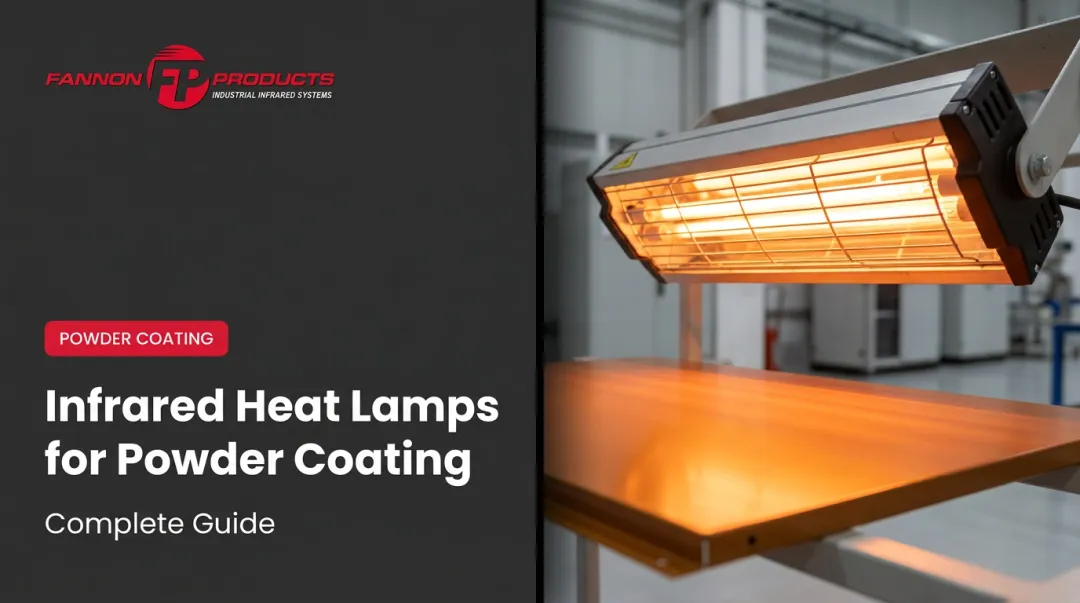
Infrared heaters emit electromagnetic energy in the infrared spectrum, absorbed directly by the target material — bypassing the surrounding air entirely. The material heats from within the surface layer rather than through a heated medium, which makes infrared particularly effective for surface and thin-material applications.
Unlike convection or steam-based systems that heat through a medium, infrared heats through direct electromagnetic radiation. No energy is wasted heating ambient air, and response times are near-instantaneous.
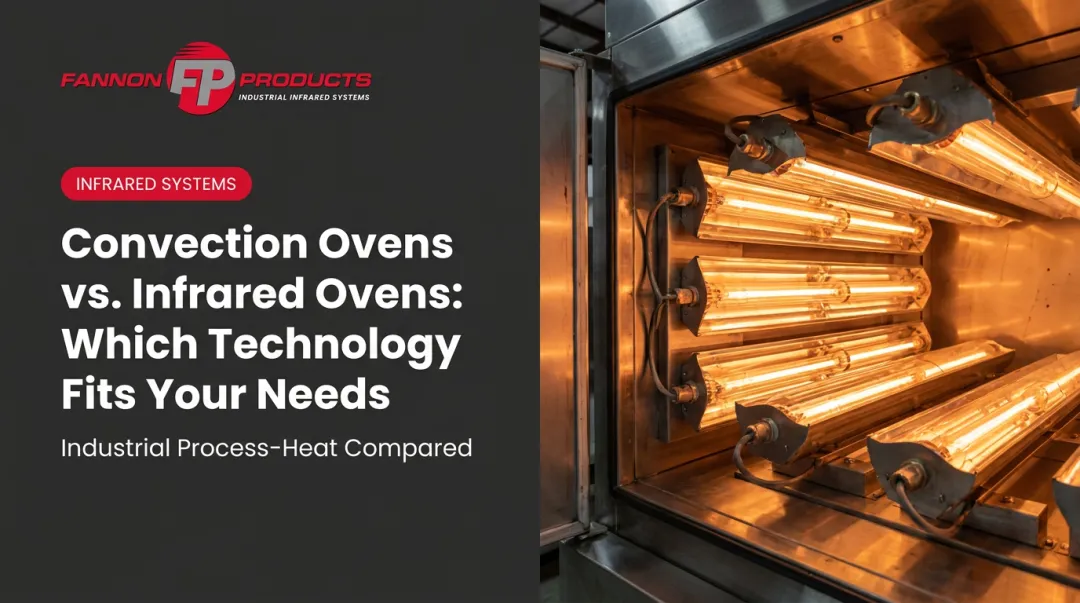
According to EPRI's industrial infrared curing and drying research, industrial infrared ovens can be up to 90% more efficient than conventional convection ovens in suitable drying and curing applications.
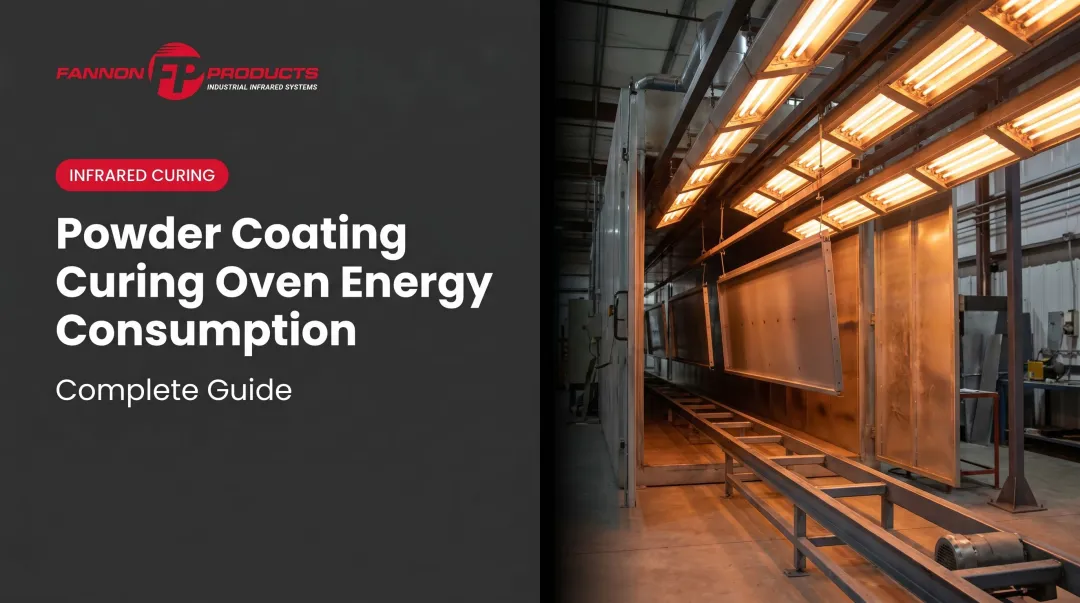
Best suited for: Drying, curing, and bonding in automotive paint and coating lines, printing (ink and inkjet drying), textiles (drying and heat setting), electronics manufacturing, and food processing. Particularly effective for continuous-line production environments requiring fast cycle times and precise temperature targeting.
Fannon Products, based in Algonac, Michigan, has been designing and manufacturing infrared lamps and custom infrared heating systems for nearly 70 years — offering short-wave and medium-wave configurations across a wide range of wattages (250W to 6,000W+) and voltages (115V to 600V) for exactly these industrial applications.
Key strengths:
- Near-instantaneous heat-up and response times
- Energy-efficient — heat delivered directly to the material, not the surrounding air
- Precise zone control and compact footprint for integration into existing production lines
- No combustion emissions
Limitations:
- Less effective for thick or highly reflective materials that resist infrared absorption
- Requires careful lamp selection (wavelength and wattage) matched to the specific material — mismatched lamps result in poor absorption and wasted energy
Induction and Resistance Heating Systems
Induction heaters use alternating electromagnetic fields to generate heat within electrically conductive materials. Resistance heaters pass electrical current through a conductive element or material, generating heat through electrical resistance. Both are electricity-based with no combustion.
Induction is the only major heating method that generates heat inside the material itself, rather than applying it from an external source — making it uniquely suited for fast, precise, and clean heating of metals without physical contact.
Best suited for: Metal hardening, brazing, melting, and forging in automotive, aerospace, and precision manufacturing. Resistance heating is used in wire processing, semiconductor manufacturing, and laboratory applications requiring very precise temperature profiles.
Key strengths:
- Generates heat within the material itself — no physical contact required
- Precise, repeatable temperature control with fast response times
- No combustion byproducts or open flame
Limitations:
- Induction is strictly limited to electrically conductive materials — it cannot heat plastics, ceramics, or composites
- High equipment cost and technical complexity
- Requires expertise to design and operate correctly for consistent results
Steam-Based Heating Systems
Steam-based systems generate steam through boilers and distribute it to heat exchangers, jacketed vessels, or steam injection points. Heat transfers either indirectly (through vessel walls or heat exchanger surfaces) or directly by injecting steam into the product.
Steam is a significant force in industrial process heating: according to the DOE, steam-based systems account for approximately 30% of process heating systems, representing roughly 32% of U.S. process-heating energy as of the most recent DOE process-heating assessment.
Best suited for: Low-to-medium temperature processes — generally below 212°F at atmospheric pressure — including food processing (cooking, sterilization, pasteurization), chemical processing, paper manufacturing, and pharmaceutical production.
Limitations:
- Temperature ceiling limits steam to lower-temperature applications
- Requires boiler infrastructure, water treatment, and regular maintenance of valves, traps, and distribution lines
- Energy losses in distribution (leaks, uninsulated surfaces, malfunctioning traps) reduce overall system efficiency
- Fuel can represent up to 96% of a steam system's total lifecycle cost
Convection and Forced Air Heating Systems
Convection heaters circulate heated air or gas over and around the material, transferring heat through continuous contact between the medium and the material surface. Forced air systems use fans or blowers to accelerate this process, improving heat transfer efficiency and temperature uniformity.
Convection is the established baseline for many industrial drying and curing operations — particularly where the process depends on heating air around parts, evaporating moisture, or treating three-dimensional loads with complex geometry.
Best suited for: Batch and continuous drying operations (food, chemicals, minerals, textiles), curing of coatings and adhesives, general manufacturing ovens, and applications where uniform temperature distribution across irregular shapes is needed.
Limitations:
- Slower heat-up compared to infrared or induction
- Energy is consumed heating the air medium in addition to the material itself
- Less effective for very thick materials where surface-to-core temperature differentials matter
- Poor airflow management creates uneven heating zones that affect product quality
How to Choose the Right Industrial Heat Processing Equipment
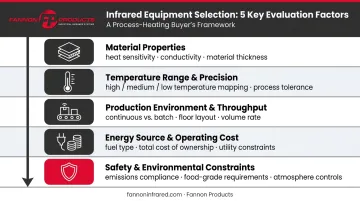
The right equipment is the one that matches the specific material, process parameters, and production environment — not the most advanced or most expensive option on the market. Here are the five factors that should drive the decision.
Material Properties Heat sensitivity, surface characteristics, moisture content, thickness, and electrical conductivity all shape equipment selection. Conductive metals work with induction; non-conductive materials like plastics and ceramics do not. Moisture-bearing materials — food, textiles — respond well to infrared or convection drying.
Temperature Range and Precision Match operating range to the process requirement:
- High-temperature bulk processes (above 750°F) → furnaces and kilns
- Precision surface applications at lower temperatures → infrared or convection systems
- Low-to-moderate temperature processes needing latent heat transfer → steam systems
Production Environment and Throughput
- Continuous-line production (automotive paint, printing lines) → infrared for speed and line integration
- Batch processes with long hold times → furnaces or steam systems
- High-volume metal processing → induction for speed and repeatability
Energy Source and Operating Cost Fuel costs alone exceed 90% of total process-heating costs — capital price is only part of the picture. Evaluate:
- Available energy sources (gas, electricity, steam)
- Local energy rates and supply reliability
- Total cost of ownership: installation, maintenance, and lifetime energy consumption
Safety and Environmental Constraints Flammable materials, explosive atmospheres, food-grade requirements, and emissions regulations all restrict equipment options. In enclosed spaces or food-contact environments, combustion-based systems are off the table — infrared and electric systems are the practical alternatives.
Common Selection Mistakes to Avoid
Three mistakes drive most poor equipment selection outcomes:
Assuming more capability equals better results. Oversized or overengineered equipment increases capital cost, energy consumption, and control complexity without improving outcomes for applications that don't require it. Match the equipment to the process, not the other way around.
Selecting based on familiarity rather than fit. A steam system that works well for pasteurization may be entirely wrong for paint curing or ink drying. Each new application deserves a fresh evaluation, not a default to whatever technology is already on the floor.
Ignoring total lifecycle cost in favor of low purchase price. Equipment with a lower upfront cost but higher energy consumption, frequent element replacement, or poor process control can cost more over a three-to-five year operating period than a better-matched system. Since fuel typically represents over 90% of process-heating costs, purchase price is the least meaningful number in the comparison.
Frequently Asked Questions
What is the difference between direct and indirect industrial heat processing?
Direct heating puts the heat source or medium in physical contact with the material — for example, steam injection or open-flame combustion. Indirect heating separates the heat source from the material, transferring energy through walls, tubes, or radiant panels. This distinction affects contamination risk, heat control precision, and suitability for food-grade or chemically sensitive processes.
Which type of industrial heat processing equipment is the most energy efficient?
Infrared radiation heating ranks among the highest-efficiency options for surface and thin-material applications — heat transfers directly to the material without warming the surrounding air. EPRI data supports up to 90% efficiency gains over conventional convection ovens in suitable applications. That said, the best choice depends on your specific material, throughput, and process temperature requirements.
What industries use infrared heating equipment?
Automotive (paint and coating drying), printing (ink curing and drying), textiles (heat setting and drying), electronics manufacturing (reflow soldering, PCB curing), and food processing are the primary sectors. Infrared is preferred where fast cycle times, compact installation, and precise surface heating are required.
How do I determine what temperature range my industrial heating equipment needs to reach?
The required temperature range is defined by the process itself — the material's transformation temperature, cure temperature, or drying threshold. Engineers should consult material datasheets and process specifications before selecting equipment, as these documents define the non-negotiable thermal requirements the system must meet.
Can industrial heat processing equipment be custom-engineered for specific applications?
Yes, and infrared systems offer the most flexibility here — custom wattages, wavelengths, lamp configurations, and fixture layouts can all be specified to fit unique production line geometries. Fannon Products has engineered and manufactured custom infrared heating systems for automotive, printing, food processing, electronics, and textile applications for nearly 70 years, with in-house design and manufacturing at their Algonac, Michigan facility.
What is the most commonly used type of industrial heat processing equipment?
Furnaces and steam-based systems have historically dominated industrial process heating due to their use in high-volume, high-temperature industries like steel, cement, and food processing. Electric systems including infrared are growing in adoption due to energy efficiency advantages and tighter process control — particularly in surface treatment, curing, and drying applications where convection ovens have been the traditional baseline.