But powder coating system costs vary far more than most first-time buyers expect. Pricing a single piece of equipment — just the gun, or just the oven — and calling it a budget is the most common and costly mistake. The real number depends on what you're buying, what your facility already supports, and what production volume you're actually targeting.
This guide covers realistic price tiers, what each major component costs, what drives prices up or down, and how to build a budget that holds up once equipment arrives.
Key Takeaways
- Small shop powder coating systems range from $8,000–$21,500 (entry-level) to $32,000–$52,500+ (professional batch)
- The curing oven is the single largest expense; size it for your largest parts before speccing anything else
- Facility upgrades (electrical, gas, booth ducting) add $3,000–$15,000 and are frequently overlooked
- Professional-grade guns and well-insulated ovens cut powder waste and rework, paying back higher upfront costs through lower operating expenses
- IR curing systems cure faster and consume less energy than conventional ovens, making them a strong option for shops focused on throughput and operating costs
How Much Does a Powder Coating System Cost?
There's no single fixed price. The total depends on your equipment mix, whether you buy new or used, your facility's current infrastructure, and the scale of work you plan to run.
Two budgeting mistakes show up constantly:
- Costing only one component (gun or oven) and treating it as a full system budget
- Assuming hobby-grade prices translate to commercial requirements — a $200 DIY gun and a $500 tabletop booth won't survive a production workload
Typical Cost Ranges
| Tier | Typical Range | Best For |
|---|---|---|
| Entry-level / garage | $8,000–$21,500 | Hobbyists, small-part coaters, limited weekly volume |
| Mid-range professional batch | $32,000–$52,500 | Small commercial shops, job shops, consistent revenue targets |
| Advanced production batch | $52,500–$100,000+ | Established shops, larger parts, B2B contracts |
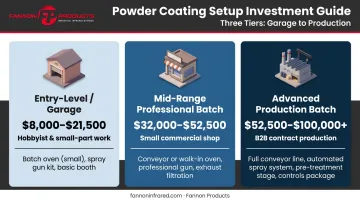
These ranges cover core equipment only. They exclude facility upgrades, permits, installation labor, pretreatment systems, and initial powder inventory.
Here's what each tier actually covers — and where the budget gaps typically appear.
Entry-Level Setup ($8,000–$21,500)
This tier is only realistic for shops that already have adequate electrical service, sufficient square footage, and no major booth compliance hurdles.
A typical entry-level setup includes:
- Used or compact batch oven (10–13 ft interior)
- Entry-level electrostatic gun ($500–$1,500)
- Basic open-face booth with minimal filtration
- Small air compressor
This works for coating wheels, brackets, and small custom pieces at low weekly volume. Most shops at this tier hit capacity constraints within 6–12 months of consistent use.
Mid-Range Professional Setup ($32,000–$52,500)
This is the more realistic starting point for any shop targeting consistent revenue. A 2025 guide from PowderX puts a basic professional small-shop setup at $20,000–$50,000 — that range reaches $32,000–$52,500 once equipment and modest facility prep are combined.
Equipment commonly found at this level:
- New batch curing oven with better temperature uniformity
- Professional gun with higher transfer efficiency
- Enclosed spray booth with proper filtration
- Refrigerated air dryer plus compressor
- Basic surface prep equipment
Advanced/Production Batch Setup ($52,500–$100,000+)
For shops with an established customer base, larger part sizes, or B2B finishing contracts. At this level, installed booth costs, compliance electrical work, and premium application equipment routinely add 25–40% on top of the base equipment price — pushing a $65,000 equipment list to $80,000–$90,000 installed.
Key Cost Components of a Small Shop Powder Coating System
Total system cost is the sum of several individual components. Understanding each item's range prevents budget gaps from appearing after equipment is ordered.
Curing Oven
The oven is the single largest equipment expense, and the right place to anchor your budget conversation.
Small electric batch ovens for startups run $5,103–$11,453 based on current supplier listings (Creative Coating Solutions 4x4x8 and 6x6x10 models). Mid-size professional ovens push into the $15,000–$35,000 range. Oven size, fuel type (electric vs. gas), and insulation quality all drive price.
For shops managing tight energy budgets or running varied part sizes, infrared (IR) curing technology is worth evaluating seriously. A DOE case study of Progressive Powder Coating found that switching to an IR oven increased production 50%, reduced natural gas use 25%, and saved $54,000 per year with a 2.5-year payback. IR heats the coating and substrate directly rather than cycling hot air through an entire chamber — faster cycle times, lower energy draw per part.
Fannon Products, a Michigan-based manufacturer with nearly 70 years in infrared process heating, builds custom IR curing systems for powder coat applications. Their systems deliver 96% radiant efficiency with instant on/off response — a practical advantage for batch shops where oven idle time adds up.
Spray Booth
Booth pricing spans a wide range depending on size and compliance requirements:
- Compact open-face booths: $1,500–$6,290 (equipment only)
- Enclosed walk-in booths with filtration: $7,000–$15,000
- Mechanical installation labor alone: $8,366+, with ductwork and electrical separate
NFPA 33 compliance — covering ventilation, explosion-proof electrical, grounding, and spark-resistant exhaust — is non-negotiable in the US. A $3,000 booth can become a much larger project once installation, classification electrical work, and local AHJ review are factored in.
Electrostatic Spray Gun System
Gun selection has a direct impact on powder waste, finish quality, and long-term operating cost — yet it's where small shops most often under-invest.
- Entry-level guns: $500–$1,500, limited parameter control and shorter service life
- Professional systems (Wagner, Gema, Nordson): $6,900–$9,000+
Nordson states that HDLV dense-phase technology saves approximately 30% more powder versus conventional venturi systems. That savings compounds over time, making professional guns financially justified beyond the finish quality argument.
Compressor and Air Treatment System
An undersized compressor causes pressure drops mid-job. Unfiltered air carrying moisture or oil causes fish-eye defects and adhesion failures. Most shops underestimate this line item until they're troubleshooting finish defects after the fact.
- Basic compressor (5 HP, 60-gallon): $1,999–$3,183
- Refrigerated air dryer (15 CFM range): $951–$1,904
Budget for both. PCI Magazine sets air quality targets for powder coating lines at:
- Maximum oil content: 0.1 ppm
- Dew point: 35°F or lower
- Particulate size: no larger than 10 microns
Meeting those targets requires a dryer and oil filtration stage. These aren't optional accessories — they're what separates consistent finishes from costly rework.
Surface Prep and Supporting Equipment
Individually modest, but these add up:
- Blast cabinet: $800–$3,000 (or higher for industrial models)
- Parts hanging racks and hooks: $300–$1,000
- Coating thickness gauge, grounding tester, masking supplies: $500–$1,500+
Budget $2,000–$5,000+ for this category.
Key Factors That Drive Powder Coating System Costs
Scale and Throughput Requirements
Weekly part volume directly determines oven size, booth capacity, and whether a batch setup is sufficient at all. A shop coating 20 wheels a week has entirely different equipment requirements than one targeting 200 fabricated steel panels.
Use part geometry to anchor the oven decision:
- Small parts (wheels, brackets): 4x4x6 to 5x5x6 ft batch ovens
- Automotive or structural components: 8x8x10 ft or larger
Size for your current volume, not aspirational growth. Oversizing the oven means higher electrical draw, longer warm-up times, and more energy wasted per cure cycle.
New vs. Used/Refurbished Equipment
Buying used can halve upfront costs, but the risks are real. As Reliant Finishing Systems notes, used equipment carries failure modes that show up as coating defects — not equipment error codes:
- Ovens: cold spots from settled insulation, hidden rust, or unstable temperature control
- Booths: potential NFPA 33 non-compliance requiring costly remediation
- Filters: replacements often exceed $1,000 before the first job runs
Before committing to used equipment, ask the seller for a recent temperature uniformity survey and confirm the booth's last inspection date.
Facility Readiness and Installation Costs
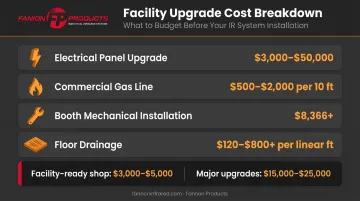
Facility prep is the most consistently overlooked budget item. Shops without existing industrial infrastructure should expect significant add-on costs:
- Electrical panel upgrade: $3,000–$7,000 (small commercial); $15,000–$50,000 for major industrial service upgrades
- Commercial gas line: $500–$2,000 per 10 linear feet
- Booth mechanical installation: $8,366+ (labor only, ductwork and electrical separate)
- Floor drainage for pretreatment: $120–$800+ per linear foot
A facility-ready shop may spend $3,000–$5,000 on installation. One requiring new electrical service, gas utility coordination, and booth penetrations can easily hit $15,000–$25,000 before a single part is coated.
Full Cost Breakdown: One-Time vs. Ongoing Expenses
One-Time Costs
| Item | Estimated Range |
|---|---|
| Equipment (entry to professional) | $8,000–$52,500+ |
| Facility upgrades and installation | $3,000–$15,000 |
| Permits and compliance inspections | Variable by jurisdiction |
| Initial powder inventory and masking | $500–$2,000 |
Recurring Costs
- Powder consumption: Entry-level guns waste more powder per job; professional systems with dense-phase technology recover significantly more, lowering cost per part over time
- Energy: A 6x6x10 electric oven at 240V/91A draws ~21.84 kW. At the US commercial average of 13.51 cents/kWh, that's roughly $2.95/hour at full draw; actual cure-cycle cost varies with warm-up time, part mass, and duty cycle. A practical operating reference for professional batch ovens: $10–$15/hour for gas or electric
- Labor burden: Don't price labor at base wage only. The SBA estimates an employee costs 1.25–1.4x base salary after taxes and benefits; in higher-burden shops, that multiplier can reach 1.5–1.8x
- Maintenance: Booth filter replacement, gun part replacement, oven element or burner servicing
Periodic/Depreciation Costs
Spread major equipment cost over 8–10 years and include a monthly depreciation figure in every job's pricing. A $40,000 system depreciated over 10 years is $333/month — a real cost that belongs in every job's pricing, not written off until the equipment needs replacing.
How to Budget Smartly for Your Powder Coating Setup
The right budget is the one matched to your actual production volume and revenue goals — not the lowest number that gets equipment through the door.
Common mistakes to avoid:
- Focusing only on upfront equipment price and ignoring installation
- Skipping recurring energy and powder cost estimates
- Over-specifying for future capacity that may never arrive
- Choosing the cheapest option without checking parts availability or service support
Practical budgeting framework:
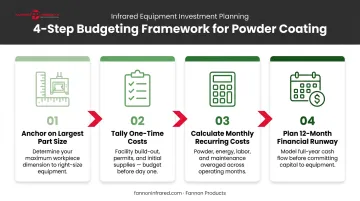
- Start with your largest part size — this anchors oven selection and drives every other equipment decision
- Tally all one-time costs: facility prep, permits, and initial supplies
- Calculate monthly recurring costs at realistic volume — powder, energy, labor burden, and maintenance
- Plan a 12-month financial runway that covers operating costs before your customer base is fully established
For shops prioritizing energy efficiency and faster cycle times, IR-based curing systems are worth evaluating — either as a complement to a conventional oven or as a primary curing method. Fannon Products builds custom IR systems with 96% radiant efficiency; their Goldenrod directional lamps deliver 23.5% energy savings compared to standard lamp configurations. With nearly 70 years of infrared expertise, their team can help small shops determine whether IR suits their specific part mix and throughput requirements.
Frequently Asked Questions
How much does a powder coating system cost?
Basic garage setups start around $8,000–$21,500 for compact, facility-ready configurations. Professional small-shop systems run $32,000–$52,500 or more. Final cost depends heavily on oven size, gun quality, booth type, and how much facility preparation the space requires.
How much does it cost to start a small powder coating business?
Total startup investment — equipment, facility prep, permits, and initial supplies — typically runs $20,000–$50,000 for a commercially viable small shop. Budget an additional 12-month operating reserve to cover recurring costs before customer volume fully ramps up.
How much is powder coating per square foot?
Outsourced powder coating typically runs $0.50–$2.00 per square foot depending on part complexity, material, and local market rates. In-house costs drop substantially once equipment is paid down — often to $0.15–$0.40 per square foot in direct materials. That gap is the core financial case for bringing the process in-house.
What is the cheapest way to set up a powder coating system for a small shop?
Buying a used batch oven, a basic electrostatic gun, and a simple open-face booth keeps upfront costs lowest. The trade-offs are real: used ovens may have temperature uniformity problems, entry guns waste more powder, and basic booths may not meet NFPA 33 requirements without additional installation work.
Is powder coating more expensive to set up than traditional liquid painting?
Yes — powder coating requires a curing oven, which liquid paint does not. That's the primary upfront cost difference. Over time, powder coating typically wins on material waste (no solvents, recyclable overspray), finish durability, and reduced rework costs.
How long does it take to recoup the investment in a powder coating system?
Shops that price jobs to cover labor, powder consumption, energy, and equipment depreciation can reach breakeven within 6–18 months. The key variable is utilization — a half-busy shop takes twice as long to recoup costs as a consistently loaded one.