The confusion is understandable — both heater types use coiled wire heating elements, and both are technically classified as infrared heaters. The meaningful difference isn't whether they produce heat. It's how efficiently that heat reaches the target material.
This article breaks down the specific, measurable operational advantages quartz infrared heaters hold over ceramic heaters, so facility managers and industrial buyers can make an informed decision.
Key Takeaways
- Quartz delivers infrared energy directly to the target — ceramic absorbs it first, losing energy to convection
- Quartz heaters reach operating temperature in 1–2 seconds; medium-wave quartz models heat up in 30 seconds or less
- Faster cool-down means operators can stop heating precisely, reducing overprocessing risk
- Quartz enables focused, directional heating — ceramic's convection output disperses based on airflow
- Quartz outperforms ceramic on energy efficiency, speed, and process control in high-throughput industrial applications
Ceramic vs. Quartz Infrared Heaters: What's the Difference?
Both heater types use a coiled wire element — typically an iron-chromium-aluminum (FeCrAl) alloy — as the primary heat source. The difference lies in what surrounds that element and how that material handles the energy the element produces.
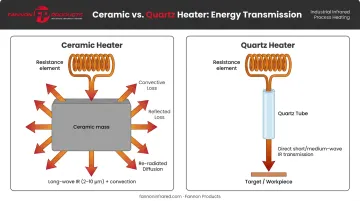
Ceramic heaters embed the element within a ceramic structure. That ceramic body absorbs the infrared energy produced by the coil, then re-radiates it as longer-wavelength infrared (typically 2–10 μm) while simultaneously generating convection heat. You're not getting direct transmission — you're getting a two-step conversion process, with heat going in multiple directions.
Quartz heaters work differently. The element sits inside a quartz tube that is optically transparent to infrared radiation. Energy from the coil passes straight through the quartz envelope and travels directly toward the target. According to Casso-Solar Technologies, quartz functions as an excellent IR transmitter while ceramic acts as a base material that absorbs heat and re-radiates it — a path that loses usable energy at each conversion step.
The practical question is always the same: how much usable energy reaches the target per watt consumed? That answer drives everything from lamp selection to system design — and it's where quartz's direct-transmission advantage compounds across a full production cycle.
Key Advantages of Infrared Quartz Heaters Over Ceramic Heaters
Advantage 1: Direct Energy Transmission with Minimal Loss
When a ceramic heater operates, the ceramic mass absorbs energy from the element and re-radiates it — but a meaningful share converts to convection heat rather than directed infrared. That convection heat warms the surrounding air, not the product. Air currents in a real process environment carry that heat away from the target, creating inconsistency and forcing higher energy input to compensate.
Quartz doesn't work this way. Energy from the element travels through the quartz tube and goes directly where it's aimed.
Why this matters operationally:
- Every watt lost to convection is a watt that didn't cure, dry, or process the product
- Ceramic heaters require more electrical input to deliver the same heating result as a quartz unit
- Heraeus reports that infrared systems can reduce energy consumption by up to 50% compared with conventional warm-air ovens
- Lower energy waste per process cycle compounds into significant cost savings across high-volume industrial operations
This advantage is most pronounced in automotive paint drying, ink curing, and powder coating lines where heaters run continuously. Small efficiency gaps at scale translate into large cost differences over time.
Advantage 2: Faster Heat-Up and Cool-Down Response Times
Ceramic heaters must thermally saturate the ceramic mass before re-radiation begins. That inertia creates a lag — both at start-up and at shut-down. You can't precisely switch a ceramic heater on and off during a dynamic process because the ceramic body keeps radiating heat after the element is de-energized.
Quartz heaters don't carry that mass. The element heats the quartz envelope, which doesn't absorb meaningful energy, and output begins almost immediately.
Documented response times for quartz:
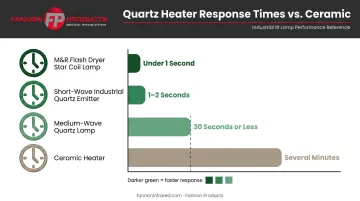
- Short-wave industrial quartz emitters: 1–2 second response time, per Helios Quartz specifications
- Fannon Products' medium-wave quartz lamps: heat-up and cool-down in 30 seconds or less
- Fannon's M&R Flash Dryer replacement lamps (fast-response star coil): heat-up in under 1 second
Why this matters operationally:
- Shorter time-to-process-ready reduces cycle time and increases throughput
- Precise shut-off prevents residual heat from overprocessing heat-sensitive materials like printed substrates or plastics
- Intermittent zone heating becomes practical ; ceramic heaters' inertia makes zone-by-zone control unreliable
Screen printing flash dryers, paint curing lines, and any application requiring rapid process changes or tight temperature tolerances see the clearest gains here.
Advantage 3: Precision Heat Targeting and Wavelength Control
Short-wave quartz emitters produce infrared in the 0.76–2 μm range; medium-wave quartz in the 2–4 μm range. Both are more directional and penetrating than the longer-wavelength infrared (2–10 μm) re-radiated by ceramic heaters. Quartz heaters' convection output is minimal, so their energy goes where it's aimed.
Ceramic heaters produce convection heat as a byproduct that disperses based on air currents, not operator intent. No reflector can redirect that.
Quartz heaters, by contrast, support precision through:
- Reflector configurations that focus and direct infrared output onto specific zones
- Wavelength matching between emitter output and target material absorption, improving how efficiently the material absorbs the energy
- Multi-zone layouts where individual lamps are set to deliver specific wattages in specific areas
Fannon Products' Goldenrod directional lamps demonstrate this directly. The integral 24K gold reflector directs virtually 100% of infrared energy toward the work surface, eliminating the need for secondary reflectors while keeping surrounding equipment cooler. Compared to standard lamps, the Goldenrod design delivers 23.5% energy savings through targeting efficiency alone. Fannon offers these lamps across a wide range of heated lengths and wattages, with custom configurations available for multi-zone setups in automotive, printing, and industrial process-heating applications.
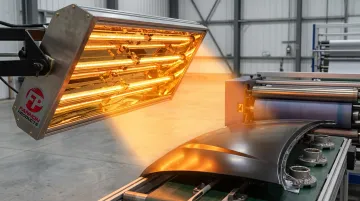
This matters most in multi-zone curing lines and electronics assembly, where adjacent materials cannot absorb stray heat without affecting product quality.
What Happens When You Stick with Ceramic Heaters in the Wrong Application
The operational consequences of mismatched heater technology compound over time. In applications where quartz would be more appropriate, ceramic heaters tend to produce:
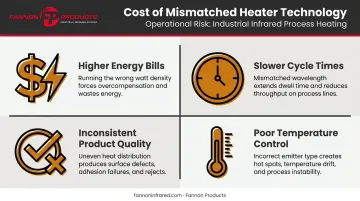
- Higher energy bills: convection losses demand more electrical input to reach equivalent heating results
- Slower cycle times: warm-up lag cuts throughput in processes that depend on rapid start/stop cycling
- Inconsistent product quality: uncontrolled convection airflow creates variable heat distribution across the target surface
- Poor temperature control: thermal inertia makes precise setpoint management harder to sustain
Facilities often absorb these costs as a baseline — elevated energy spend, higher scrap rates — without tracing them back to heater technology. As production volume scales, that gap compounds. Ceramic heaters become progressively more expensive relative to the output they deliver.
That facility-level problem reflects a broader pattern. The DOE's Process Heating Technology Assessment reports average process-heating losses of 36% across U.S. manufacturing, totaling more than 2,500 TBtu of annual on-site energy losses. Not all of that is attributable to heater selection — but heater technology is a controllable variable that directly affects where a facility lands within that range.
How to Get the Most Value from Infrared Quartz Heaters
Quartz heaters deliver their advantages most fully when properly specified and maintained. Three areas consistently determine whether the efficiency gains hold up in practice:
Sizing and Positioning
- Undersized units force longer run times, eroding the cycle-time advantage
- Poor placement wastes the directional benefit of quartz IR
- Wattage, voltage, heated length, and mounting geometry all need to match process requirements
- Fannon Products requires customers to specify overall length, heated length, voltage, wattage, quartz diameter, and reflector configuration — ensuring each lamp is matched precisely to the application
Element Quality and Replacement Timing
- Degraded quartz tubes reduce transmission efficiency and increase energy waste
- Fannon's quartz infrared lamps carry a rated life expectancy of 5,000+ hours, providing a concrete benchmark for replacement planning
- Sourcing from an experienced manufacturer ensures consistent output specs are maintained. Fannon offers over 1,000 replacement infrared lamp configurations in every size, wattage, and voltage, including direct-fit replacements for Heidelberg presses, M&R flash dryers, and Fostoria systems
Performance Monitoring
- Track cycle time, energy consumption, and defect rate against baseline metrics
- Degraded heater performance rarely announces itself loudly; it shows up gradually in process drift and rising scrap rates
- Regular review catches the decline before it affects product quality or operating cost
Conclusion
The efficiency advantage of quartz over ceramic infrared heaters comes down to material physics. Quartz transmits energy directly; ceramic absorbs it first and re-radiates it with convection losses the process never recaptures. That difference compounds into measurable reductions in energy draw and improvements in process speed and output quality — results most pronounced in industrial, high-throughput settings where heaters run continuously.
Choosing the right infrared technology isn't a one-time decision. Proper sizing, quality lamp sourcing, and regular performance review are what sustain the efficiency advantage long-term. For facilities running powder coating lines, flash dryers, or continuous curing systems, those disciplines determine whether an upgrade delivers on its promise — or just looks good on paper. Fannon Products has spent nearly 70 years manufacturing replacement quartz lamps and custom infrared systems for exactly these environments, and that depth of application experience is available to any facility working through these decisions.
Frequently Asked Questions
Do infrared quartz heaters use a lot of electricity?
Quartz infrared heaters transmit nearly all energy directly to the target with minimal convection loss, making them among the more efficient electric heating options. Actual consumption depends on wattage and run time, but that direct-transfer efficiency typically means less energy is needed to match the output of ceramic or convection-based alternatives.
Which is better, quartz infrared or ceramic heaters?
Quartz infrared heaters are the better choice for industrial and commercial applications requiring speed, precision, and energy efficiency. Ceramic heaters may be adequate for low-demand or steady-state applications where long-wave wavelength output matches the target material.
What industries benefit most from infrared quartz heaters?
Automotive paint curing, screen printing and ink drying, powder coating, textile processing, food processing, electronics/PCB manufacturing, and glass-ceramics all benefit significantly. These high-cycle applications are where quartz heaters' fast response time and precise targeting deliver the greatest return on energy and process efficiency.
How long do quartz infrared heating elements last compared to ceramic?
Quartz element lifespan varies by application intensity and lamp quality. Fannon Products' quartz infrared lamps carry a rated life expectancy of 5,000+ hours, with specialty products like the Fostoria F-Series quartz-composite panel heater rated up to 25,000 hours. For high-cycle industrial applications, replacement planning around rated hours minimizes production downtime.
Can infrared quartz heaters replace ceramic heaters in existing systems?
In many cases, yes — but wattage, voltage, overall length, heated length, quartz diameter, and end-cap configuration must all match the existing fixture. Fannon Products offers over 1,000 replacement lamp configurations plus custom manufacturing, making it practical to spec a quartz replacement for most existing ceramic heater installations.
Are infrared quartz heaters safe for industrial use?
Quartz infrared heaters are a standard choice in industrial environments — they produce no open flames, combustion byproducts, or carbon monoxide. Standard safety practices include maintaining proper mounting distance from target materials, using appropriate reflectors, and following manufacturer guidelines for wattage, voltage, and installation orientation.