Most people plug in and point. They skip distance setup, ignore session timing, and move a hot lamp with bare hands. The result is either underwhelming performance or an avoidable safety issue — neither of which has anything to do with the lamp itself.
This guide covers correct infrared heat lamp use across both personal and industrial contexts: how to set up, operate, monitor, and shut down properly. Whether you're using a consumer therapy lamp at home or running high-cycle industrial equipment, the same core principles apply.
Key Takeaways
- IR lamps heat targets directly through radiant energy — not by warming the surrounding air
- Positioning distance is the most skipped setup step — keep at least 30 cm for personal use, 45–75 cm in clinical settings
- Keep personal sessions to 15 minutes maximum per area
- Never apply skin products before an IR session
- Use proper IR-rated eye protection when working near the face
- Allow the lamp to cool fully before touching or repositioning it after use
When Should You Use an Infrared Heat Lamp?
Not every situation calls for IR heat — and using it at the wrong time can make things worse.
Personal and Therapeutic Use
IR lamps are well-suited for chronic muscle soreness, joint stiffness, and post-exercise discomfort. A 2022 systematic review of infrared therapy for musculoskeletal conditions found significant potential for pain reduction, with one chronic low-back-pain study reporting roughly 50% pain reduction over six weeks with no adverse effects observed.
However, IR heat is not appropriate in every scenario. Avoid it when:
- The injury is fresh — NHS guidance advises against heat for the first couple of days after sprains or strains, since increased blood flow can worsen swelling
- Swelling is visible — Safer Care Victoria extends the no-heat window to 48–72 hours post-injury
- Cold therapy is indicated — if the area is hot, swollen, or acutely inflamed, ice is the right call
Point the lamp at the specific area you want to treat. Using it as a general room warmer produces far weaker results.
Industrial and Commercial Use
In manufacturing and commercial environments, IR lamps work best when you need precise, controlled radiant energy directed at a specific surface — not as a substitute for ambient heating systems. Common industrial applications include:
- Automotive paint curing — short-wave IR penetrates coating layers for faster, more uniform drying
- Screen printing and flash drying — medium-wave lamps provide targeted heat between print passes without overexposing substrates
- Plastics thermoforming — consistent radiant heat softens material evenly before forming
- Inkjet drying systems — high-intensity IR accelerates ink adhesion on fast-moving media
The application context determines everything. Duty cycles, wattage, and fixture design for an industrial line differ significantly from a 15-minute personal session — and getting those parameters right is where purpose-built equipment matters.
What You Need Before Getting Started
Before switching anything on, confirm you have the right equipment for your specific application.
| Requirement | Why It Matters |
|---|---|
| Correct wattage and voltage | An underpowered lamp won't achieve proper curing or therapeutic effect; an overpowered one at close range creates safety risks |
| Stable, adjustable fixture | Lamp angle and height directly affect how evenly radiant energy reaches the target |
| IR-rated eye protection | Standard glasses do not block infrared radiation — EN 171:2002-compliant eyewear is required for use near the face |
That wattage requirement in the first row covers a wider range than most people expect. Fannon Products manufactures replacement infrared lamps from 250W to 6,950W across voltages from 57.5V to 600V — spanning comfort heaters, Heidelberg printing presses, M&R flash dryers, automotive curing systems, and HP 3D printers.
Spec accuracy matters here. A replacement lamp built to exact OEM dimensions and electrical specs delivers consistent output; a generic substitute may underperform or fail before its rated lifespan — costing more in downtime than the initial price difference.
How to Use an Infrared Heat Lamp (Step-by-Step)
Effective use follows a defined sequence. Skipping any step (setup, monitoring, or shutdown) reduces performance and adds risk.
Setup and Preparation
For personal/therapeutic use:
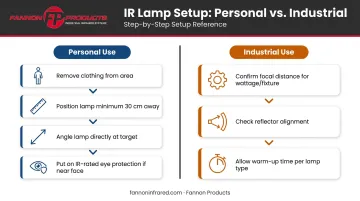
- Position the lamp at a minimum of 30 cm from the target body area (manufacturer manuals from Beurer, Medisana, and Philips all specify 30 cm as the minimum)
- Clinical IR applications typically place lamps 45–75 cm from the body, which provides a conservative baseline for home use
- Remove clothing from the treatment area; fabric over the skin blocks radiant energy and significantly reduces effectiveness
- Point the lamp directly at the target — angle matters; uneven coverage reduces results
For industrial/commercial use:
- Follow the manufacturer's specified focal distance for the lamp wattage and fixture type — this varies significantly across applications
- Short-wave lamps reach operating temperature in approximately one second; long-wave emitters may require up to 10 minutes to stabilize
- Confirm reflector alignment before starting; misaligned reflectors scatter energy and create uneven heat distribution
Common setup errors to avoid:
- Placing the lamp too close (causes discomfort or surface damage)
- Leaving clothing or material between the lamp and the target
- Positioning at an angle rather than directly at the target surface
Initiating Use
Switch on the power. If your fixture includes a dimmer or intensity control, start at a lower setting and adjust upward rather than beginning at full output.
Signs of correct initiation:
- Near-infrared lamps produce a visible reddish glow within seconds
- The target area begins to feel steady, comfortable warmth — not intense heat
If you feel intense heat or any burning sensation immediately, increase the distance. Don't adjust your tolerance threshold downward — adjust the lamp position.
Operating the Lamp Correctly
Personal/therapeutic use:
- Standard session duration: up to 15 minutes per area — confirmed by Beurer (IL 50, IL 60), Medisana (IR 885), and Philips (PR3110) manufacturer manuals
- For sessions near the face or eyes: follow your device's specific face/eye guidance; Medisana advises against facial irradiation entirely, while Beurer requires supplied EN 171:2002 eyewear and closed or covered eyes
- Heat should feel consistently comfortable throughout — if it becomes increasingly intense, reduce session time or increase distance
Industrial/commercial use:
- Operate within the duty cycle and wattage parameters specified for your lamp and fixture
- Continuous-use industrial lamps are built for sustained operation, but ventilation conditions and reflector condition must be maintained to preserve output consistency
- Replacement lamps for industrial equipment such as Heidelberg presses and M&R flash dryers are rated for 5,000+ hours at 96% radiant efficiency. Fannon Products manufactures direct-fit replacements for both; those ratings hold only when the lamp operates within the fixture's specified parameters
Monitoring During Use
Personal use — stop immediately if you notice:
- Heat that escalates rather than staying steady
- Skin that looks deeply red, feels burning, or develops a net-like pattern
- Any eye discomfort
Erythema ab igne (a heat-induced skin reaction) can develop from repeated overexposure. Early signs include a temporary reddish, net-like rash. Catch it early by adjusting distance or session time before any lasting pigment change develops.
Industrial use — watch for:
- Uneven heating across the target surface (typically indicates fixture misalignment)
- Reduced output or longer-than-normal process times (often a sign of lamp degradation)
- Visual darkening of the lamp envelope
Shutting Down
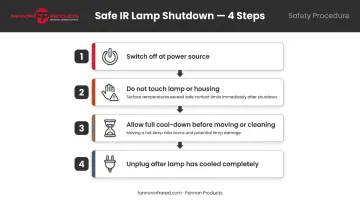
- Switch off the lamp at the power source
- Do not touch the lamp or housing — both remain very hot for several minutes after shutdown
- Allow full cool-down before repositioning, cleaning, or transporting
- Unplug after the lamp has cooled completely
Moving a hot lamp risks burns and filament damage. In industrial settings, skipping cool-down shortens lamp lifespan — a real cost when running high-wattage lamps at scale.
Where Infrared Heat Lamps Are Commonly Used
Personal and Comfort Heating
In homes and commercial spaces, IR lamps are used for:
- Targeted muscle and joint therapy
- Bathroom and space warming
- Outdoor patio and stadium venue heating
The appeal is direct, localized warmth that activates immediately, with no waiting for air temperature to rise.
Industrial and Commercial Applications
Industrial applications demand far more precision than comfort heating — specific wavelengths, exact temperature control, and lamp types matched to the process. Here's how that plays out across major sectors:
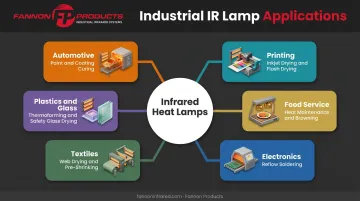
Automotive: IR systems cure primer, color coat, clear coat, and powder coat applications, requiring precise temperature control across the entire surface. Fannon Products' automotive solutions also cover seat de-wrinkling and headliner forming, using short-wave lamps that reach operating temperature instantly for tight production cycles.
Printing: Fannon's LightSpeed InkJet Drying Systems use patented "Goldenrod" lamps with a 24K gold reflector that directs nearly all infrared energy at the substrate. Medium-wave lamps are specifically chosen for screen printing because they're less color-sensitive to light and dark inks and plastisols than short-wave alternatives. That distinction directly affects print quality and consistency.
Food service: Commercial IR heat lamps maintain plate and food temperatures at serving stations. Baking, browning, and dehydrating processes use different wavelength configurations than comfort heating lamps.
Other sectors: Electronics (reflow soldering), textiles (web drying, pre-shrinking), plastics (thermoforming, welding), and glass-ceramics (drying mirrors and safety glass) all use IR at specific process stages with application-matched lamp types.
Fannon Products has served these industries for nearly 70 years, supplying both replacement lamps for existing equipment and custom-engineered systems built to specific workflow requirements.
Best Practices for Effective Use
Before each personal session:
- No oils, lotions, or creams on skin — these absorb heat differently and increase burn risk; Philips, Beurer, and Medisana all flag this in their product manuals
- Confirm distance before switching on
- Have IR-rated eye protection ready if treating near the face
For ongoing therapeutic use:
- Consistent shorter sessions (daily or near-daily at 15 minutes) produce better outcomes for chronic pain than occasional long exposures — Philips' guidance permits multiple daily sessions and consecutive days of treatment
- If no improvement appears after 6–8 treatment sessions, consult a healthcare provider
Lamp inspection — replace when you see:
- Visible darkening of the quartz envelope
- Reduced heat output at normal operating distance
- Visible damage to the element or end caps
- Longer-than-usual warm-up time
Any of these signs mean the lamp is delivering uneven heat — which produces inconsistent results in industrial applications and reduces therapeutic effectiveness in personal use. When replacing, match the original lamp's wattage, voltage, and physical dimensions to restore full output.
Frequently Asked Questions
Does an infrared heat lamp reduce swelling?
Avoid IR heat within the first 48–72 hours of a new injury, as increased blood flow can worsen acute swelling. For chronic conditions like arthritis, consistent IR use can improve circulation to affected areas. Always consult a medical professional before using IR for injury-related swelling.
Does an infrared heat lamp help neck pain?
IR heat helps relieve neck muscle tension and chronic pain by increasing local circulation and relaxing soft tissue. For use near the face and head, follow your manufacturer's guidance: Beurer and Medisana manuals include specific eye and facial precautions. Maintain correct distance and wear IR-rated eye protection.
How far should you be from an infrared heat lamp?
Most manufacturer manuals specify a minimum of 30 cm for personal therapeutic use; clinical applications typically use 45–75 cm. The heat should feel comfortably warm. Increase the distance if it feels intense. Industrial focal distances vary by lamp wattage and fixture design.
How long should you use an infrared heat lamp per session?
15 minutes per session is the standard limit across Beurer, Medisana, and Philips product manuals. Extending sessions beyond the recommended time doesn't increase benefit and raises the risk of skin redness. Follow the limits specified in your device's manual.
Can you use an infrared heat lamp every day?
Daily use at recommended session durations is safe for personal wellness applications, and Philips permits multiple sessions per day on consecutive days. Monitor your skin response and consult a healthcare provider if using IR for a specific medical condition.
Is it safe to use an infrared heat lamp on bare skin?
Bare skin exposure is intended for treatment. Clothing over the area reduces effectiveness. The key safeguards are maintaining correct distance, avoiding skin products before use, and stopping if skin becomes more than mildly warm or develops any redness beyond a light flush.