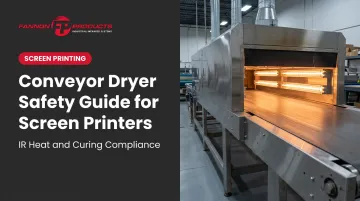
Conveyor dryers run at 300°F–400°F, operate for hours at a stretch, and sit in workspaces where flammable inks, solvents, and aerosol adhesives are within arm's reach. That combination doesn't make them inherently dangerous — but it does mean casual familiarity isn't enough. The layered risks (thermal, electrical, chemical, mechanical) each require deliberate habits, not just a one-time setup check.
This guide covers what you need to know: from installation and PPE to daily operating rules and the maintenance mistakes that turn routine production into a safety incident.
Key Takeaways
- Never activate the heating element with a stationary belt — this can damage the belt and ignite nearby materials.
- Keep flammable materials (aerosols, open ink containers, scrap fabric) away from the dryer at all times.
- Run active exhaust ventilation when curing plastisol, discharge, or water-based inks — it's a requirement, not a preference.
- Always run a 10-minute warm-up with the belt moving before loading garments.
- Replace worn infrared lamps with correctly specified parts — mismatched wattage causes hot spots and undercure.
- Pre-use inspection, PPE, and employee training are standard parts of every production run.
Conveyor Dryer Safety Guidelines for Screen Printers
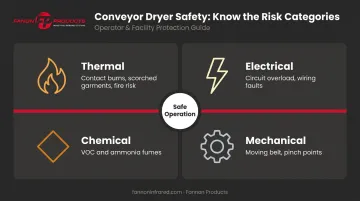
Conveyor dryer safety spans four overlapping risk categories:
- Thermal — contact burns, scorched garments, fire from radiated heat
- Electrical — circuit overload, wiring faults, improper extension cords
- Chemical — VOC and ammonia fumes released during ink curing
- Mechanical — moving belt, pinch points, snag hazards
No single precaution covers all four. Safe operation depends on correct setup, disciplined daily habits, and keeping the equipment in working condition — not just reading the startup instructions once.
General Safety Precautions
Personal protective equipment:
- Heat-resistant gloves for any garment handling near the exit end
- Closed-toe shoes — required wherever hot surfaces and moving equipment are present per OSHA 1910.136
- Eye protection when working near quartz tube heating elements, which can shatter
- No loose clothing or dangling items near the belt entry — these are both snag and burn hazards
Workspace clearance: The dryer needs clearance on all sides for heat dissipation — check your model's manual for the specific distance. The exit end area must be kept clear of fabric, paper, and any flammable materials that could ignite from radiated heat. OSHA's fire prevention rules explicitly require maintaining clearance around heating units to prevent ignition of combustibles.
Fire extinguisher placement: An ABC or Class C extinguisher should be within reach of the dryer before any issue arises. OSHA 1910.157 sets maximum travel distances to extinguishers — 75 feet for Class A hazards, 50 feet for Class B. More importantly, every employee working near the dryer should know where it is and how to use it.
Safety During Installation
Electrical setup is the highest-stakes installation step. Conveyor dryers typically require dedicated high-voltage circuits at specific amperage ratings — always verify your dryer's nameplate and manual. Per OSHA 1910.303(b)(2), listed equipment must be installed according to its listing or labeling. That means:
- Match the circuit to the dryer's specified voltage, phase, and amperage
- Do not share circuits with other equipment
- Never use household extension cords as a substitute for fixed wiring — OSHA 1910.305(g)(1)(iv) explicitly prohibits flexible cords as replacements for permanent wiring
- Have a licensed electrician verify the circuit and overcurrent protection before first use
Positioning: Place the dryer on a stable, level surface away from drafts — open garage doors, HVAC vents, and floor fans can disrupt the heat tunnel and cause inconsistent curing. Operators who compensate by cranking heat or slowing the belt to make up for airflow interference are creating scorching risks that wouldn't exist on a stable setup.
Ventilation confirmation: Before powering the dryer on for the first time, confirm that exhaust is directed away from the workspace or vented externally. Plastisol inks release VOCs during curing; inadequate exhaust exposes operators to those fumes directly.
Safety While Operating the Conveyor Dryer
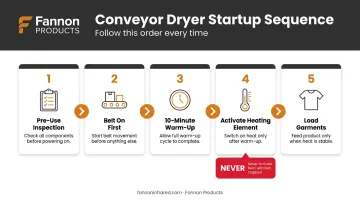
The single most critical operating rule: never activate the heating element with the belt stopped. Both the RileyCure and RC17-6500 manufacturer manuals explicitly state this. Concentrated infrared heat on a stationary belt can scorch or melt it, damage garments, and in worst cases ignite nearby materials. The correct startup sequence is always belt on first, then heat.
Temperature and belt speed are interdependent. Running the belt too slowly risks scorching and ink overheating — especially with infrared. Running it too fast risks undercure, which has both quality and safety implications (uncured plastisol contains residual solvents). Verify settings for each fabric type and ink system, and document them rather than guessing each run.
Fume management during production:
- Curing plastisol inks releases VOCs — the EPA classifies organic printing solvents as potential VOCs or hazardous air pollutants
- Discharge inks release ammonia — NIOSH sets the ammonia REL at 25 ppm TWA / 35 ppm short-term; OSHA's PEL is 50 ppm TWA
- Water-based inks produce steam and chemical vapor
An open window is not an adequate control. NIOSH recommends local exhaust ventilation — source capture — because it removes contaminants before they mix with workroom air. Position exhaust to pull fumes away from the operator's breathing zone.
Garment handling at the exit end: Use heat-resistant gloves, or allow garments to travel fully off the belt before handling. The belt and exit area reach temperatures that cause immediate contact burns. Never reach across an active belt.
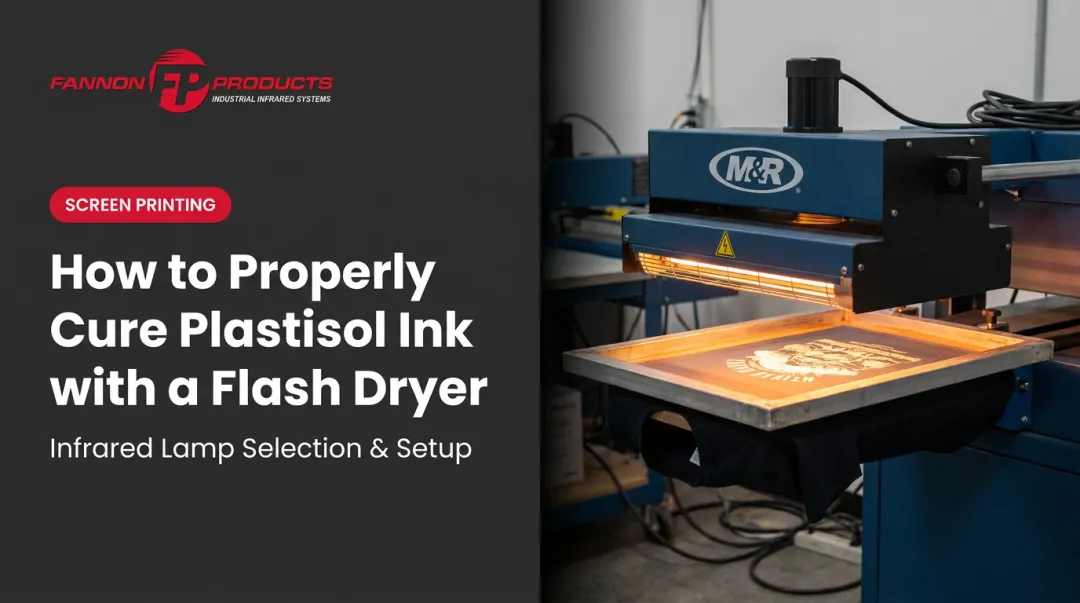
Infrared lamp condition directly affects safety. Worn or damaged lamps produce uneven heat distribution — hot spots that can scorch garments, cold zones that leave ink undercured. Inspect lamps regularly and replace them promptly using correctly specified parts.
Substituting a wrong-wattage or incompatible lamp doesn't just affect print quality; it changes the heat distribution the system was designed around. Fannon Products stocks replacement infrared lamps across a wide range of wattages, voltages, and lengths — including direct-fit replacements for M&R flash dryers — so you can maintain exact specifications without resorting to substitutes.
Environmental and System Safety Considerations
Shop humidity affects how you set the dryer. High ambient moisture means garments retain more water, which requires longer dwell times or higher temperatures to achieve full cure. Operators who compensate by improvising — cranking heat or drastically slowing the belt without documenting it — create scorching risks. Use a hygrometer to track humidity and document adjusted settings for consistent, repeatable results.
Equipment proximity creates compounding risks. Flash cure units, presses, and aerosol adhesives near the dryer interact badly with each other:
- Federal hazardous substance regulations require aerosol containers to warn against exposure to temperatures above 120°F — well below what a dryer's exhaust produces
- In 2001, an OSHA-documented screen printing incident involved a spray adhesive can exploding near a heat source, resulting in burns to the arms and face and a 10-day hospitalization
- Aerosol cans should never be stored on, above, or immediately adjacent to a running dryer
- Spray adhesive applications should happen away from the dryer's heat exhaust
When to Stop and Inspect
Pause production and shut down if you notice any of the following:
- Loss of ventilation in the shop
- Burning smell or smoke beyond normal startup off-gassing
- Unexpected belt slowdown or stoppage
These aren't inconveniences — they're warning signs. Don't resume until you've identified the cause.
Common Safety Mistakes to Avoid
Skipping the Warm-Up and Pre-Use Inspection
Many printers power on the dryer and immediately start loading. The correct approach is a 10-minute warm-up with the belt running — this allows the system to reach stable operating temperature and gives operators time to catch unusual odors, sounds, or smoke before garments enter the heating chamber.
Inspection during warm-up should cover:
- Belt movement (smooth, centered, no fraying)
- Unusual sounds from the motor or heating elements
- Any smoke or smell beyond normal initial off-gassing
- Heating element visibility (look for dark spots or visible damage to lamps)
Assuming "No Incidents" Means "No Hazards"
Conveyor dryers are high-duty-cycle equipment. Components degrade gradually — and operators who rely on familiarity rather than periodic inspection routinely miss early warning signs:
- Uneven curing zones — a sign of failing or mismatched infrared lamps
- Fraying belt edges — a mechanical and fire hazard
- Loosened electrical connections — vibration over time works fittings loose
A wrong-wattage replacement lamp changes how heat distributes across the heating chamber — creating hot spots that damage garments and cold zones that fail to cure ink. Fannon Products' direct-fit replacement inventory is cross-referenced to OEM part numbers with exact wattage, voltage, and length specifications, which prevents the substitution errors behind most of these problems.
Placing Flammable Materials Near the Dryer
This one has documented consequences. A 2018 OSHA incident record describes a screen printing employee sustaining burns when a flammable aerosol screen opener caused a vapor flash during screen cleaning. Aerosol cans overheat, rupture, and ignite. Solvents flash. Paper positives catch.
Keep clear of the dryer:
- Aerosol spray adhesives and screen openers
- Open ink containers
- Scrap fabric and paper film positives
- Any pressurized or solvent-containing container
Failing to Train New Employees Before They Work Near the Dryer
An employee who's been shown how to load garments — but not told about burn zones, fume hazards, or where the emergency shutoff is — will bypass safety steps under production pressure. Before any new employee works near the dryer, cover:
- The dryer's heat zones and why the exit end is high-risk
- Location of the emergency shutoff and fire extinguisher
- PPE requirements for their specific role
- The belt-before-heat rule and why it matters
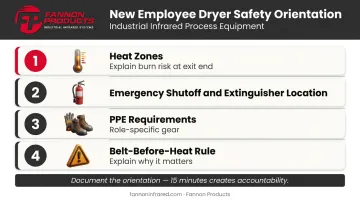
Document the orientation. It takes 15 minutes and creates accountability.
Conclusion
Incidents on conveyor dryers rarely come from a single failure — they come from gaps across multiple areas. All three of these have to be in place:
- Initial setup: correct electrical circuit, ventilation, and machine positioning
- Daily operating habits: proper warm-up, PPE use, and never stopping the belt under heat
- Ongoing maintenance: lamp condition checks, belt inspections, and temperature verification
A gap in any one of them is where things go wrong.
Treat the safety checklist as a standard part of production workflow, not a pause in it. If a lamp starts running hotter than calibrated, or a belt shows uneven wear, those are the moments the checklist catches problems before they become stoppages — or worse.
Frequently Asked Questions
What temperature does a conveyor dryer reach, and how can I avoid burns?
Most screen printing conveyor dryers operate between 300°F and 400°F. The heating chamber and exit end are the highest burn-risk zones. Use heat-resistant gloves when handling garments near the exit, and allow garments to fully clear the belt before touching them.
Do conveyor dryers produce harmful fumes?
Yes. Curing plastisol releases VOCs, discharge inks release ammonia, and all inks produce vapor at cure temperatures. Active exhaust ventilation is required, directed away from the workspace. An open window doesn't provide adequate source capture.
What PPE should screen printers wear when operating a conveyor dryer?
Heat-resistant gloves for handling near the exit zone, closed-toe shoes, and eye protection when working near quartz tube heating elements. Loose clothing and dangling accessories near the belt entry are both snag and burn hazards.
Can I leave a conveyor dryer running unattended?
No. If the belt stops or a garment jams while the heating element is active and no one is present, the fire risk is significant. Power the dryer down completely if no one will be in the shop.
How do I know when to replace the infrared lamps or heating elements?
Signs include uneven curing zones, cold spots on the belt, longer required dwell times, and visible damage to the lamp or quartz tube. Always replace with lamps that match the original wattage, voltage, and physical dimensions. Mismatched specs alter heat distribution and introduce new hazards.
What electrical requirements should I check before installing a conveyor dryer?
OSHA prohibits using flexible extension cords as substitutes for fixed wiring. Verify that the circuit matches your dryer's nameplate voltage and amperage rating, and confirm proper overcurrent protection. Have a licensed electrician verify the installation before first use.