Introduction
Infrared heat lamps have been quietly doing serious work across physical therapy clinics, restaurant kitchens, and automotive paint shops for decades. What's changed is a surge of consumer interest in drug-free pain management — and with it, a flood of competing products that are often mislabeled or misunderstood.
Many people lump infrared heat lamps together with red light therapy panels or infrared saunas, treating them as interchangeable. They're not.
Infrared heat lamps work through radiant thermal energy: heat that penetrates below the skin surface rather than simply warming the surrounding air. That distinction matters whether you're evaluating health applications or specifying industrial heating equipment.
This article breaks down what the research actually supports, where infrared heat lamps are genuinely useful, and what separates effective use from wasted energy — whether you're managing a physical therapy practice, running a commercial kitchen, or sourcing industrial heating equipment.
Key Takeaways
- Infrared heat lamps deliver radiant energy that penetrates tissue, promoting circulation, reducing inflammation, and supporting recovery
- Clinical evidence is strongest for chronic pain relief and post-exercise muscle soreness — a 2023 study found 55–60% less soreness and strength recovery up to 3 days faster than untreated controls
- Industrial applications span food service, automotive paint curing, plastics processing, screen printing, and agricultural brooding
- Safe use requires correct distance, session duration, and matching the right lamp type to the application
What Is an Infrared Heat Lamp?
An infrared heat lamp is a radiant heating device that emits energy your body experiences as heat — but unlike a space heater warming the surrounding air, it delivers that energy directly to surfaces and tissues through radiation. According to ICNIRP, infrared radiation spans 780 nm to 1000 µm, divided into three bands:
| Band | Wavelength Range | Penetration Depth |
|---|---|---|
| IR-A (Near-infrared) | 780 nm – 1.4 µm | Several millimeters into skin |
| IR-B (Mid-infrared) | 1.4 – 3 µm | Moderate skin penetration |
| IR-C (Far-infrared) | 3 µm – 1 mm | Superficial absorption |
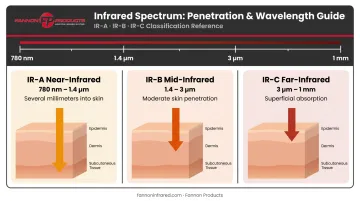
Near-infrared reaches deeper tissues; far-infrared is absorbed closer to the surface. Lamp selection — wattage, wavelength, and fixture design — determines the depth of effect you actually get.
Common infrared lamp designs each serve different applications:
- Short-wave quartz lamps — instant response, high color temperature; suited for precision industrial curing
- Medium-wave lamps — cost-effective with longer lamp life; ideal for sustained process heating
- Twin-tube configurations — designed for direct replacement in existing industrial equipment
Key Health Benefits of Infrared Heat Lamps
Infrared heat's therapeutic effects trace back to one core mechanism: penetrating tissues to raise local temperature, dilate blood vessels, and trigger cellular repair. That mechanism has been studied across pain management, sports recovery, and rehabilitation settings — with varying quality of evidence.
Pain Relief and Improved Circulation
When infrared heat warms tissue locally, blood vessels dilate and endothelial nitric oxide synthase produces nitric oxide — a vasodilator that increases blood flow to the area. The result: more oxygen and nutrients reach injured or inflamed tissue, and metabolic waste clears faster.
That physiological mechanism underlies infrared therapy's use in joint pain, lower back pain, and arthritis treatment.
The clinical evidence is real, though not always lamp-specific. A 2006 randomized controlled trial in 39 chronic low-back-pain patients found infrared therapy (800–1200 nm) reduced mean pain scores from 6.9 to 3.0, compared to a drop from 7.4 to 6.0 in the placebo group. The device used was a portable infrared wrap, not a standalone lamp — but the thermal mechanism is consistent with lamp-based therapy.
A 2022 systematic review covering IR for osteoarthritis, fibromyalgia, lower back pain, and sports injury reported mixed but promising findings. For knee osteoarthritis, one included study showed 12.5% pain improvement after one week and 25% after four weeks, though other studies in the same review found no significant effect.
Who benefits most: Individuals with arthritis, chronic joint stiffness, or soft tissue injuries — and physical therapy or rehabilitation settings where targeted heat application is part of an ongoing treatment protocol.
Muscle Recovery and Tissue Repair
Far-infrared lamp therapy has produced some of the most compelling lamp-specific recovery data to date. A 2023 PubMed-indexed study used FIR lamps (8–14 µm, 30-minute sessions) after eccentric exercise in healthy sedentary women. The results:
- Muscle soreness attenuated by 55–60%
- Peak plasma creatine kinase reduced by 45–89%
- Muscle strength returned to baseline by 72 hours in the FIR group vs. remaining 17–19% below baseline at 120 hours in the sham group
- Overall strength and proprioception recovery was 1–3 days faster
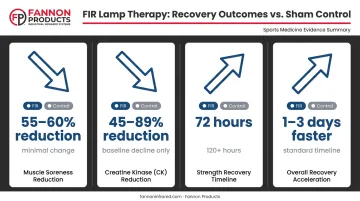
For coaches and sports medicine practitioners weighing practical recovery tools, a 1–3 day acceleration in return-to-strength is a measurable operational advantage.
Who benefits most: Athletes managing training loads, physically active individuals dealing with delayed onset muscle soreness, and post-injury or post-surgical rehabilitation patients. Also relevant in occupational settings with repetitive strain exposure.
Relaxation and General Wellness
Beyond acute recovery, infrared heat also serves a broader comfort function. Raising core tissue temperature prompts muscle relaxation and mild perspiration — effects that parallel sauna use — and the 2022 musculoskeletal review identified fibromyalgia as a condition where IR therapy shows potential for reducing pain and discomfort.
That said, claims around detoxification through sweat and mood improvement from infrared heat lamps specifically lack strong lamp-focused clinical backing. The relaxation effects are real, but infrared heat works best as a complementary tool for managing chronic muscle tension and fatigue — not a standalone treatment for serious conditions.
Who benefits most: People managing chronic stress, muscle tightness, or fatigue — and practitioners seeking non-pharmacological adjuncts to conventional therapy.
Infrared Heat Lamp Uses Across Industries
Beyond personal health, infrared heat lamps are workhorses in commercial and industrial settings. Their ability to deliver precise, directional radiant heat — without wasting energy heating surrounding air — makes them more efficient than convection methods in many process-driven applications.
Food Service and Comfort Heating
In restaurants, stadium concessions, and outdoor dining areas, infrared heat lamps serve two related functions: keeping prepared food at safe holding temperatures and keeping patrons comfortable.
On the food safety side, the FDA Food Code 2022 requires hot-holding of temperature-controlled-for-safety (TCS) foods at 135°F (57°C) or above. Infrared heat lamps provide the directional radiant heat needed to maintain those temperatures at serving stations without drying out food the way convection warming can.
For comfort heating in outdoor or semi-enclosed spaces, infrared heat lamps heat people and objects directly rather than heating the air — a practical advantage in drafty environments where air heating is inefficient and uncomfortable.
Automotive and Manufacturing
Infrared lamps have transformed automotive refinishing. Axalta reports that infrared cure equipment accelerates cure rates and reduces wait time between procedures, improving overall refinish productivity. IR curing times are now published in the technical data sheets for Axalta, BASF, PPG, and Sherwin-Williams paint systems.
The advantages extend to other manufacturing processes:
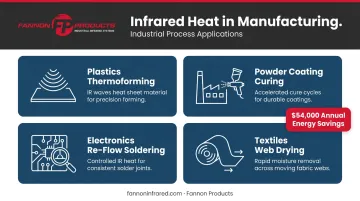
- Plastics: IR heating of thermoplastic sheets for thermoforming reduces cycle times compared to convection oven methods
- Powder coating: A DOE case study reported an IR curing oven yielded annual energy savings of approximately $54,000 over conventional gas-fired curing
- Electronics: Re-flow soldering, water dry-off, and silk screening benefit from infrared's precise, instant-response heat delivery
- Textiles: Web drying and finishing operations use IR to reduce process time
Agriculture and Printing
Infrared heat lamps are standard equipment in poultry and swine production:
- Poultry brooding: Penn State Extension recommends 95°F at chick level during the first week; University of Minnesota Extension notes a single 250-watt lamp typically covers 80 chicks at 50°F ambient
- Swine production: NC State Extension cites an ideal floor mat temperature of 95°F for newly weaned pigs — achievable with targeted infrared heat sources
In screen printing, infrared flash dryers gel plastisol ink between passes in multicolor runs. Medium-wave infrared is well-suited here because it's less color-sensitive to light and dark inks — consistent curing across different ink types without manual adjustments.
Across all of these applications, sourcing the right lamp specification matters. Fannon Products, based in Algonac, Michigan, has supplied infrared lamps to industries from food service and automotive to agriculture and printing for nearly 70 years. Their catalog includes direct replacements for Heidelberg printing presses, M&R flash dryers, Solaira and Fostoria comfort heaters, and inkjet drying systems — across every standard size, wattage, and voltage — as well as custom-designed heating solutions for process-specific requirements.
Using Infrared Heat Lamps Safely and Effectively
Safe Use for Health Applications
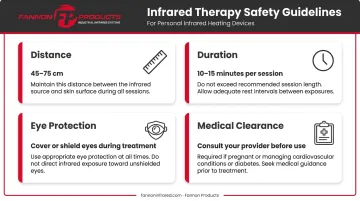
Clinical review guidance is more conservative than many consumer lamp manuals suggest. A 2022 musculoskeletal IR review recommends:
- Distance: 45–75 cm from the body
- Duration: 10–15 minutes per session
- Eye protection: Cover or shield eyes during treatment
- Medical clearance: Consult a healthcare provider if pregnant or managing cardiovascular conditions, diabetes, or other serious health issues
The ICNIRP notes that infrared harm is primarily thermal injury — and that irreversible skin damage can result from either extended lower-heat exposure or brief high-heat exposure. Erythema ab igne (a rash from chronic heat exposure below burn threshold) is a real risk with poorly managed repeat sessions.
Lamp Selection Matters
Using the wrong lamp for a given application produces poor results and creates unnecessary risk. Key selection variables:
- Wattage and distance — determines heat intensity at the target surface
- Wavelength (short, medium, or far-infrared) — determines penetration depth and application suitability
- Fixture design — affects heat distribution, directionality, and whether energy reaches the target or heats surrounding equipment
These variables matter in health therapy settings, but the stakes scale up considerably in industrial environments. Automotive paint curing, poultry brooding, and inkjet drying each require distinct specifications — wattage, wavelength, and fixture geometry all shift depending on the process. Working with an experienced manufacturer, rather than defaulting to whatever lamp fits the socket, ensures the right output for the application.
Structured Sessions Yield Better Outcomes
For health therapy, sporadic use limits outcomes. The 2023 recovery study used structured sessions at defined post-exercise intervals — not occasional ad hoc treatment. Regular, disciplined use compounds benefits. Tracking progress between sessions helps users and practitioners determine whether adjustments are warranted. Useful metrics to monitor include:
- Pain levels before and after each session
- Recovery times compared to untreated baseline
- Range of motion or functional improvement over weeks
Frequently Asked Questions
What is an infrared heat lamp good for?
For health purposes, infrared heat lamps relieve pain, improve circulation, and support muscle recovery. For commercial and industrial use, they serve food warming, automotive paint curing, plastics processing, screen printing, agricultural brooding, and comfort heating — anywhere precise, directional radiant heat outperforms convection methods.
How deep does infrared heat penetrate the body?
Near-infrared (IR-A) penetrates several millimeters into skin, reaching underlying muscle tissue. Far-infrared (IR-C) is absorbed more superficially at the skin surface. That depth difference is what makes infrared heat more therapeutically useful than surface-level heat methods like heating pads.
Are infrared heat lamps safe to use at home?
Generally yes, when used correctly. Maintain 45–75 cm distance from the lamp, limit sessions to 10–15 minutes, keep eyes protected, and avoid use if you have cardiovascular conditions, are pregnant, or have other serious health concerns without first consulting your doctor.
How long should you use an infrared heat lamp in a single session?
Clinical review evidence supports 10–15 minutes for therapeutic lamp sessions at the recommended distances. Manufacturer manuals may vary. Exceeding appropriate durations without proper heat management raises the risk of thermal discomfort, skin irritation, or erythema ab igne with repeated overexposure.
What is the difference between an infrared heat lamp and red light therapy?
Infrared heat lamps work through thermal (heat) energy across a broad infrared spectrum. Red light therapy devices use specific narrow wavelengths (roughly 600–880 nm) at low power for photobiomodulation, a non-thermal mechanism involving cellular chromophores. The two operate on different principles and serve different purposes.
Can infrared heat lamps help with arthritis or joint pain?
Yes, with appropriate expectations. Infrared heat promotes blood flow, reduces stiffness, and eases inflammation, and it appears in musculoskeletal IR research covering osteoarthritis and related conditions. Evidence is mixed across specific conditions, so consult your healthcare provider before starting sessions.