For at-home users, the difference often comes down to speed and convenience. For salon professionals, it compounds across every client, every day. Getting it wrong leads to under-cured nails, premature lifting, or recurring costs that add up faster than expected.
This guide breaks down exactly how each lamp works, where each one excels, and which is the better choice for your specific situation.
Key Takeaways
- Both lamp types cure gel by activating photoinitiators with UVA light; neither qualifies as truly "non-UV"
- LED emits a narrower, targeted wavelength that cures modern gel formulas in 30–60 seconds, compared to ~2 minutes for UV
- UV bulbs need replacing every 6 months; LED diodes can last up to 50,000 hours
- LED is the current industry standard for most gel polishes; UV remains relevant for older formulas
- Dual UV/LED lamps solve the compatibility problem for professionals working across multiple brands
UV vs. LED Nail Lamps: Quick Comparison
Here's how UV and LED nail lamps stack up across the factors that matter most.
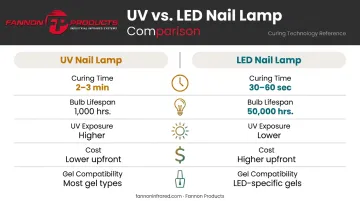
| Feature | UV Nail Lamp | LED Nail Lamp |
|---|---|---|
| Curing Time | ~2 minutes per coat | 30–60 seconds per coat |
| Bulb Lifespan | ~1,000 hours; replace every 6 months | Up to 50,000 hours; rarely needs replacement |
| UV Exposure Per Session | Broader wavelength; longer time under light | Narrower wavelength; shorter total exposure per session |
| Cost | Lower upfront (~$30–$50); recurring bulb replacement costs | Higher upfront ($40–$320+); minimal long-term maintenance |
| Gel Compatibility | Compatible with traditional/older gel formulas | Optimized for modern gel polishes; dual lamps cure both |
What Is a UV Nail Lamp?
UV nail lamps use fluorescent tubes to emit a broad spectrum of ultraviolet light — typically 320–400 nm — that triggers polymerization in gel polish photoinitiators. This is the older of the two technologies, widely used in salons before LED became standard.
According to NAILS Magazine, traditional UV nail lamps are essentially compact fluorescent lights (UV CFL) — the same basic technology as fluorescent bulbs, adapted for nail curing.
The core operational limitations:
- Cure times run ~2 minutes per coat, so a full manicure requires 8+ minutes of lamp time
- Fluorescent UV bulbs lose curing output gradually and need scheduled replacement to avoid under-curing — even when they still appear lit
- Bulb replacement adds up: NailKnowledge recommends swapping them roughly three times per year; Mylee suggests every six months
Where UV Lamps Still Make Sense
UV lamps remain useful in specific situations:
- Some traditional gel polishes specify UV-only curing and haven't been reformulated for LED compatibility
- If you already own a UV lamp with gel inventory to use up, there's no reason to replace it immediately
- Entry-level UV lamps start around $30–$50, which undercuts most LED options at $40+
Understanding these trade-offs helps clarify where LED technology changed the equation — and where it didn't.
What Is an LED Nail Lamp?
LED nail lamps use light-emitting diodes to produce a narrow, targeted UVA wavelength, calibrated specifically to match the absorption range of modern gel polish photoinitiators. Most gels respond to wavelengths between 340–380 nm; LED lamps deliver exactly that range without the excess.
This precision is the core advantage. Instead of a broad UV spectrum where only some wavelengths are useful, LED delivers what the gel actually needs.
Why Wattage Is the Wrong Metric
NailKnowledge states explicitly that wattage measures electrical power consumption — not UV intensity or curing ability. A well-designed LED lamp with efficient diode placement and a reflective interior can cure more thoroughly than a higher-wattage lamp with poor geometry.
NAILS Magazine reinforces this: bulb distance from the gel and lamp geometry affect cure quality as much as power output. Reflector design can eliminate 15–20 minutes from a traditional UV salon service — not because of raw wattage, but because of how efficiently the light reaches the nail.
LED Operational Advantages
- Cures in 30–60 seconds per coat (CND Shellac: 1 min in LED vs. 2 min in UV; OPI GelColor: 30 sec in LED)
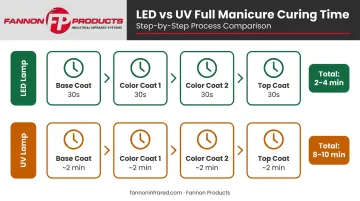
- Full manicure totals ~2–4 minutes with LED vs. 8+ minutes with UV (base + 2 color coats + top coat)
- Lasts up to 50,000 hours; most users never replace the bulbs
- Smaller footprint and lower power draw than most UV equivalents
Use Cases for LED
Best fit for:
- At-home kits using modern gel polish formulas
- Professional salons reducing per-client appointment time
- Any setting where long-term reliability matters more than upfront cost
If compatibility across gel brands is a concern, dual UV/LED lamps solve the problem. They emit both wavelengths, curing older traditional formulas and modern LED-optimized polishes in one unit — eliminating the need for two separate lamps entirely.
UV vs. LED Nail Lamps: Which One Is Better?
The honest answer: it depends on your gel polish. But for most people using modern formulas, LED wins on nearly every practical metric.
Speed in Real Terms
A full manicure with LED (base + 2 color coats + top coat) takes roughly 2–4 minutes of curing time. The same manicure with UV takes 8–10 minutes. For a home user, that's a minor convenience. For a salon running 8–10 clients per day, saving 6+ minutes per client translates to meaningful throughput gains — the equivalent of fitting in additional appointments without extending hours.
Safety: Clearing Up the Confusion
Both UV and LED nail lamps emit UVA radiation. LED lamps are not "non-UV" — they're UV devices with a narrower output range and shorter exposure time per session.
Harvard Health summarizes the medical guidance clearly: a gel manicure every two weeks is unlikely to deliver enough UVA exposure to significantly increase skin cancer risk, based on 2014 JAMA Dermatology data measuring 17 nail lamps. The American Academy of Dermatology recommends practical precautions regardless of lamp type:
- Apply broad-spectrum SPF 30+ to hands before curing
- Use dark opaque fingerless gloves if you have photosensitivity concerns
LED's faster cure times mean shorter total UV exposure per session — a concrete reduction that compounds across frequent use.
Long-Term Cost: The Real Comparison
| UV Lamp | LED Lamp | |
|---|---|---|
| Entry-level price | ~$30–$50 | ~$40 (OPI GELement: $39.99) |
| Professional price | Lower | $192–$320+ (CND LED Lamp) |
| Replacement bulbs | $4.45–$19.95 per bulb | None needed |
| Replacement frequency | ~3x per year | Rarely, if ever |
| 2-year bulb cost (estimate) | $106–$214+ | $0 |
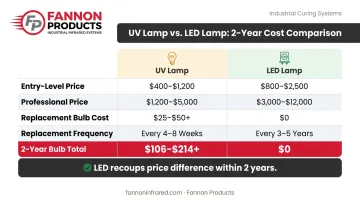
A UV lamp's lower sticker price flips quickly once bulb replacement cycles are factored in. By year two, most LED lamp owners have already recouped the price difference — and bulb costs continue to zero from there.
Situational Recommendations
- Choose UV if your gel polishes specify UV-only curing, or if minimizing upfront cost is the overriding priority
- Choose LED for modern gel formulas, faster curing, and minimal long-term maintenance
- Choose dual UV/LED if you're a professional working across multiple gel brands that require different curing spectrums
Match the lamp to your formula first — speed, cost, and safety considerations all follow from that decision.
Conclusion
For most industrial applications today, LED UV curing is the stronger choice. It reaches operating intensity instantly, runs cooler than traditional UV mercury lamps, and delivers a longer service life — all of which reduce downtime on production lines where consistency matters.
Traditional UV mercury systems aren't obsolete. They remain practical for operations already built around them, particularly where the substrate or chemistry hasn't been qualified for LED wavelengths. Some industrial inks and coatings still cure more reliably under broadband UV output.
The right call depends on three factors:
- Substrate and chemistry compatibility — confirm your ink or coating is qualified for the lamp's output wavelength
- Production volume — higher throughput lines recover LED's upfront cost faster through energy savings and reduced lamp replacement
- Existing infrastructure — retrofitting a running line has different economics than specifying a new system from scratch
Matching the curing system to the process — not chasing the newer technology for its own sake — is what drives consistent output quality.
Frequently Asked Questions
Which is better — a UV lamp or a UV LED lamp?
LED lamps cure modern gel formulas faster (30–60 seconds vs. ~2 minutes per coat) and offer a far longer diode lifespan — up to 50,000 hours compared to ~1,000 for UV bulbs. Traditional UV lamps cure more slowly and need periodic bulb replacement, but stay compatible with older gel formulas not yet reformulated for LED.
Can you use an LED lamp to cure UV resin?
Some LED nail lamps can cure UV resin, but compatibility depends on the resin's specific photoinitiator formulation and whether the lamp's wavelength output matches. Always check the resin manufacturer's specifications before assuming an LED lamp will work — not all UV resins respond to the same wavelengths.
Do nail salons use UV or LED lamps?
Most modern nail salons have transitioned to LED lamps. Faster cure times reduce appointment length, and the longer diode lifespan lowers maintenance costs, both of which improve salon efficiency and throughput directly.
Is it safe to use a nail curing lamp regularly?
Both UV and LED nail lamps emit low levels of UVA radiation, and research indicates exposure during normal manicure use is minimal compared to tanning beds or extended sun exposure. Applying broad-spectrum SPF 30+ to hands before curing is a simple precaution recommended by the American Academy of Dermatology.
Does wattage determine how well a nail lamp cures?
No. Wattage measures electricity consumption, not curing effectiveness. A well-designed lower-wattage LED lamp with efficient diode placement and a reflective interior can deliver a more thorough, even cure than a higher-wattage lamp with poor design. Lamp geometry and wavelength output matter more than raw power.