Traditional boiler-based heating systems are increasingly being replaced or supplemented by industrial heat pump systems — and this shift is accelerating. According to the IEA, heat pumps are 3 to 5 times more energy efficient than natural gas boilers, a performance gap that has become impossible to ignore as fuel costs fluctuate and carbon regulations tighten.
But installing a heat pump is only the starting point. What separates a facility that captures real ROI from one that just replaces equipment is optimization — how the system is sized, zoned, integrated with other heating assets, and maintained over time.
This guide covers the key areas that determine whether a heat pump system actually performs in a food production environment: sizing and zoning, temperature and humidity control, integration with supplemental process heating, waste heat recovery, and maintenance for compliance.
Key Takeaways
- Food processing heat pumps must handle both ambient climate control and direct process heating simultaneously
- Zoning by temperature requirement and contamination risk is essential for energy efficiency and food safety
- Waste heat from refrigeration and cooking cycles can be captured and redirected to process heating applications
- Infrared heating supplements heat pumps for process steps requiring precise, localized heat delivery
- Smart controls and preventive maintenance keep food safety compliance on track year-round
Why Food Processing Facilities Are Adopting Heat Pump Systems
The Business Case Is Strengthening
Three converging pressures are driving adoption: fuel cost volatility, tightening carbon regulations, and the limitations of legacy boiler systems:
- Fuel cost volatility: Natural gas prices fluctuate sharply, making long-term production cost modeling unreliable
- Carbon regulations: Tightening emissions standards are pushing facilities toward lower-carbon alternatives
- Legacy boiler limitations: Aging boiler infrastructure lacks the controls integration modern compliance and efficiency demands require
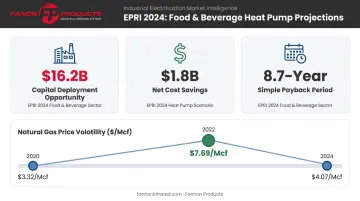
U.S. industrial natural gas prices swung from $3.32/Mcf in 2020 to $7.69/Mcf in 2022, before easing to $4.07/Mcf in 2024, according to EIA data. That kind of volatility makes long-term production cost modeling difficult — and exposure to it a liability.
Heat pump systems, powered by electricity, reduce that direct exposure. Their COP-based efficiency (ranging from 1.6 to 5.8 depending on temperature lift, per LBNL research) means every unit of electrical input delivers multiple units of useful heat.
On the regulatory side, FSMA preventive controls under 21 CFR Part 117 require facilities to document temperature control where it functions as a food safety preventive control. Heat pump systems with integrated building management platforms make that documentation straightforward. Boiler-based systems typically do not.
EPRI's 2024 food and beverage sector analysis projects $16.2 billion in capital deployment opportunity for industrial heat pumps in the sector, with $1.8 billion in net cost savings and an aggregate simple payback of 8.7 years — a horizon that rewards facilities willing to evaluate total cost of ownership rather than upfront capital alone.
Dual-Use Value in Food Production
Unlike conventional HVAC, industrial heat pumps can simultaneously handle space conditioning and supply process-grade heat for applications like pasteurization, drying, and sterilization. That dual-use capability makes them a different category of investment than a boiler or a rooftop unit — they're not just replacing a heating system, they're consolidating two operational functions into one.
Optimization, in this context, means coordinating system sizing, zone design, controls, and integration with refrigeration and supplemental heating assets already running in the facility. Equipment selection is the starting point — not the finish line.
Sizing and Zoning Heat Pump Systems for Food Production Environments
Why a Single-Zone Approach Fails
Food processing facilities operate across extreme temperature differentials in close proximity. A freezing and cold chain zone may sit 200 feet from a pasteurization or rendering area. A single-zone heat pump system cannot simultaneously maintain the conditions required in both — and attempting to force it to do so results in either under-conditioning in one area or energy waste in the other.
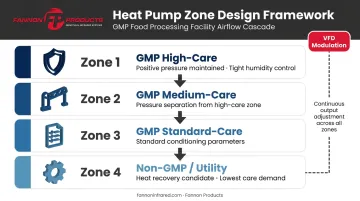
The AFDO/Dennis Group classification framework provides a practical starting point for zone design:
| Zone Type | Description | Heat Pump Design Priority |
|---|---|---|
| GMP High-Care | Exposed ready-to-eat finished product | Filtered positive pressure, tight humidity control |
| GMP Medium-Care | Production before a kill step | Pressure separation from high-care zones |
| GMP Standard-Care | Product not exposed | Standard conditioning with contamination barriers |
| Non-GMP/Utility | No production or storage | Basic HVAC, heat recovery candidate |
Each zone requires its own sizing analysis and pressure relationship design — not a shared setpoint.
Capacity Sizing Variables Specific to Food Facilities
Standard commercial HVAC sizing methods don't translate directly to food processing environments. The key variables that require explicit calculation include:
- Internal heat loads from processing equipment (ovens, pasteurizers, CIP systems)
- Moisture generation from hot-water sanitation washdowns, which can be enormous in volume
- Occupancy patterns that shift with production schedules
- Seasonal outdoor air enthalpy, which affects how much conditioning the incoming air requires
A commonly overlooked sizing requirement: process air handling units must be sized for peak sanitation purge cycles, not just steady-state production conditions. The moisture load during and immediately after a washdown can be multiples of the load during normal operation.
Modulation and Airflow Validation Tools
Variable-frequency drives on heat pump compressors and fans are not optional in food processing — they're essential. Production schedules change and seasonal demands shift. A system that can only cycle on/off will either overshoot setpoints or fall short of them. VFD benefits include:
- Continuous output modulation rather than binary on/off cycling
- Tighter setpoint control across fluctuating production loads
- Reduced mechanical wear, extending equipment service life
- Measurable energy savings during partial-load operation
Before installation, computational fluid dynamics (CFD) modeling has become a practical validation tool for sizing and airflow design. Engineering firms specializing in food facilities use CFD to confirm even airflow distribution before equipment is committed to a layout — catching design problems on screen rather than in the field is far less expensive.
Temperature and Humidity Optimization Strategies for Food Plants
The Two-Sided Risk
Humidity mismanagement creates problems in both directions. Too much moisture causes condensation on surfaces and products, which creates conditions favorable to Salmonella and Listeria biofilm formation — a direct food safety failure. Too little humidity causes product desiccation, texture changes, and shelf-life reduction.
ASHRAE's Standard 62.1 addendum ae establishes a 60°F indoor dew point limit and 65% RH maximum under specified mechanical cooling conditions. The facility's dew point must consistently stay below the temperature of the coldest exposed surface — otherwise condensation is inevitable regardless of what the thermostat reads.
Sensors, Controls, and Sanitation Purge Cycles
Real-time monitoring is the foundation of humidity optimization. Heat pump systems in food facilities should be paired with industrial-grade pressure, temperature, and humidity sensors distributed across all zones.
The accuracy gap between low-cost sensors and industrial-grade instruments directly affects energy consumption. A sensor that reads 2°F high will cause the system to condition more outside air than necessary.
The sanitation purge cycle is a design requirement that standard HVAC specifications routinely miss. After hot-water washdowns, facilities generate large volumes of saturated air that must be evacuated before production resumes. Key design requirements include:
- Configure a 100% outside air purge mode tied to the facility's PLC
- Set automatic activation at the end of each sanitation cycle
- Verify purge capacity is sufficient to clear peak post-washdown moisture loads
Facilities that skip this design step end up with lingering moisture conditions that affect both food safety and equipment performance.
Zoned Pressurization
Pressure relationships between zones are not a set-and-forget commissioning task. They require active management:
- Positive pressure in clean and ready-to-eat areas prevents contaminated air infiltration
- Negative pressure in raw ingredient and waste zones contains odors and particulates
- As filters load and belts wear, the supply and exhaust fan balance drifts — without active monitoring, what was compliant at commissioning is no longer compliant six months later
Pressurization drift is one cause of recurring condensation — but surface temperature is another. Insulating cold pipes and equipment surfaces is equally critical; facilities that skip this step will see condensation issues regardless of how well the heat pump system is tuned.
Integrating Heat Pumps with Supplemental Process Heating Technologies
Where Heat Pumps Have Limits
Heat pumps are well-suited for ambient conditioning and medium-grade process heat. Certain food processing steps — surface browning, targeted dehydration, pasteurization of individual product streams — require precise, localized radiant heat that a distributed HVAC system cannot efficiently deliver. Trying to achieve surface-level product heating by raising the ambient air temperature is energy-intensive and imprecise.
Hybrid system design solves this directly.
Infrared as a Complementary Technology
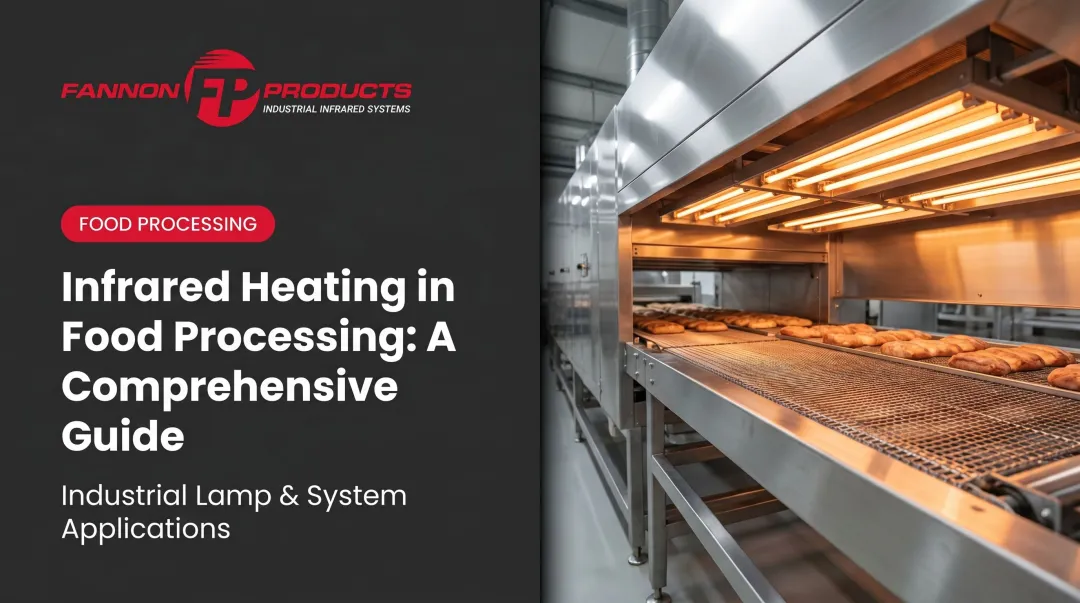
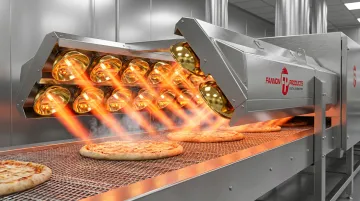
Infrared heating delivers energy directly to a product or surface without heating the surrounding air mass. The heat pump maintains ambient conditions; the infrared system handles product-level heating. That separation keeps each system operating within its efficient range — no energy wasted forcing one technology to do the other's job.
This combination is particularly effective for:
- Baking and browning — precise surface heat application for consistent caramelization or crust formation
- Dehydration — controlled moisture removal without overheating the surrounding environment
- Pasteurization — targeted thermal delivery that achieves required temperatures faster than convection-based methods
Fannon Products engineers and manufactures custom infrared systems for exactly these food processing applications. Their systems use proprietary Goldenrod lamps with integral 24K gold reflectors that direct virtually 100% of infrared energy to the target surface, achieving 96% radiant efficiency.
That instant on/off thermal response matters on a production line — the system heats and cools in seconds, giving the facility precise control over each product's heat exposure.
For a hybrid system to work efficiently, both the heat pump and infrared systems need to feed into a single control platform — a BMS or PLC-based system that can coordinate zone setpoints, production schedules, and sanitation cycles. Without that integration layer, the two systems will work against each other, creating energy waste and inconsistent product conditions.
Waste Heat as a Thermal Bridge
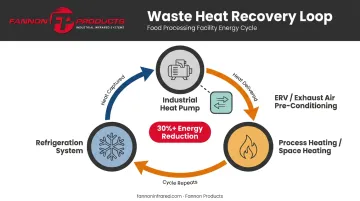
In facilities running both refrigeration and process heating, heat pumps can serve as the thermal bridge between the two. Heat pumps capture the waste heat rejected from the refrigeration cycle — heat that would otherwise vent to atmosphere — and upgrade it to usable process temperatures, reducing the load on supplemental infrared or resistance heating systems. This is one of the more underutilized efficiency opportunities in food processing facility design.
Leveraging Waste Heat Recovery for Maximum Efficiency
Refrigeration systems, cooking equipment, and pasteurizers all reject substantial heat as a byproduct of normal operation. In most food facilities, most facilities simply waste it. Industrial heat pumps are specifically designed to capture this low-grade waste heat and upgrade it to temperatures useful for sanitation water heating, space heating, or pre-conditioning incoming product streams.
An IIR case study of an integrated industrial dairy in Norway demonstrates this in practice — combining refrigeration heat rejection with process heating through an integrated heat pump system, reducing the facility's net energy consumption by over 30%.
Energy recovery ventilators (ERVs) complement this strategy. By capturing thermal energy from exhaust air and pre-conditioning incoming outside air, ERVs reduce the conditioning burden on the heat pump — a direct load reduction for facilities with mandated high outside-air ventilation rates.
One important caveat: ERVs should not be applied indiscriminately. Exhaust from raw ingredient zones, allergen areas, or post-sanitation exhaust streams should not be recirculated through an energy recovery device without careful contamination analysis.
The Financial Horizon
These efficiency gains form the foundation of the financial case — one that requires a longer horizon than conventional projects. Upfront costs are higher than conventional alternatives, so the financial case requires a longer evaluation window:
- Model total cost of ownership across 10–15 years, not just capital cost
- Factor in reduced fuel costs, lower carbon tax exposure for larger facilities, and reduced mechanical load on supplemental heating equipment
- EPRI's sector-level estimate of an 8.7-year aggregate simple payback provides a reasonable benchmark for initial project screening
Maintenance and Compliance Practices for Long-Term Heat Pump Performance
Why Food Processing Accelerates Wear
Food processing environments are harder on heat pump systems than typical industrial settings. Frequent hot-water and chemical sanitation, high sustained humidity, and airborne particulates — fats, proteins, starches — degrade filters, coils, and seals faster than manufacturer standard maintenance intervals account for.
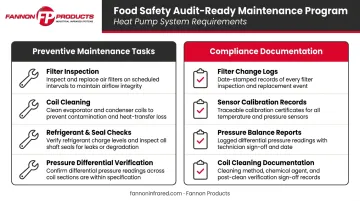
Preventive maintenance schedules must reflect the actual operating environment, not the equipment datasheet. In practice, this means:
- Filter inspection and replacement more frequently than standard intervals
- Coil cleaning on a schedule tied to the sanitation cycle intensity of each zone
- Refrigerant checks and seal inspections at a cadence appropriate to humidity exposure
- Pressure differential gauges on filters, with monthly verification that filters are functioning as designed
Compliance Documentation
Food safety audits under FSMA and FDA increasingly review HVAC and thermal system maintenance records. The records worth maintaining include:
- Filter change logs with dates and zone identification
- Sensor calibration records
- Pressure balance verification reports showing zone differential was checked and confirmed
- Coil cleaning documentation
Thorough documentation turns audit preparation into a routine task. Without it, auditors have no way to confirm that thermal controls were operational during the period under review — a gap that creates real compliance exposure.
Predictive Maintenance
Modern heat pump systems with integrated BMS platforms generate continuous performance data — energy consumption trends, compressor run hours, discharge temperatures. That data does more than confirm normal operation — it surfaces early signs of degradation before they become failures.
Establish baseline performance metrics at commissioning and monitor for drift over time. The most common culprits — refrigerant loss, fouled coils, and control system calibration drift — all show up as performance trends well before they cause failures. Common drift indicators include:
- Rising compressor run hours without corresponding load increases
- Discharge temperatures trending outside established baseline ranges
- Energy consumption increases inconsistent with production volume
Catching these patterns early avoids unplanned downtime and the food safety risks that come with thermal control failures.
Frequently Asked Questions
What temperature range can industrial heat pumps achieve for food processing applications?
Modern industrial heat pumps can achieve output temperatures up to approximately 180°F (82°C), making them suitable for pasteurization, sterilization, and sanitation water heating. For higher-temperature applications, a hybrid approach pairing heat pumps with supplemental heating is typically required, and a thermal audit of all process requirements should be the first step in system design.
Can heat pumps fully replace boilers in food processing facilities?
Heat pumps can replace boilers for process heat below 180°F in many applications. Above that threshold, a hybrid configuration is typically required. The replacement decision should be made facility by facility — a full boiler swap is rarely appropriate without first confirming every process heat load falls within range.
How do heat pumps integrate with existing refrigeration systems in food plants?
Heat pumps can be configured to recover waste heat rejected by refrigeration condensers and redirect it to space heating or process heating applications. This converts a heat rejection cost center into a usable energy asset, reducing the load on other heating systems throughout the facility.
What filtration standards are required for heat pump HVAC systems in food facilities?
Haskell recommends MERV 7 prefilters and MERV 15 or higher final filters for food process air handling units as engineering best practice (these are not FDA or USDA code requirements). Air change rates should be engineered based on product risk, moisture load, sanitation cycle intensity, and pressure cascade requirements rather than applying a single universal standard.
How often should heat pump systems in food processing facilities be serviced?
The harsh operating environment — moisture, particulates, and chemical sanitation — demands more frequent servicing than manufacturer standard intervals suggest. Facilities should work with their equipment provider to establish a preventive maintenance schedule tied to their specific production and sanitation cycle patterns.
What role do smart controls play in optimizing heat pump performance in food plants?
Integrated BMS and PLC-based controls allow heat pump systems to automatically respond to zone setpoint changes, production schedules, and sanitation purge cycles. This improves energy efficiency and maintains food safety conditions without constant manual adjustment; it also generates the performance data needed for predictive maintenance and compliance documentation.