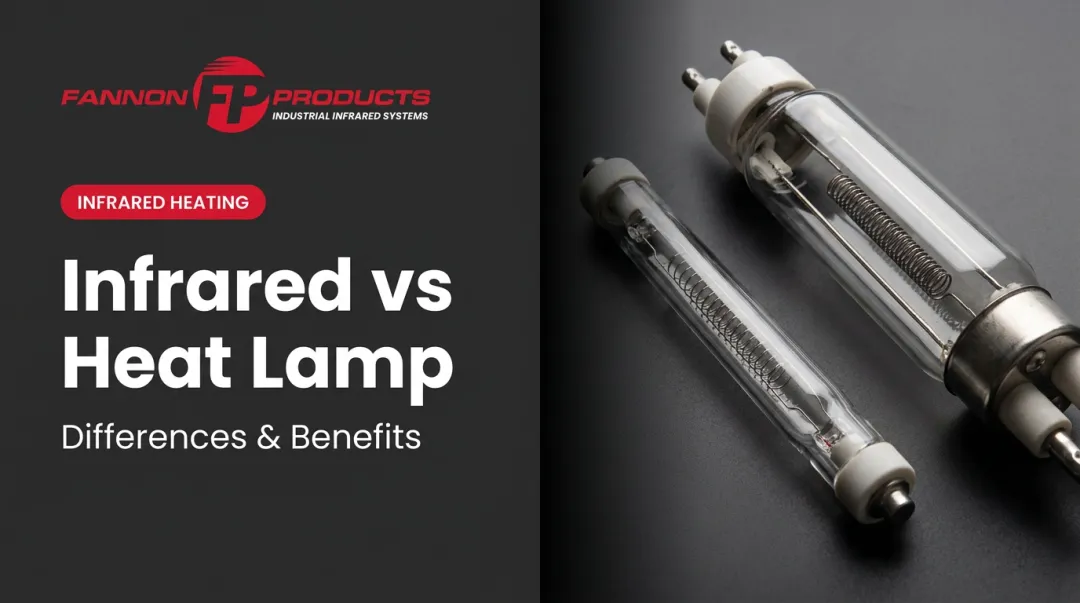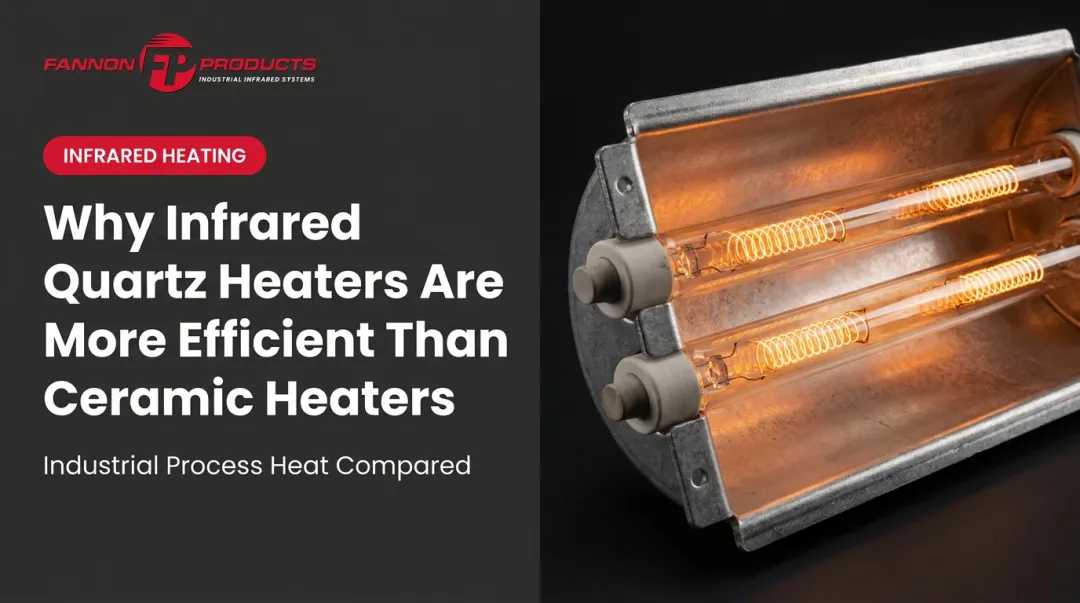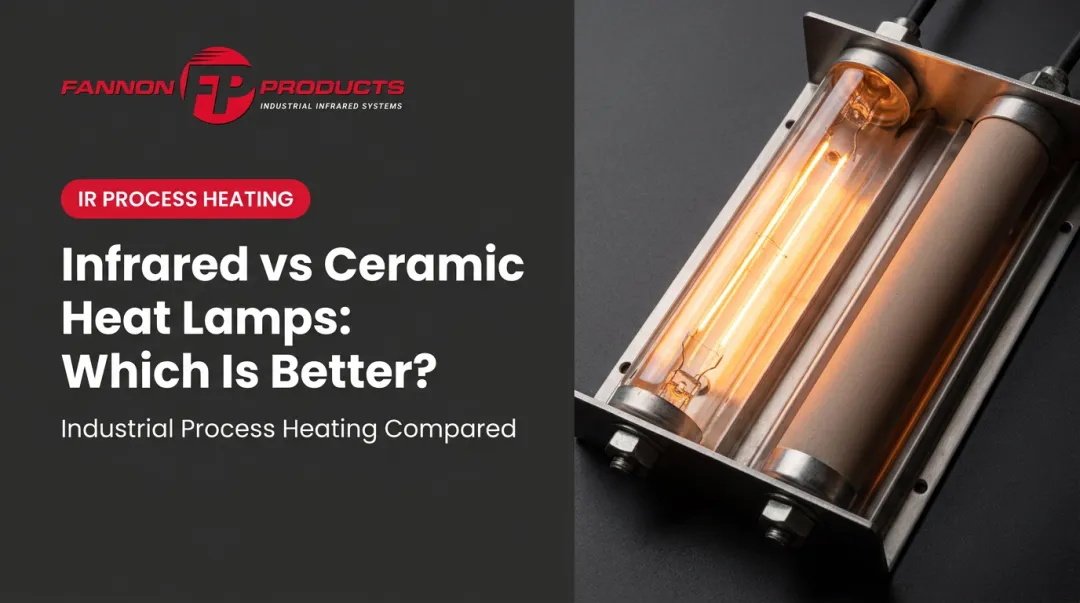
One important clarification before diving in: this comparison covers infrared heat lamps (short/medium-wave quartz or tungsten filament devices) versus ceramic heat lamps (long-wave IR-C emitters using a resistance wire in a ceramic body). This is not a comparison with ceramic space heaters, which use convection fans and are an entirely different technology.
Neither lamp type is universally better. The right choice depends entirely on your target material, process requirements, and wavelength match.
Key Takeaways
- Infrared heat lamps (IR-A/IR-B) respond in 1–2 seconds and excel at drying, curing, and precision industrial heating
- Ceramic lamps emit long-wave IR-C radiation (2–10 μm), produce no visible light, and suit ambient or light-sensitive warming
- Wavelength matching is the single most important selection factor — choose the lamp whose output the target material actually absorbs
- For speed and precision in industrial processes, infrared wins; for sustained low-intensity warming, ceramic is the better fit
- Match the lamp to the process — not to price or familiarity
Infrared vs Ceramic Heat Lamp: Quick Comparison
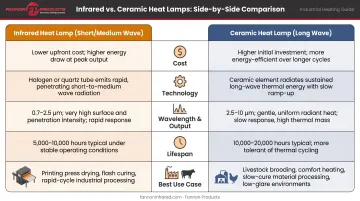
| Criterion | Infrared Heat Lamp (Short/Medium Wave) | Ceramic Heat Lamp (Long Wave) |
|---|---|---|
| Cost | Higher upfront (quartz/tungsten construction); lower operating cost when correctly matched | Lower purchase price; simpler resistance wire and ceramic construction |
| Technology | Tungsten or carbon filament in a quartz tube; filament temperatures 1,000–2,600°C depending on wave type | Coiled alloy resistance wire embedded in ceramic body; operates at 300–700°C |
| Wavelength & Output | IR-A (750 nm–1.4 μm) or IR-B (1.4–3 μm); high power density; visible light emitted at full intensity | IR-C (2–10 μm); gentle, diffuse radiant heat; no visible light output |
| Lifespan | 5,000–10,000+ hours depending on duty cycle and installation; frequent switching reduces life | Up to 20,000 hours under normal use; durable but vulnerable to physical shock |
| Best Use Case | Industrial drying, curing, thermoforming, automotive paint lines, printing ink drying | Animal husbandry, reptile enclosures, overnight warming, light-sensitive environments |
What Is an Infrared Heat Lamp?
Infrared heat lamps transfer energy directly to objects and surfaces through electromagnetic radiation — with no contact or air medium required. They're classified by emitted wavelength:
- IR-A (short wave): 750 nm–1.4 μm — highest intensity, fastest response
- IR-B (medium wave): 1.4–3 μm — slightly lower intensity, broader material absorption
- IR-C (long wave/far infrared): above 3 μm — lower intensity, overlaps with ceramic emitter range
Most industrial infrared heat lamps use a tungsten wire filament inside a sealed quartz tube. Short-wave lamps run at filament temperatures of 1,800–2,400°C; medium-wave lamps operate around 1,000–1,400°C. These temperature differences directly determine peak emission wavelength and response speed — as documented by Heraeus Noblelight, short-wave emitters achieve response times of approximately 1 second, while fast-response medium-wave emitters reach operating temperature in 1–2 seconds.
Why Wavelength Matching Determines Real Efficiency
Infrared energy only becomes usable process heat when the target material actually absorbs the emitted wavelength. A powerful lamp pointed at a material that's partially transparent to its wavelength is wasted energy.
Practical examples:
- Water and water-based coatings absorb most efficiently around 2.7–3.3 μm, placing them squarely in the medium-wave range
- PEEK and many polymers show strong absorption between 3 and 6 μm — a 2026 peer-reviewed study found that ceramic long-wave emitters reduced effective energy demand by about 18% compared to medium-wave quartz lamps for PEEK processing specifically because of that spectral alignment
- Metal surfaces vary significantly based on finish and oxidation — no single wavelength band universally dominates for metals
This is why two lamps with identical wattage ratings can produce dramatically different results on the same production line.
Industrial Use Cases
Infrared heat lamps dominate wherever fast response, precise control, and targeted heat delivery matter:
- Automotive paint curing (primer, color coat, clear coat, powder coat)
- Inline inkjet and offset printing ink drying
- Thermoforming and plastics processing
- Electronics re-flow soldering
- Textile web drying and finishing
- Food processing (baking, browning, dehydrating)
Fannon Products has supplied infrared lamp solutions across all of these sectors for nearly 70 years. That experience spans over 1,000 lamp configurations, including direct replacement lamps for Heidelberg printing presses, M&R flash dryers, HP 3D printers, and Solaira and Fostoria comfort heaters, as well as custom-engineered systems for automotive and plastics applications.
What Is a Ceramic Heat Lamp?
Ceramic heat lamps — also called ceramic heat emitters (CHEs) — work differently at the construction level. A coiled alloy resistance wire embedded in a ceramic body heats the surrounding ceramic material to 300–700°C. The ceramic then emits long-wave infrared radiation in the 2–10 μm range (IR-C). Because operating temperatures are much lower than quartz infrared lamps, ceramic emitters produce no visible light — a defining characteristic for many of their applications.
Where Ceramic Excels (and Where It Doesn't)
Long-wave IR-C emission aligns well with absorption bands of plastics, organic tissues, and water-based materials. However, IR-C radiation penetrates surfaces only shallowly — heating the outer layer rather than transmitting deeper into thick materials.
Ceramic emitters produce uniform, diffuse heat across their surface area, which suits even ambient warming well. The real limitation is response time: ceramic elements take several minutes to stabilize, making them a poor fit for stop-start production lines or high-throughput processes that need fast temperature cycling.
Where ceramic heat lamps fit well:
- Reptile enclosures and vivaria (overnight heat with no light disruption)
- Animal husbandry and veterinary warming
- Agricultural brooding applications
- Specialty industrial processes requiring sustained low-intensity long-wave IR
- Any environment where visible light cannot be present
That said, there are clear scenarios where ceramic falls short:
Where ceramic heat lamps fall short:
- High-throughput industrial drying or curing
- Applications requiring fast temperature cycling
- Precision spot heating of specific surface zones
- Processes where energy efficiency scales with response time
Infrared vs Ceramic Heat Lamp: Which Is Better?
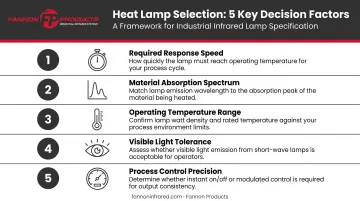
The honest answer: neither lamp wins universally. Five factors determine the right choice for any specific application.
The Five Decision Factors
- Required response speed: If your process stops and starts, you need a lamp that reaches operating temperature in seconds, not minutes
- Target material's absorption spectrum: Match the lamp's emission peak to where your material actually absorbs energy
- Operating temperature range: Short-wave lamps reach much higher intensities than ceramic elements can achieve
- Visible light tolerance: Overnight animal care, light-sensitive manufacturing environments, and certain agricultural settings require a no-light solution
- Process control precision: Industrial lines with feedback controls and variable power need lamps with fast, predictable response
When to Choose an Infrared Heat Lamp
Infrared heat lamps (short or medium wave) are the right call when:
- The process requires response times under 2 seconds
- High throughput and production speed are operational priorities
- Precise temperature control matters for consistent output quality
- You need targeted heat delivery to a specific surface zone
- The application is in automotive finishing, commercial printing, plastics forming, electronics, or food processing
The automotive paint sector illustrates this clearly. A 2022 peer-reviewed review of coating and curing processes found that IR curing can reduce energy consumption by 50% compared with conventional curing approaches — and the automotive paint shop accounts for roughly 36% of total energy use in conventional manufacturing plants. The efficiency gain from properly matched infrared lamps isn't marginal; it directly affects operating cost at scale.
When to Choose a Ceramic Heat Lamp
Ceramic heat lamps earn their place when:
- Visible light cannot be present (overnight reptile or livestock care, light-sensitive environments)
- Sustained low-intensity ambient warming over extended periods is the goal
- The process specifically benefits from diffuse, even long-wave IR distribution
- Response time is irrelevant because the application runs continuously
The Process-First Selection Approach
The right selection starts with your process, not the lamp. What does your material absorb? How fast must the system respond?
Start with the material's absorption profile, then identify the required response time. Wattage, wavelength, tube configuration, and controls selection follow from there.
For industrial buyers evaluating process heating, Fannon Products offers two entry points:
- Replacement lamps: The replacement lamp catalog covers over 1,000 configurations — every size, wattage, and voltage — for systems from Heidelberg to HP to M&R
- Custom solutions: Custom infrared heating systems designed and engineered around specific process requirements
Conclusion
Infrared heat lamps are the stronger choice for industrial applications that demand speed, precision, and process control. Ceramic heat lamps serve a distinct and legitimate role in low-intensity, no-light-required warming scenarios.
Performance comes down to how well the lamp's emission spectrum matches the target material, and whether its response characteristics fit the process. When heating is a production variable rather than a comfort feature, that alignment directly affects cycle time, energy consumption, product quality, and operating costs.
The right fit by application:
- Infrared lamps: Paint curing, inkjet drying, plastics forming, screen printing — anywhere fast response and precise spectral targeting matter
- Ceramic lamps: Animal husbandry, food warming, low-intensity ambient heat — situations where visible light must be avoided and output levels are modest
Start with the material and the process requirement. The hardware choice follows from there. Fannon Products has engineered infrared heating solutions across automotive, printing, plastics, and custom manufacturing applications for nearly 70 years — if you're matching a lamp to a process, that's a practical starting point.
Frequently Asked Questions
What's better, ceramic heat or infrared heat?
"Better" depends entirely on the application. Short or medium-wave infrared heat lamps are better for fast, precise, high-intensity industrial processes. Ceramic long-wave emitters are better for sustained ambient warming without visible light output. Neither type is universally superior.
What heat lamp puts out the most heat?
Short-wave infrared heat lamps (NIR) operate at the highest filament temperatures — above 1,800°C — and reach the highest power densities of any heat lamp category. Ceramic heat lamps operate at 300–700°C and produce gentler, diffuse output that cannot match short-wave intensity.
What is the difference between infrared and ceramic heat lamps?
Infrared heat lamps use a tungsten or carbon filament in a quartz tube to emit short or medium-wave radiation, enabling fast, high-intensity heating. Ceramic heat lamps use a resistance wire in a ceramic body to emit long-wave IR-C radiation at lower temperatures with no visible light.
Are ceramic heat lamps the same as ceramic space heaters?
No. Ceramic heat lamps (CHEs) are radiant devices that emit infrared radiation directly to objects. Ceramic space heaters use convection — a fan blows over a heated ceramic plate to warm the surrounding air. They share the "ceramic" name but operate through completely different heating mechanisms.
How long do infrared heat lamps last compared to ceramic heat lamps?
Ceramic heat emitters typically last up to 20,000 hours under normal use. Quartz infrared lamps generally range from 5,000 to 10,000+ hours depending on duty cycle, thermal cycling frequency, and installation quality.
Can infrared heat lamps be used outdoors, unlike ceramic heat lamps?
Infrared heat lamps work well outdoors because they heat objects directly through radiation and aren't affected by wind or air movement. Ceramic heat lamps can also function in sheltered outdoor settings, but their lower output intensity makes them less practical in open or exposed environments.