Introduction
Conventional offset printing has a drying problem. Ink dries through absorption into the substrate and slow oxidation — a process that can take hours or even days depending on the stock. While sheets wait, they stack wet, creating setoff risk where ink transfers to the back of the sheet above.
To prevent that, pressrooms spray anti-setoff powder across every printed sheet — introducing pressroom dust contamination, rough print surfaces that interfere with lamination and foiling, and extra cleaning time.
Finished jobs sit on pallets "gassing out" before they can be cut, folded, or shipped. Same-day turnaround on complex jobs is largely off the table.
LED-UV curing eliminates both problems — ink cures instantly under the lamp, powder-free, with no waiting. This guide covers how it works, what it means for your offset workflow, how it compares to conventional UV and traditional drying, and what to know before retrofitting your press.
TL;DR: Key Takeaways
- LED-UV curing polymerizes ink instantly — no drying time, no setoff
- Anti-setoff spray powder becomes unnecessary, eliminating pressroom contamination
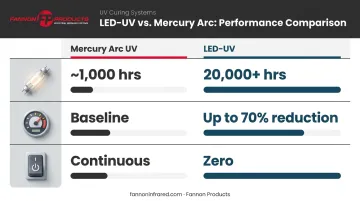
- LED lamps run cooler, consume less energy, and last 20,000+ hours vs. ~1,000 hours for mercury arc lamps
- Expands printable substrate range to include heat-sensitive materials like PET, PP, and synthetic papers
- Most sheetfed presses can be retrofitted, though compatible inks, rollers, and blankets are required
What Is LED-UV Curing and How Does It Work?
LED-UV curing is a photochemical process, not a drying process. That distinction drives every practical advantage the technology offers.
Traditional offset inks dry in two stages: oil-based vehicles absorb into the substrate, and the remaining pigment film oxidizes and hardens over time. Depending on ink coverage, stock type, and environmental conditions, full drying can take hours. The press can run fast, but the job isn't truly finished until the ink stabilizes.
The Chemistry Behind Instant Cure
LED-UV works differently at a molecular level. LED lamps emit focused ultraviolet light in a narrow UVA band — commonly 385–395 nm, with 395 nm being the dominant wavelength in current offset lamp systems. When that light hits LED-UV ink, it activates photoinitiators — chemical compounds engineered to react at those specific wavelengths.
The photoinitiators trigger polymerization: the liquid ink converts into a hardened solid polymer in a fraction of a second. No heat, no absorption, no waiting for oxidation to finish the job.
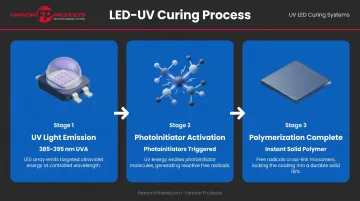
This is why standard oil-based offset inks can't simply be used with an LED-UV system. The photoinitiators in conventional inks aren't formulated to respond to narrow UVA wavelengths — they need to be specifically matched to the LED's spectral output. LED-UV inks are purpose-built formulations, not a drop-in substitute.
Physical Integration on a Press
In a retrofitted sheetfed offset press, the LED-UV lamp unit sits at the press delivery. As printed sheets exit the last printing unit, they pass under the lamp — and by the time they reach the delivery pile, the ink is fully cured. There's no wet ink in the stack.
A well-engineered installation accounts for three core variables:
- Lamp placement — positioned at delivery to cure sheets before they stack
- Reflector design — focuses UV output directly at the substrate surface
- Module width — matched to press width (3-inch, 6-inch, and 9-inch configurations are common)
Fannon Products engineers UV LED curing systems built for exactly this kind of printing environment, drawing on nearly 70 years of industrial lamp and curing technology expertise.
Key Benefits of LED-UV Curing for Offset Printing
LED-UV curing changes the economics and workflow of offset printing in ways that compound across every job. Here's where the gains show up most clearly.
Instant Cure and Zero Setoff
Setoff is a quality control failure — wet ink transfers to the sheet above and requires reprinting or outright rejection. Because LED-UV ink is fully polymerized before sheets stack, that transfer is physically impossible. The defect is eliminated at the source rather than managed after press.
Spray Powder: Gone
Anti-setoff powder creates a microscopic air gap between stacked sheets to prevent wet ink contact. It works, but at a cost:
- Fine powder contaminates the pressroom environment and settles on equipment
- It creates a rough surface texture that interferes with lamination, foiling, and coatings
- Powder must be cleaned from press components regularly
- Jobs with powder cannot go directly to finishing without additional prep
According to GEW, instant LED-UV curing eliminates the need for anti-setoff spray powder, machine varnish, or sealers, and removes the associated contamination and cleaning burden.
Energy Efficiency and Lamp Longevity
LED-UV delivers measurable cost reductions across power draw, lamp life, and maintenance intervals:
- LED systems can reduce energy consumption by up to 70% compared to H-UV or IR systems, partly because no power is consumed when the press is idle
- Mercury arc lamps typically last around 1,000 hours; LED systems are designed for 20,000+ hours, with some suppliers citing up to 60,000 hours under optimal conditions
- Fewer lamp replacements mean less downtime and lower maintenance costs
Cooler Substrate Temperatures
Mercury UV lamps generate significant heat, which limits the substrates you can run. LED lamps emit minimal infrared heat toward the substrate — a direct advantage when printing on:
- PET, PP, and PE films
- Synthetic papers
- Foil board and foil-laminated stocks
- Thin papers prone to curling
Same-Day Workflow
Cured sheets exit press-ready. No floor staging. No pallet gassing-out time. Cutting, folding, laminating, and shipping can happen immediately after printing — a genuine same-day turnaround becomes achievable on jobs that previously required overnight drying.
LED-UV vs. Conventional UV vs. Traditional Offset: A Clear Comparison
| Dimension | Traditional Offset | Conventional UV (Mercury Arc) | LED-UV |
|---|---|---|---|
| Cure/Dry Method | Absorption + oxidation | Photochemical (broadband UV) | Photochemical (narrow UVA, 385–395 nm) |
| Setoff Risk | High | None | None |
| Spray Powder Needed | Yes | No | No |
| Lamp Lifespan | N/A | ~1,000–2,500 hours | 20,000+ hours |
| Heat Output | Low | High | Minimal |
| Ozone Production | None | Yes (requires exhaust) | None |
| Substrate Versatility | Paper/board focused | Limited (heat-sensitive materials at risk) | High (plastics, films, synthetics) |
| Energy Consumption | Moderate | High | Low |
Where Conventional UV Still Has an Edge
Both systems cure instantly and eliminate setoff, but mercury UV holds a few remaining advantages worth knowing:
- Lower fluid costs: Traditional UV inks and coatings are less expensive and available in more varieties
- Better UVC-range curing: Certain protective varnishes and specialty coatings — particularly those requiring UVC wavelengths (below 240 nm) — achieve higher surface hardness under mercury arc systems
- Hybrid compatibility: Many pressrooms run LED-UV interdeck for ink colors and mercury arc in extended delivery for the final varnish
That hybrid approach reflects where coating chemistry currently stands, not a shortcoming of LED-UV technology.
Mercury Regulation as a Business Factor
Conventional UV lamps contain between 10 and 200 mg of elemental mercury, depending on the lamp type. In the EU, RoHS exemptions for mercury vapor UV curing lamps are currently scheduled to expire February 24, 2027, with regulatory review underway. In the US, the EPA's universal waste framework covers mercury-containing lamps for disposal and management purposes. Mercury faces increasing regulatory pressure on both continents, making LED-UV the lower-risk long-term investment.
Substrate Versatility and Ink Considerations
What LED-UV Opens Up
Because LED lamps produce minimal heat at the substrate, printers can safely run materials that would warp, deform, or discolor under conventional UV or heatset systems:
- PET, PP, PE, and PU films
- Synthetic papers (Yupo and similar stocks)
- Foil board and foil-laminated sheets
- Shrink sleeve substrates
There's an additional quality benefit on uncoated papers: because LED-UV ink cures on the surface rather than absorbing into paper fibers, dot gain is reduced and color stays sharper than with conventional absorption drying.
Ink Formulation Requirements
LED-UV inks are formulated with photoinitiators tuned to longer UVA wavelengths — the 385–395 nm range that LED diodes emit. Standard oil-based offset inks will not cure under LED lamps. Conventional UV inks (formulated for mercury broadband output) are incompatible as well.
For shops in transition, dual-cure formulations are now widely available from major ink suppliers — including Sun Chemical and Siegwerk. They work with both LED and mercury-vapor systems, which simplifies SKU management during a phased switchover without requiring an immediate full-line ink change.
Equipment Compatibility
The shift in ink chemistry extends to press hardware. LED-UV inks require UV-compatible rollers and blankets. Conventional nitrile rubber swells when exposed to UV ink chemistry — EPDM rollers and blankets are the standard for dedicated LED-UV workflows. Compatible UV wash solutions are also required.
Unlike ink and substrate costs, roller and blanket upgrades are a one-time capital investment — worth accounting for in retrofit planning before committing to a switchover timeline.
Implementing LED-UV on Your Offset Press
Retrofitting Existing Presses
Most sheetfed offset presses from major manufacturers can be retrofitted with LED-UV lamp units. According to a PRIMIR forecast cited by Printing Impressions, 90% of LED-UV sales for straight presses were projected as retrofits rather than new press purchases — reflecting strong industry preference for upgrading existing equipment.
Press families with confirmed LED-UV retrofit support include:
- Heidelberg (SM74, SM102, and related models)
- Komori sheetfed offset presses
- Koenig & Bauer / KBA
- RMGT, Ryobi, and Mitsubishi (5, 6, 7, 9, and 10 series)
- Manroland
Key Factors to Evaluate Before Retrofitting
Not all retrofit decisions are straightforward. Evaluate these before committing:
- Lamp intensity vs. press speed — Under-powered lamps at high press speeds produce incomplete cure. The ink surface may appear dry while remaining uncured underneath. Match wattage to your maximum production speed.
- Ink and substrate compatibility — Confirm your ink supplier's LED-UV formulations are validated for your substrate mix before you order the system.
- Electrical supply — Fannon Products' systems, for example, run on 120V AC (540W and 1080W models) or 220–230V AC (1620W model). Know your press-side electrical capacity before specifying a lamp unit.
- Roller and blanket replacement — Budget for EPDM upgrades at the same time as the lamp installation.
Working through these variables before installation — not after — prevents costly mismatches. If you need help sizing a system to your press, Fannon Products' technical team can walk you through specifications based on your press model and production requirements.
Frequently Asked Questions
What is the difference between UV printing and offset printing?
Offset printing is an image-transfer method: ink moves from a plate to a rubber blanket, then to the paper. UV printing describes how the ink is cured — using ultraviolet light rather than heat or absorption. The two terms describe different parts of the production process and can be combined (UV-cured offset printing).
What is the difference between UV printing and LED-UV printing?
Traditional UV uses mercury vapor (arc) lamps emitting a broad spectrum (200–450 nm, including UVC). LED-UV uses diodes at a narrow UVA band — typically 385–395 nm — running cooler, consuming less energy, producing no ozone, and lasting significantly longer than arc lamps.
What is an LED-UV curing system for printing?
It's a lamp assembly integrated into a printing press that emits focused UV light to instantly polymerize (cure) specially formulated inks as printed sheets pass under the lamp. This replaces heat drying, eliminates setoff, and allows immediate post-press finishing without waiting.
Can I retrofit my existing offset press with LED-UV curing?
Yes — most major-brand offset presses support LED-UV retrofit, and it's typically more cost-effective than buying new equipment. Key steps include matching lamp intensity to press speed and upgrading rollers and blankets to EPDM UV-compatible materials.
Do LED-UV inks cost more than conventional offset inks?
Per unit, yes — LED-UV inks cost more than standard oil-based inks. For shops with sufficient volume, operational savings in energy, spray powder elimination, reduced waste, and faster turnaround typically recover that premium over time.
What substrates work best with LED-UV curing on offset presses?
LED-UV performs well on both coated and uncoated paper stocks, and it makes it possible to print on heat-sensitive materials — PET, PP, synthetic papers, foil laminates — that would be damaged by conventional UV or heatset processes.