That's where operators run into trouble. Water-based inks dry differently than solvent-based inks, and press teams who don't understand the underlying mechanisms end up chasing symptoms — slow dry times, ink drying on the anilox, blocking on rewind — without knowing which variables to adjust or why. This article breaks down the full drying process, from chemistry to dryer technology, so you can diagnose problems and make informed decisions at the press.
Key Takeaways
- Water-based inks dry through evaporation and, on porous substrates, absorption into the material
- Water evaporates more slowly than alcohol-based solvents, so dedicated dryer systems are essential for press efficiency
- Ink pH must stay between 8.0–10.0 to prevent premature drying on the plate and anilox
- IR dryers accelerate drying by coupling energy directly to water molecules in the ink film
- On non-porous substrates like plastic film, dryer capacity directly limits achievable press speed
What Are Water-Based Inks and Why Do They Dry Slowly?
Water-based flexographic inks use water as the primary carrier, combined with pigment, acrylic resin binders, and functional additives — defoamers, wetting agents, and pH stabilizers. The Flexographic Technical Association identifies the core components as colorants, acrylic-type resins, amines that stabilize the resin dispersion, and surfactants.
That carrier water makes up 45–60% of total ink weight, according to Western Michigan University flexographic linerboard research — and that proportion is what drives the drying challenge.
The physics explain why:
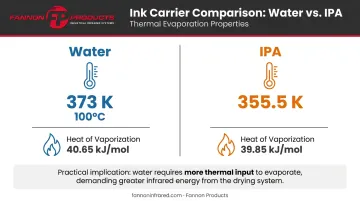
- Water's normal boiling point is 373 K (100°C)
- Isopropyl alcohol — a common solvent-based ink carrier — boils at 355.5 K
- Water's heat of vaporization is 40.65 kJ/mol at 100°C, compared to 39.85 kJ/mol for IPA
The gap in boiling points and vaporization energy means water simply needs more thermal input to leave the ink film. On fast-moving flexo presses, that difference matters considerably.
Why This Requires Deliberate System Design
Solvent-based inks can often dry adequately at ambient conditions or with minimal heat assistance. Water-based inks rarely can — particularly on non-porous substrates where there's no absorption pathway to assist the process. This is why dryer systems on water-based flexo lines must be engineered for the job — sized for adequate zone length, tuned to the right temperature band, and matched to press speed — rather than treated as an afterthought bolted onto an existing configuration.
How Water-Based Inks Actually Dry: The Two Mechanisms
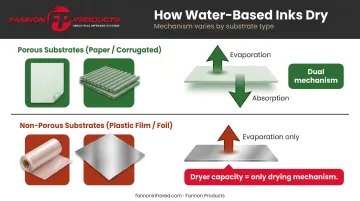
Water-based inks dry through two distinct mechanisms. Which one dominates depends entirely on the substrate.
Evaporation
The water carrier — along with any co-solvents like glycol ethers — must leave the ink film as vapor. Heat raises the vapor pressure at the ink surface; moving air carries the moisture away. Both variables are controllable on modern presses, and both matter.
As evaporation proceeds, acrylic resin particles dispersed in the water phase fuse into a continuous film. This film formation stage determines the dried ink's final properties:
- Adhesion strength to the substrate
- Opacity and color density
- Gloss level
- Rub and scratch resistance
Incomplete evaporation before coalescence can trap moisture beneath the surface and compromise adhesion. This won't surface immediately, but it will cause failures during downstream converting or lamination.
Absorption
On porous substrates like paper and corrugated board, the liquid vehicle is drawn into the substrate by capillary action, depositing pigment and resin at the surface. This process accelerates apparent dry time considerably (capillary dynamics, not just surface evaporation, are doing the work), which explains why water-based inks have historically performed strongest on paper-based substrates.
The Critical Non-Porous Distinction
On plastic films, metallic foils, and treated laminates, absorption doesn't occur. The ink must dry entirely through evaporation. This makes dryer system capacity the primary operational constraint for press speed on film jobs. If the dryers are undersized, nothing compensates — there's no absorption mechanism to fall back on.
Key Variables That Control Drying Speed and Quality
Substrate Type
This is the single most influential variable. Set your baseline dryer temperatures differently for paper and film jobs:
- Paper and corrugated: Absorption assists drying; moderate dryer settings can achieve adequate dry times
- Plastic film and foil: Full reliance on evaporation; maximum dryer capacity becomes the limiting factor for press speed
Ink Viscosity and pH
Both need active monitoring throughout the press run.
Viscosity: Thicker ink films carry more water per unit area and take longer to dry. Monitor with a Zahn cup — Nazdar's W100 paper ink runs 12–24 seconds on a No. 3 Zahn at 77°F; their W300 film ink runs 10–30 seconds. Adding water to reduce viscosity also increases water content, which can slow drying if dryer output isn't adjusted accordingly.
pH: Water-based flexo inks use amines to keep the acrylic resin in stable dispersion. When pH drops below the target range:
- Amines evaporate faster than intended
- Resin begins precipitating out of solution
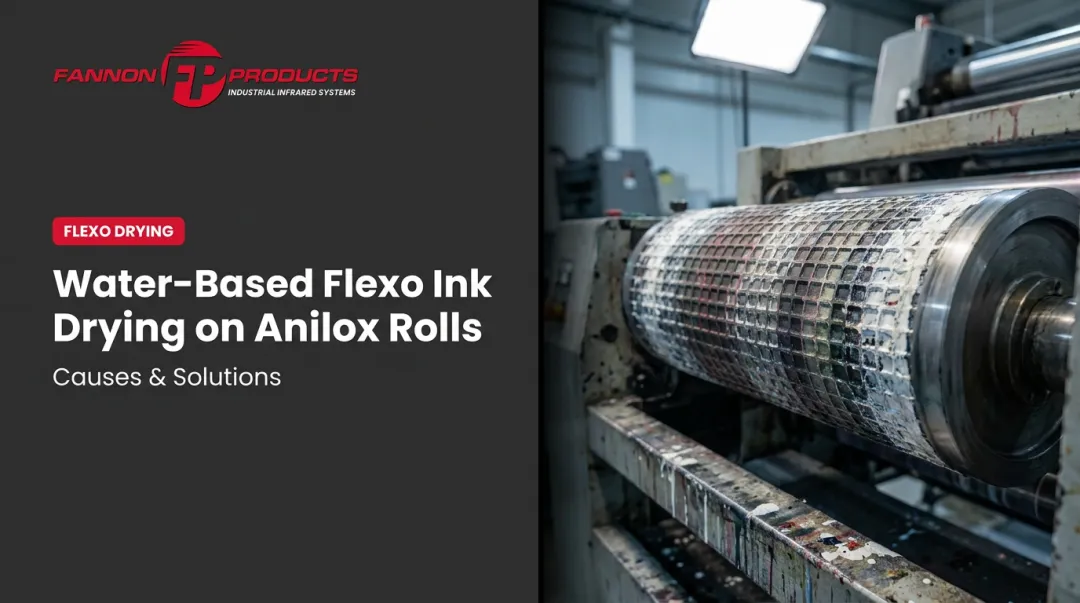
- Ink starts drying prematurely on the plate and anilox
- Result: dirty print, plugged anilox cells, inconsistent ink transfer
Nazdar's W100 paper ink specifies a pH range of 8.0–10.0; the W300 film ink runs 9.0–10.0. Check your ink supplier's TDS for the specific range — there's no single universal number across all water-based flexo inks.
Press Speed, Dryer Temperature, and Airflow
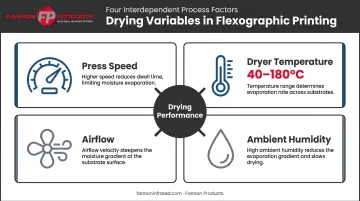
Once ink properties are dialed in, machine-side settings determine whether the dryer can keep up. These three variables form an interdependent system:
- Lower press speeds increase the risk of ink drying on the plate before reaching the dryer
- Higher press speeds reduce dwell time under dryers, increasing the risk of insufficient drying between stations
- Dryer temperature is the primary lever — general flexo dryer ranges span 40–180°C depending on substrate, ink, and machine configuration; heat-sensitive films require careful upper-limit management to avoid substrate distortion
- Airflow carries moisture-laden air away from the ink surface, maintaining the concentration gradient that drives evaporation — high-velocity impingement air improves water-based ink drying performance
Ambient Humidity
High relative humidity in the pressroom reduces the concentration gradient between water in the ink film and the surrounding air, slowing evaporation. Pressrooms without climate control often see inconsistent dry times between shifts and seasons as a result — compensate with higher dryer temperatures or reduced press speeds during humid conditions.
Where Drying Technology Fits in the Flexographic Workflow
Two Dryer Positions, Both Critical
A standard flexographic press uses two dryer positions:
Inter-station dryers sit between each print unit and dry the ink from the previous color before the next layer is applied. This prevents wet trapping, picking, and color mixing. Insufficient inter-station drying is the most common source of multicolor registration and quality problems on water-based jobs.
Final exit dryers are positioned before the rewind to ensure ink is fully cured before the web is wound under tension. Without adequate final drying, blocking occurs — ink transfers to the reverse side of the web, making the product unusable.
Hot Air vs. Infrared: How Each Works
| Technology | Heat Transfer Mechanism | Best Suited For |
|---|---|---|
| Hot air (convection) | Heated air blown across the web surface heats the ink indirectly | General flexo applications; inter-station and final dryer positions |
| Infrared (IR) | Radiant energy absorbed directly by water molecules in the ink film | Non-porous substrates; high-speed applications where evaporation is the only drying mechanism |
The physics behind IR's effectiveness on water-based inks is specific: water has near-IR absorption bands at approximately 970, 1,200, 1,450, and 1,950 nm. IR dryers emitting in these ranges deposit energy directly into the water molecules in the ink film, generating heat from within rather than from the surrounding air.
This targeted approach reduces energy loss from heating the substrate and press environment before the ink itself gets warm. On non-porous substrates — where evaporation carries the entire drying load — it translates to faster evaporation rates at equivalent or lower total energy input compared to convection alone.
Fannon Products' IR Lamp Options for Printing Applications
Operators looking to improve water-based ink drying performance or replace aging dryer lamps have several options from Fannon Products. Based in Algonac, Michigan, Fannon has been manufacturing infrared lamps for nearly 70 years.
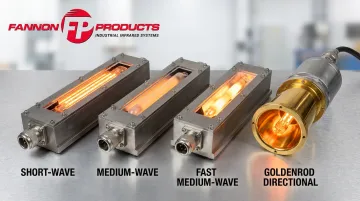
Fannon produces several lamp types relevant to printing dryer systems:
- Short-wave lamps: Instant response, 96% radiant efficiency, suited for high-speed drying where precise energy delivery is critical
- Medium-wave lamps: Less color-sensitive than short-wave, making them better suited for multicolor printing environments where ink color varies across stations
- Fast medium-wave lamps: Combine medium-wave's color insensitivity with instant on/off response — useful where thermal lag would affect process control
- Goldenrod directional lamps: Fannon's patented design with an integral 24K gold reflector that directs virtually 100% of infrared energy at the substrate, saving 23.5% in energy expense compared to standard lamps
Their LightSpeed and Near Infrared inkjet drying systems are engineered to dry water-based inks on both glossy and non-glossy substrates. Available configurations include:
- Wattage: 3,000W to 21,900W
- Heated lengths: 10 to 38 inches
- Voltages: 208V, 240V, 277V, 480V, 575V (custom sizes available for non-standard press configurations)
For replacement lamps or custom-configured solutions, contact Fannon at 810-794-2000 or sales@fannonir.com.
Frequently Asked Questions
How long does it take for water-based ink to dry in flexographic printing?
Dry time varies too widely for a single answer. Substrate type, dryer configuration, press speed, and ambient humidity all play major roles. On absorbent paper with adequate heat, drying can occur within fractions of a second; on non-porous film substrates without sufficient dryer capacity, incomplete drying is one of the most common problems press operators encounter.
What causes water-based ink to dry too slowly?
The most common causes are insufficient dryer heat or airflow, ink viscosity running too high, ink film thickness too heavy (often an anilox volume issue), high ambient humidity reducing the evaporation gradient, or low substrate surface energy preventing proper ink spread and contact.
How does substrate type affect water-based ink drying?
Porous substrates like paper and corrugated assist drying through capillary absorption, giving operators some margin on dryer settings. Non-porous substrates like plastic films and foils force full reliance on evaporation, making dryer system capacity the binding constraint for press speed on those applications.
What is the role of pH in water-based ink drying?
Ink pH controls the stability of amines that keep the acrylic resin in dispersion. When pH drops below the target range, amines evaporate prematurely, resin begins to precipitate, and ink dries on the plate and anilox rather than the substrate. The result: dirty print, plugged anilox cells, and inconsistent ink transfer across the run.
How does infrared drying improve water-based flexo printing?
IR energy is absorbed directly by water molecules in the ink film at specific near-IR wavelengths, heating from within the ink layer rather than from surrounding air. This makes IR faster and more energy-efficient than convection alone , particularly on non-porous substrates where evaporation is the only available drying mechanism.
Is plastisol ink comparable to water-based flexo ink?
These inks serve different processes entirely. Plastisol is used in screen printing on textiles and cures through heat fusion rather than evaporation, while water-based inks are used in flexographic printing for packaging, labels, and corrugated. They're not interchangeable.