Whether a flash dryer belongs in your setup depends on what you're actually printing, how often, and what your customers expect. This guide covers what flash dryers do, who genuinely needs one, how they stack up against alternatives, and what to look for when buying.
Key Takeaways
- Flash dryers serve two purposes: gelling ink between color layers and fully curing finished prints
- Single-color hobbyists at low volume can manage with a heat gun — multi-color or regular-order work requires a flash dryer
- Plastisol gels at 240–250°F and fully cures at 300–330°F; water-based inks cure at 320°F
- Discharge inks require a forced-air conveyor dryer — a flash dryer won't work
- Lamp quality inside the unit determines cure consistency; replacement availability matters for long-term uptime
What Is a Flash Dryer in Screen Printing?
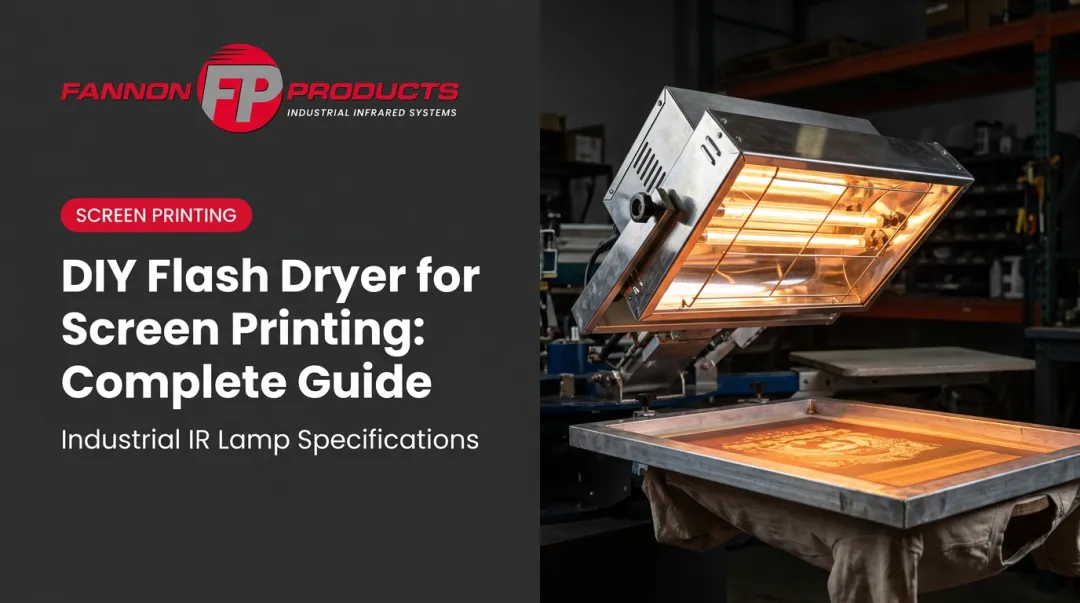
A flash dryer is a focused infrared heat source mounted on a swing arm above the press platen. It's not a conveyor dryer (which moves garments through an enclosed tunnel), and it's not a heat gun. It sits over the print and radiates concentrated heat downward onto the ink surface.
Two Jobs, One Tool
Flash dryers serve two distinct purposes — and confusing them causes real problems:
- Flashing (gelling): Partially heating ink to its gel point (~240–250°F) so it becomes tack-free. The ink isn't fully cured — it's just solid enough that the next color can be printed on top without bleeding or registration errors.
- Curing: Fully hardening the ink through the entire film so it bonds permanently to the fabric. This requires higher temperatures and longer dwell time.
When used for final curing, ScreenPrinting.com recommends removing the shirt from the platen first so heat penetrates the full ink layer — otherwise the edges of the design can wash out.
Temperature Benchmarks
| Ink Type | Gel Point (Flash) | Full Cure Temp |
|---|---|---|
| Plastisol | 240–250°F | 300–330°F |
| Water-based | N/A | ~320°F |
| Discharge | Not applicable | Requires forced-air conveyor |
Always verify cure temperatures against your specific ink manufacturer's data sheet — formulations vary.
How the Heating Element Affects Performance
The infrared lamp inside the unit is the central variable. Element quality determines how evenly heat distributes across the print surface. Units with closely spaced filaments and well-designed radiant panels produce fewer hot and cold spots than poorly constructed alternatives.
Replacement lamps engineered specifically for M&R flash dryers — like those manufactured by Fannon Products — use a medium-wave "star" coil that reaches operating temperature in under one second. Medium-wave technology is also less color-sensitive than short-wave emitters, meaning more consistent results across light and dark inks.
That consistency matters most when you're gelling a white underbase before printing four colors on top.
Do You Actually Need a Flash Dryer?
The honest answer: not always — but the threshold arrives faster than most people expect.
Hobbyists and Low-Volume Printers
If screen printing is a hobby with single-color designs on light fabrics, a heat gun can get the job done. The trade-offs are real:
- No reliable way to confirm actual ink temperature
- Inconsistent heat distribution across larger designs
- Slow, requiring careful circular passes over the print area
- ScreenPrinting.com notes heat guns are suitable only for small production runs
At very low volume, those trade-offs are manageable. But as soon as orders stack up, the heat gun becomes a bottleneck, and improper curing leads directly to cracking, fading, or total washout.
Production and Growing Shops
For anyone printing multi-color designs, working with dark garments requiring an underbase, or fulfilling orders for paying customers, a flash dryer stops being optional.
The reason comes down to the print-flash-print workflow. Here's how it works:
- Print the first color (typically a white underbase on dark garments)
- Flash the underbase to gel point — tack-free, but not fully cured
- Print the next color directly on top with clean registration
- Repeat for each additional color
- Full cure the completed print
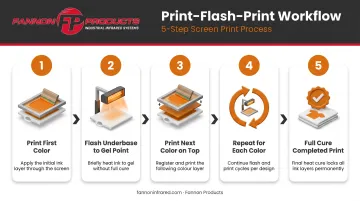
A heat gun can't support this workflow reliably. The timing is wrong, heat distribution is inconsistent, and there's no reliable way to gel a full print evenly in the few seconds a production rhythm requires.
Three-question decision framework:
- How often do you print? (More than occasionally = flash dryer territory)
- Do your designs use multiple colors or require an underbase on dark garments?
- Are customers depending on durable, wash-resistant results?
Two or more "yes" answers means a flash dryer pays for itself in time saved, rework avoided, and customer complaints that never happen.
Key Benefits of Using a Flash Dryer
Speed
A properly pre-heated flash dryer gels a plastisol layer in 3–15 seconds depending on wattage and ink deposit. Final curing with a flash dryer typically takes 30–40 seconds once the ink reaches cure temperature. A heat gun operating over the same print area requires multiple slow passes with no timing benchmark.
Consistent Heat Distribution
Even heat across the entire print surface means every part of the ink film reaches temperature simultaneously. Uneven heat creates under-cured edges and over-heated centers — both produce durability problems. Undercured prints are one of the most common causes of wash failure in screen printing — the ink bonds poorly to fabric fibers and breaks down after just a few wash cycles.
Multi-Color Capability
Without reliable gelling, multi-color screen printing isn't practical. A flash dryer is what makes layered designs work — printing color over color without bleeding, smearing, or losing registration. Without one, every additional color layer becomes a gamble on smear and misregistration.
Fewer Reprints
When every print exits at the correct temperature for the correct duration, cracking, fading, and adhesion failures drop sharply. Reprints cost ink, garments, and production time — and on customer orders, they cost credibility that's harder to recover than the material losses.
Flash Dryer vs. Other Curing Methods
Heat Gun
- Cost: Around $30–$40 for a dual-temperature 1500W unit
- Consistency: Poor — no reliable temperature feedback, uneven distribution
- Speed: Slow, requires manual passes
- Best for: Solo hobbyists, single-color prints, minimal volume only
Flash Dryer
- Cost: Entry-level units around $600–$700 (e.g., Riley Hopkins 16×16" at ~$599.95, 1600W; 18×18" at ~$699.95, 2300W)
- Consistency: Good — even radiant heat across the print area
- Speed: 3–15 seconds to gel; 30–40 seconds to fully cure
- Best for: Multi-color designs, underbase work, small-to-mid production shops
Conveyor Dryer
- Cost: Entry-level units start around $2,800+ (Vastex D-100 at ~$2,809 with 18" belt)
- Consistency: Excellent — enclosed tunnel with controlled dwell time, the gold standard for curing
- Speed: Can process 50–110 garments per hour depending on ink type
- Best for: High-volume production shops where consistent throughput is the priority
| Heat Gun | Flash Dryer | Conveyor Dryer | |
|---|---|---|---|
| Cost | ~$30–$40 | ~$600–$700 | $2,800+ |
| Consistency | Poor | Good | Excellent |
| Speed | Slow (manual) | 3–40 sec/piece | 50–110 garments/hr |
| Best For | Solo hobbyists | Small-to-mid shops | High-volume production |
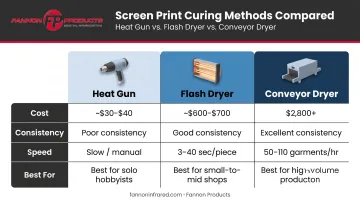
For shops moving beyond hobbyist volume but not yet running high-capacity production, a flash dryer fills that middle ground — capable equipment at roughly one-quarter the price of a conveyor dryer, with a much smaller footprint.
What to Look for When Buying a Flash Dryer
Heating Element Quality
The element is the whole product. Units with closely spaced coil or flat-panel emitters distribute heat more evenly than cheap quartz designs with wide filament spacing. Hot spots and cold spots in the element translate directly into inconsistent cure across the print.
Lamp quality also affects long-term cost. Before purchasing any unit, check whether replacement lamps are available — in the correct size, wattage, and voltage — from a reliable supplier.
Fannon Products manufactures replacement infrared lamps for M&R flash dryers in 11 configurations (1000W–2000W, 208V/240V/480V, 16.52" to 39.25" lengths), rated for 5,000+ hours of operation and typically shipping within one to two days. That kind of availability matters when a lamp failure threatens production.
Wattage and Print Size
Match the unit's wattage to the prints you're producing. General reference from available specs:
- ~1600W / 16×16" element: Suited for standard chest-size prints
- ~2300W / 18×18" element: Better for larger designs or faster cycle times
- 4000W+ / 20×20" and up: High-demand production environments, typically 220V
An underpowered unit struggles to reach cure temperatures across larger designs. Oversized units on small runs waste energy and can scorch heat-sensitive fabrics.
Value vs. Price
The cheapest flash dryers use poor-quality elements that produce uneven heat and fail quickly. The most expensive units rarely deliver results proportionally better than solid mid-range options. Look for a manufacturer with a documented track record, clear element specs, and accessible replacement parts.
Frequently Asked Questions
Frequently Asked Questions
Do you need a flash dryer for screen printing?
It depends on volume and complexity. Hobbyists doing single-color prints at very low volume can get by with a heat gun. For multi-color designs, dark garment underbases, or any regular customer work, a flash dryer is effectively essential for consistent, durable results.
What is a flash dryer in screen printing?
A flash dryer is an infrared heat source mounted above the press platen that either gels ink between color layers (flashing) or fully cures the final print. It's one of the most common curing tools in screen printing and bridges the gap between a basic heat gun and a full conveyor dryer.
What's the difference between flashing and curing in screen printing?
Flashing partially gels ink to roughly 240–250°F — enough to make it tack-free so the next color can be applied without bleeding. Curing fully hardens the ink through the entire film at 300–330°F (plastisol) or ~320°F (water-based), making the print durable and wash-resistant.
Can you use a heat gun instead of a flash dryer?
A heat gun works for very low-volume, single-color hobby printing but can't reliably replicate the even, timed heat of a flash dryer. It has no temperature verification, inconsistent heat distribution, and makes any multi-color print-flash-print workflow impractical.
What temperature does a flash dryer need to reach?
For flashing (gelling between colors), the ink needs to reach approximately 240–250°F. Full cure for plastisol requires 300–330°F; water-based inks cure at around 320°F. Always confirm against your ink manufacturer's specifications — formulations vary.
How do you know when your flash dryer lamp needs replacing?
Watch for uneven heat across the platen, longer flash times needed to achieve the same gel, or visible darkening and blackening of the lamp tube. These are reliable signs the infrared lamp is degrading. Replacing it promptly keeps cure temperatures consistent and protects print quality.