This guide cuts through the confusion: what each technology actually is, how they differ in mechanism and application, and which makes sense for your specific use case.
Key Takeaways
- Heat lamps are inexpensive incandescent bulbs that emit broad-spectrum IR radiation, suited for basic warmth tasks
- Infrared lamps (industrial) are purpose-engineered for specific wavelengths, delivering precise, process-controlled heat
- Key differences span wavelength control, energy targeting, application precision, and lifespan — far beyond simple temperature output
- Standard heat lamps cover food warming, bathrooms, and animal brooding; specialized infrared lamps are the better choice for drying, curing, forming, and production processes
Infrared Lamp vs Heat Lamp: Quick Comparison
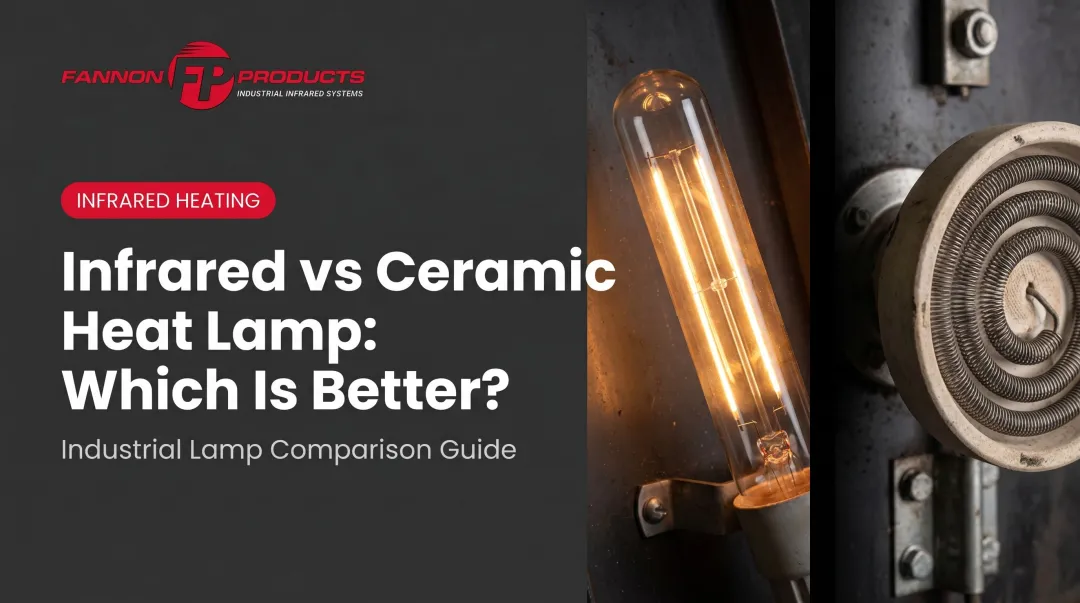
Both technologies emit infrared radiation to produce heat. Standard heat lamps are commodity bulbs designed for general warmth. Industrial infrared lamps are engineered for specific process outcomes — wavelength, intensity, and delivery are all controlled variables.
| Factor | Standard Heat Lamp | Industrial Infrared Lamp |
|---|---|---|
| Primary Purpose | Ambient warmth | Targeted, process-specific heat |
| Wavelength Control | Broad, uncontrolled IR spectrum | Engineered short-, medium-, or long-wave output |
| Energy Efficiency | Moderate — energy lost to visible light and dispersed heat | Higher — focused delivery reduces waste |
| Application Range | Food service, bathrooms, livestock | Automotive, printing, plastics, electronics, textiles |
| Typical Lifespan | ~5,000 hours (Philips/Satco 250W R40) | 5,000–20,000 hours depending on emitter type |
| Unit Cost | $11–$47 per bulb | $171–$471+ per industrial element |
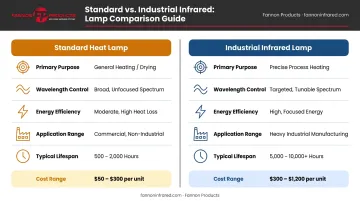
The cost gap is real, but unit price is the wrong metric. At production scale, the calculation that matters is cost per finished part — and on that measure, industrial IR consistently outperforms.
What Is a Heat Lamp?
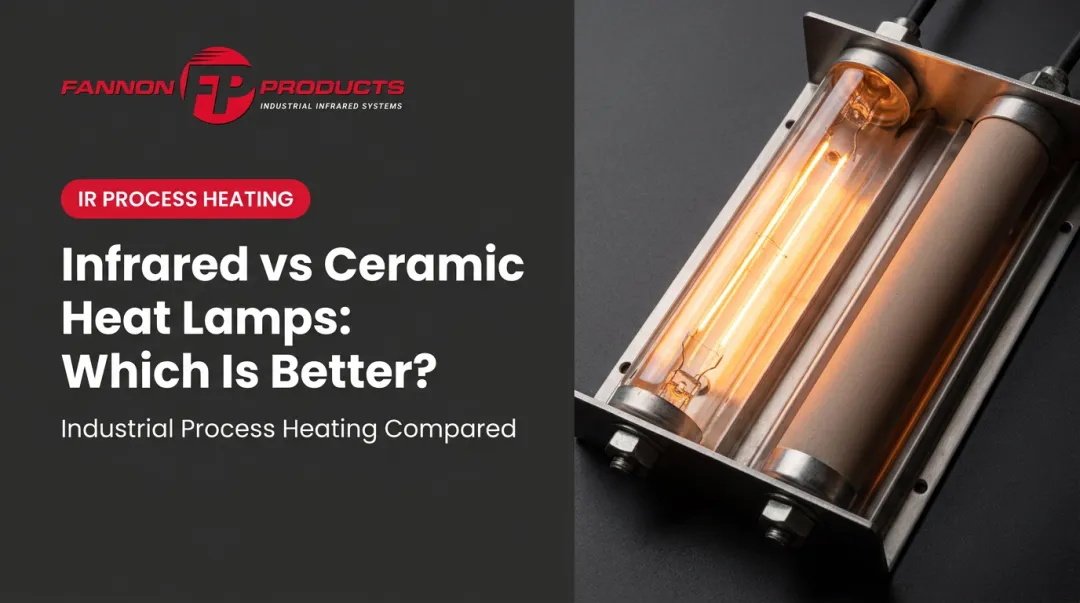
A heat lamp is a high-wattage incandescent reflector bulb designed to maximize heat output. Philips' commercial range runs 100W to 375W, and you'll find them at any hardware store or restaurant supply distributor.
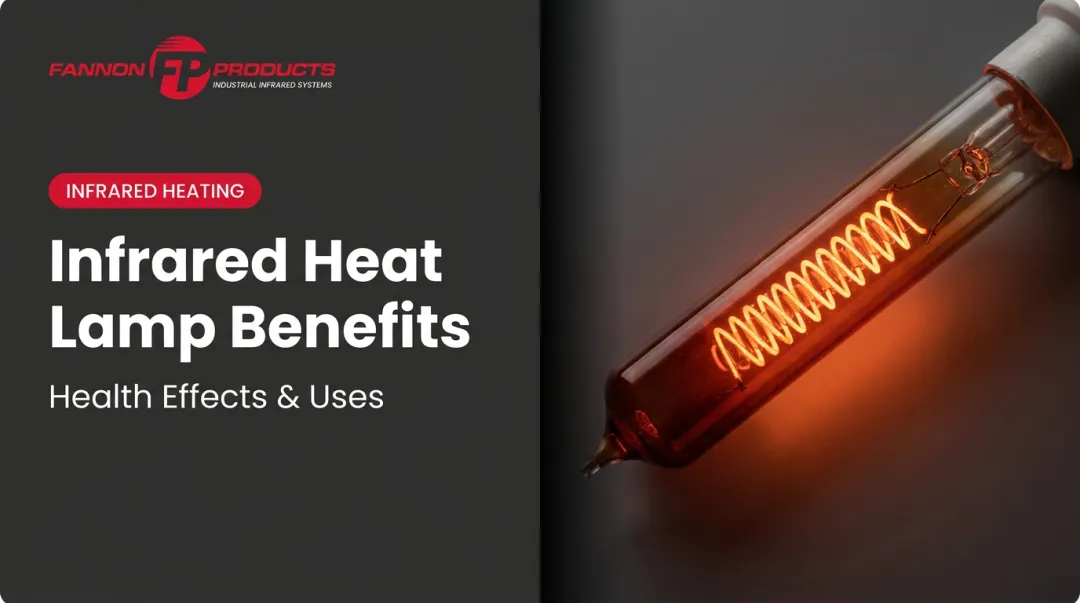
The operating mechanism is simple: electric current heats a tungsten filament until it radiates both visible light and infrared energy. According to the U.S. Department of Energy, incandescent bulbs release roughly 90% of their energy as heat — making them poor lighting choices but entirely adequate for basic radiant warming.
Two common subtypes exist:
- Standard incandescent flood lamps (soft glass, R40/BR40 shape): low-cost, widely available, suited for indoor use
- Halogen PAR lamps (hard glass, PAR38 shape): more durable with a tighter beam, better suited for commercial or outdoor exposure
Red vs. clear heat lamps: Functionally identical in heat output at the same wattage. Red lenses reduce visible glare and cast a warm amber glow — preferred in food service for aesthetics. Clear lamps are marginally less expensive and used where appearance is irrelevant.
Where Heat Lamps Make Sense
Heat lamps dominate in settings where basic, accessible warmth is the goal and precision doesn't matter:
- Restaurant food service: maintaining safe holding temperatures in buffet lines and display warmers
- Bathroom comfort heating: pre-warming spaces before or after showering
- Animal husbandry: brooding baby chicks, warming reptile enclosures
All three are infrequent or one-off heating needs — situations where $12 replacement bulbs and zero installation complexity are genuine advantages.
What Is an Infrared Lamp?
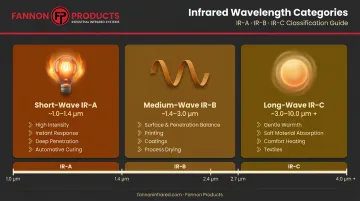
In an industrial context, an infrared lamp is a purpose-built radiant heating device engineered to emit energy at specific, controlled wavelengths. The difference from a standard heat lamp isn't just wattage; it's precision. ICNIRP classifies infrared radiation across three bands: IR-A (780 nm–1.4 µm), IR-B (1.4–3 µm), and IR-C/far IR (3 µm–1 mm), corresponding to short-wave, medium-wave, and long-wave emitters used in industrial equipment.
The mechanism matters: IR radiation travels at the speed of light and is absorbed directly by the target material (paint, ink, plastic, fabric, metal) without first heating the surrounding air. That's why IR process heating is faster and more energy-efficient than convection ovens in applications where the product absorbs the chosen wavelength efficiently.
The Three Wavelength Categories
Each wavelength category behaves differently and suits different materials:
- Short-wave IR (IR-A, ~1.0–1.4 µm peak): High-intensity, instant response, excellent penetration. Used for automotive paint curing, outdoor heating, and fast-response surface applications. Fannon Products' short-wave quartz lamps operate at approximately 4,100°F color temperature with 96% radiant efficiency.
- Medium-wave IR (IR-B, ~2.4–2.7 µm peak): Balanced surface heating and penetration. Well-suited for printing, water-based coatings, and plastics. Less color-sensitive than short-wave for screen printing applications with varying ink shades.
- Long-wave/far IR (IR-C, above 4 µm): Gentle, deeper-penetrating warmth absorbed well by soft materials. Preferred for delicate textiles and comfort heating.
Performance Advantages
Industrial IR lamps offer concrete operational benefits over both convection heating and general heat lamps:
- Faster cycle times — direct absorption eliminates oven warm-up and air-heating delays
- Consistent quality — even, repeatable heat application across every production run
- Process control — instant thermal response enables precise on/off and dimmer-compatible output adjustment
- Energy targeting — heat goes to the product, not the room
Industrial Applications for Infrared Lamps
These performance advantages translate directly into measurable outcomes across industries:
- Automotive refinishing and paint curing: IR accelerates solvent evaporation and cross-linking in primer, color coat, clear coat, and powder coat processes. I-CAR notes that IR can significantly reduce curing cycle times compared to convection methods.
- Inkjet and screen printing ink drying: Precise IR energy drives fast solvent evaporation at the ink surface without damaging the substrate. Fannon's twin-tube lamps with integral gold reflectors serve as direct replacements for Heidelberg Speedmaster presses and M&R flash dryers, engineered to exact OEM specifications.
- Plastics thermoforming: Controlled IR softens plastic sheets uniformly before vacuum forming or molding, where consistent heat distribution directly affects part quality.
- Electronics manufacturing: Reflow soldering and component drying benefit from precise, repeatable thermal cycles.
- Textiles: Web drying, dye fixing, and finishing processes use IR for gentle, even heat delivery.
- Food processing: Baking, browning, dehydrating, and pasteurizing applications rely on IR's ability to heat product surfaces without heating the surrounding air.
- Glass, ceramics, and agricultural: Annealing, coating drying, poultry brooding, and space heating round out IR's industrial reach.
Fannon Products has supplied IR lamps across all of these sectors for nearly 70 years. Their catalog spans over 1,000 quartz lamp configurations across short-wave, medium-wave, and twin-tube designs, from 250W to 6,000W+, in voltages from 115V to 600V.
Which Should You Choose?
The decision comes down to three factors: precision required, scale of use, and material being heated.
Choose a standard heat lamp when:
- The goal is straightforward ambient warmth — bathroom, food display, animal brooding
- Low upfront cost and easy hardware-store replaceability matter
- The application is non-repeating and quality consistency isn't a production variable
Choose a specialized industrial infrared lamp when:
- Heating is part of a production process — drying, curing, forming, or bonding
- Cycle time, energy cost, and output quality are measurable business metrics
- The material being heated has specific absorption characteristics that benefit from wavelength matching
The Real-World Math
A DOE/Oak Ridge case study on Progressive Powder Coating quantifies what this looks like in practice: adding an IR oven before a convection oven increased production 50%, saved approximately $54,000 per year in energy costs, reduced overall natural gas use by 25%, and paid back in 2.5 years. The IR didn't replace convection — it eliminated the bottleneck in front of it.
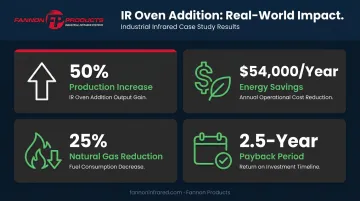
The question for buyers isn't whether an infrared lamp costs more than an incandescent heat lamp. It's whether the process improvement justifies the investment. In recurring industrial applications, it does.
For businesses working through that calculation, Fannon Products offers custom-engineered infrared systems and direct-fit replacement lamps across every size, wattage, and voltage configuration — shipped globally from their Michigan facility. Reach the Fannon team at sales@fannonir.com or 810-794-2000 for application-specific guidance.
Conclusion
Standard heat lamps and industrial infrared lamps both work — they're just built for different problems. A $12 incandescent bulb is the right answer for a restaurant buffet or a bathroom heater. It's the wrong answer for an automotive refinishing bay or a high-speed printing line.
For industrial and commercial operators, the distinction between these two technologies shows up directly in production metrics: cycle times, energy consumption, product quality, and maintenance frequency. Evaluate your heating task, material type, and production volume before committing to either approach. In process-critical environments, getting the wavelength and intensity right has a direct impact on output quality, throughput, and operating costs — not just equipment specifications.
Fannon Products has spent nearly 70 years helping industrial and commercial operators match the right infrared lamp to the right application. Whether you're replacing a lamp in an existing system or specifying a new heating setup, the engineering guidance and product range are there to support the decision.
Frequently Asked Questions
Is an infrared lamp the same as a heat lamp?
All infrared lamps produce heat via IR radiation, so technically yes. In practice, standard heat lamps are general-purpose incandescent bulbs designed for basic warmth, while industrial infrared lamps are engineered for specific wavelengths and process applications — a distinction that matters when precision and energy targeting are required.
Which is better, a red or clear heat lamp?
Functionally, they're nearly identical in heat output at the same wattage. Red lenses reduce visible glare and enhance the appearance of food, making them the standard choice in food service. Clear lamps are slightly less expensive and used in applications where the tinted light effect isn't needed.
What are infrared lamps used for in manufacturing?
The primary applications are automotive paint curing, inkjet and screen printing ink drying, plastics thermoforming, electronics reflow soldering, textile web drying, and glass annealing. Each of these processes benefits from direct, targeted heat rather than convection-based warming.
What is the difference between short-wave and long-wave infrared lamps?
Short-wave IR delivers high-intensity, instant heat over longer distances and is well-suited for outdoor use, rapid curing, and automotive applications. Long-wave IR provides gentler, more gradual warmth that soft materials and people absorb well, making it better for indoor comfort heating and delicate substrates.
Are infrared lamps more energy efficient than conventional heating?
Yes, particularly in large or open industrial environments where heating surrounding air first wastes energy. IR heats the target material directly, cutting that waste. A DOE/Oak Ridge powder coating case study found 25% lower natural gas use after adding IR to a convection process.
Can infrared lamps be used outdoors?
Short-wave infrared lamps are the best fit for outdoor use; their radiant heat isn't affected by wind. Medium- and long-wave lamps are less effective in exposed conditions, as heat dispersal in open environments reduces their efficiency.