What makes SWIR interesting is that it behaves differently from the thermal infrared bands most people associate with "heat cameras." It reflects off and absorbs into objects the way visible light does — which makes it useful for both high-contrast imaging and targeted energy delivery.
This guide covers everything you need to know: what SWIR actually is, how it behaves, how it compares to NIR and other infrared bands, and why it matters across industries ranging from food sorting and semiconductor inspection to industrial process heating.
TLDR: Key Takeaways About SWIR
- SWIR (Short-Wave Infrared) spans roughly 900nm–2,500nm — a range invisible to human eyes but detectable with specialized sensors and producible by infrared lamps
- Unlike thermal IR bands, SWIR reflects and absorbs like visible light, enabling high-contrast imaging and targeted energy delivery
- Water absorbs SWIR energy more than 60x more strongly at 1,440nm than at 970nm, which is why SWIR excels at moisture detection and material differentiation
- Industrial applications include inspection, surveillance, medical imaging, food sorting, and process heating, drying, and curing
- Where NIR ends and SWIR begins is debated, but SWIR wavelengths deliver stronger material differentiation and deeper penetration in practice
What Is SWIR? Definition, Wavelength Range, and Spectrum Position
SWIR stands for Short-Wave Infrared (sometimes written "shortwave infrared"). It defines a band of light in the electromagnetic spectrum sitting between Near-Infrared (NIR) and Mid-Wave Infrared (MWIR).
Where SWIR Sits in the EM Spectrum
The practical definition used across industry is 900nm to 2,500nm, though the exact boundaries shift depending on context. Edmund Optics defines SWIR as typically 0.9–1.7µm for imaging purposes, while broader spectroscopic applications extend the range to 2.5µm.
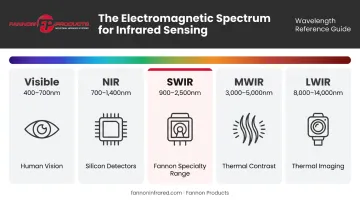
Here's how SWIR fits relative to adjacent bands:
| Band | Wavelength Range | Key Characteristic |
|---|---|---|
| Visible | 400–700nm | Detected by the human eye |
| NIR | 700–1,400nm | Partially accessible to silicon sensors |
| SWIR | 900–2,500nm | Requires specialized detectors |
| MWIR | 3,000–5,000nm | Thermal/emissive imaging |
| LWIR | 8,000–14,000nm | Standard thermal cameras |
SWIR is invisible to the unaided eye, despite being produced by many common sources including sunlight. One useful consequence: the night sky emits naturally in the SWIR band through atmospheric nightglow from OH radicals at roughly 92km altitude. SPIE research has shown that SWIR cameras can image passively on moonless nights using this airglow — no active illumination needed. That imaging capability, however, depends entirely on the detector. Standard cameras can't capture it at all.
Why Standard Cameras Can't See SWIR
Silicon-based sensors (standard CMOS and CCD) cap out at approximately 1,000–1,100nm. SWIR detection requires different materials entirely:
- InGaAs (Indium Gallium Arsenide) — the most common SWIR detector, typically covering 900–1,700nm
- Extended InGaAs — stretches sensitivity toward 2.6µm
- HgCdTe/MCT (Mercury Cadmium Telluride) — used for broader 1–3µm coverage
- CQD (Colloidal Quantum Dot) — a newer approach using solution-processed photodiode arrays
These material requirements have kept SWIR cameras expensive and limited to specialized applications. CQD technology is changing that — its solution-based fabrication process cuts manufacturing complexity significantly, pushing costs closer to conventional camera production.
SWIR Is Also an Energy Source
SWIR wavelengths aren't only detected. Specialized infrared lamps actively produce them for industrial heating — curing coatings, drying inks, forming plastics, and more. That dual role, as both a sensing band and a targeted energy delivery mechanism, explains why SWIR appears across such a wide range of industries.
How SWIR Light Behaves: Reflection, Absorption, and Material Interaction
SWIR works through reflection and absorption — the same mechanism as visible light, not heat detection. Unlike MWIR and LWIR cameras, which capture heat emitted by objects and produce blurry heat-map images, SWIR produces crisp, high-contrast images and deposits energy into specific materials. That distinction shapes everything about how SWIR is used.
Selective Absorption and Material Contrast
Different materials absorb and reflect SWIR wavelengths differently. This selective absorption is the source of SWIR's imaging power.
Water is the clearest example. Research published in PMC reports that water absorbs SWIR energy more than 60x more strongly at 1,440nm than at 970nm (NIR), and more than 260x more strongly at 1,940nm. Those strong absorption peaks at approximately 1,450nm and 1,950nm mean SWIR can detect moisture in materials — fruit, grain, textiles, coatings — with precision that NIR simply can't match.
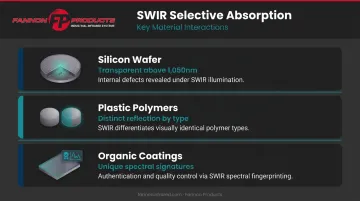
Several other materials show equally sharp contrast in SWIR:
- Silicon wafers turn transparent above their ~1,050nm band gap, exposing internal defects that visible light misses entirely
- Plastic polymers reflect SWIR at different intensities by type, allowing automated sorting of materials that look identical to the eye
- Organic coatings and compounds carry distinct spectral signatures across the SWIR range — useful for authentication and quality control
Penetration Through Opaque Materials
SWIR penetrates certain materials that block visible light. Plastic packaging becomes translucent. Paint layers can be seen through. Silicon wafers reveal internal cracks and particles. This makes SWIR well-suited to nondestructive testing — inspecting a finished product's interior without cutting it open or exposing it to damage.
Atmospheric Advantage
Longer wavelengths scatter less when passing through fog, haze, smoke, and humidity. Visible light breaks apart in those conditions; SWIR pushes through with far less degradation. In maritime imaging, for instance, a SWIR camera can resolve vessel details at distance through sea spray and low-visibility haze that renders a standard camera nearly useless. The same principle applies to outdoor surveillance, industrial monitoring in dusty environments, and airborne reconnaissance — any application where the atmosphere itself becomes an obstacle.
SWIR vs. NIR and Other Infrared Bands
The NIR-SWIR Overlap Problem
NIR is typically defined as 700–1,400nm. SWIR starts around 900–1,400nm depending on the source. The overlap is real and acknowledged across the industry — "SWIR" is sometimes used loosely to describe anything from 780nm upward.
The practical distinction matters more than the definitional one:
- NIR works within the sensitivity range of silicon sensors (below ~1,100nm) and is commonly used for basic imaging, facial recognition, and TV remotes
- SWIR requires specialized detectors and offers capabilities NIR can't match: stronger water and organic compound detection, silicon wafer transparency, and better atmospheric transmission
In practical terms, NIR ends where silicon sensors become blind — and SWIR begins where a fundamentally different detector takes over. That detector difference is also what separates SWIR from the rest of the infrared spectrum.
How SWIR Differs From Thermal IR
MWIR and LWIR detect emitted heat radiation from objects. Point a thermal camera at a person and you see their body heat. SWIR doesn't work that way — it images reflected radiation, the same physical mechanism as visible-light photography.
This difference has real practical consequences. SWIR cameras can image through glass — windshields, windows, lens covers — while MWIR and LWIR cannot. Visually, SWIR images resemble black-and-white photographs; MWIR/LWIR images look like heat maps.
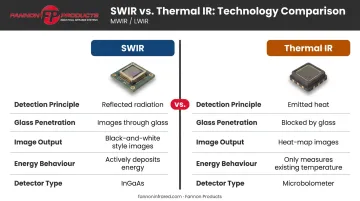
For industrial heating applications, this distinction is critical. A SWIR lamp actively deposits energy into a target material surface, driving a process — curing, drying, forming. Thermal imaging, by contrast, only measures the temperature that's already there. One causes change; the other records it.
SWIR Applications Across Industries
SWIR imaging solves problems that visible and NIR cameras can't — from detecting hidden cracks in silicon wafers to imaging through fog, glass, and biological tissue. Here's how it's used across key industries.
Industrial Inspection and Machine Vision
SWIR cameras are well-established in manufacturing quality control:
- Silicon wafer inspection — detects hidden cracks, particles, alignment marks, and cleaning defects by imaging through silicon above 1,050nm
- Solar wafer inspection — Teledyne's SWIR line-scan cameras are specifically positioned for defect detection beyond visible wavelengths
- Food sorting — detects bruising beneath intact fruit skin, foreign material in packaged goods, and moisture variation in grain
- Plastic sorting — differentiates polymer types that appear identical under visible light
- PCB and electronics inspection — reveals defects in components that standard cameras miss
Surveillance and Defense
SWIR cameras are used in border surveillance, maritime imaging, and military ISR (Intelligence, Surveillance, Reconnaissance) for several reasons:
- Passive night operation using atmospheric nightglow — no active illumination required
- Ability to image through glass (windshields, vehicle windows) unlike MWIR/LWIR
- Better performance in fog, haze, and humid conditions
- Useful at long ranges in outdoor environments
Medical and Scientific Imaging
SWIR's lower scattering compared to visible and NIR light means photons travel further through biological tissue before scattering — improving both penetration depth and image contrast.
Established and emerging applications include:
- Optical Coherence Tomography (OCT) — uses 1,300–1,600nm wavelengths to capture depth-resolved tissue data at 1–2mm imaging depth; the 1,600–1,800nm window is especially useful as it falls between water absorption bands
- Dental imaging — a 2024 clinical study found SWIR methods (1,000–2,300nm) showed higher sensitivity than radiographs for detecting interproximal lesions
- Intraoperative tumor margin detection — early-stage research is exploring SWIR hyperspectral imaging for real-time surgical guidance
Agriculture and Food Processing
SWIR's sensitivity to water content makes it valuable across the food supply chain:
- Moisture mapping in grain, alfalfa, and other crops
- Early detection of disease and stress in aerial hyperspectral imaging
- Food sorting by quality, composition, or contaminant presence
- Post-harvest quality grading on processing lines
The strong water absorption bands at 1,450nm and 1,950nm provide the spectroscopic foundation for all of these applications.
SWIR for Industrial Heating, Drying, and Process Technology
Beyond sensing, SWIR energy is actively used to heat things. Short-wave quartz infrared lamps emit radiant energy in the 0.9–2.5µm range and deposit it directly into the surface of target materials. The energy goes where it's needed rather than heating surrounding air, which is the core efficiency advantage over convective methods.
Industries and Applications
SWIR process heating is used across a broad range of manufacturing sectors:
| Industry | Typical Applications |
|---|---|
| Automotive | Primer, color coat, clear coat, powder coat curing; seat de-wrinkling |
| Printing | Ink drying on Heidelberg press lines; inkjet drying systems |
| Plastics | Thermoforming, welding, softening, curing |
| Textiles | Web drying, finishing, pre-shrinking |
| Food processing | Baking, browning, dehydrating, pasteurizing |
| Electronics | Reflow soldering, water dry-off |
| Glass-ceramics | Safety glass heating, mirror drying |

Fannon Products' SWIR Lamp Lines
Fannon Products, based in Algonac, Michigan, has been manufacturing short-wave infrared lamps since 1957. Their product line covers the full range of SWIR process heating requirements:
Standard Short-Wave Infrared Lamps
- Wattages: 1,000W to 6,000W
- Voltages: 120V to 600V (including 208V, 240V, 277V, 480V, 575V)
- Clear or translucent 3/8" O.D. quartz construction
- 96% radiant efficiency, 5,000+ hour life expectancy
- Instant on/off response for precise process control
For applications where eliminating secondary reflectors matters, the Goldenrod line builds the reflector directly into the lamp.
Goldenrod Short-Wave Infrared Lamps
- Integral 24K gold reflector directs energy toward the work surface
- Saves 23.5% energy expense compared to standard lamps by eliminating secondary reflectors
- Available in single or twin-tube designs
- Heated lengths from 1" to 58"
Twin-tube configurations offer a compact footprint for high-density installations, including press-line applications.
Twin-Tube Short-Wave Infrared Lamps
- 23mm x 11mm or 33mm x 15mm quartz configurations
- Wattages from 250W to 6,000W
- Used in Heidelberg Speedmaster press lines (74, 52, 102, 72, XL105)
- Available with or without integral gold reflectors
Fannon also manufactures replacement lamps to exact OEM specifications for Heidelberg, Fostoria, M&R, HP 3D printers, and several inkjet dryer brands. Selecting the right wavelength, wattage, and lamp configuration directly affects process efficiency and output quality. Fannon's technical team works with customers to nail that specification from the start.
Frequently Asked Questions
What is the meaning of SWIR?
SWIR stands for Short-Wave Infrared. It refers to electromagnetic radiation in approximately the 900nm–2,500nm wavelength range — beyond what human eyes can detect, but producible by infrared lamps and detectable by specialized sensors like InGaAs arrays.
What is SWIR used for?
SWIR serves two broad categories. For sensing and imaging, it supports industrial inspection, surveillance, medical diagnostics, food sorting, and hyperspectral analysis. For energy delivery, it drives industrial process heating, drying, and curing across automotive, printing, textiles, plastics, and electronics manufacturing.
What is the difference between NIR and SWIR?
NIR (Near-Infrared) typically covers 700–1,400nm; SWIR starts around 900–1,400nm, with real definitional overlap between them. In practice, SWIR wavelengths outperform NIR in three key areas: water and organic compound detection, silicon wafer transparency, and haze penetration. They also require specialized detectors rather than standard silicon sensors.
Can the human eye see SWIR light?
No. The visible spectrum ends at approximately 700nm, and SWIR begins around 900nm. SWIR light still interacts with objects — reflecting, absorbing, and penetrating materials — but these interactions are only detectable with specialized cameras and sensors, not the naked eye.
What industries use SWIR infrared lamps for heating?
Automotive (paint and coating curing), commercial printing (ink drying on press lines), plastics manufacturing (thermoforming and welding), textiles (web drying and finishing), food processing (pasteurizing and dehydrating), and electronics (reflow soldering) all rely on SWIR infrared lamps.