The answer almost always comes down to one misunderstood distinction: dry and cured are not the same thing. Dry means the surface is safe to touch. Cured means the coating has reached full hardness, adhesion strength, and durability. Confusing the two leads to damage that's entirely avoidable.
This article breaks down the science behind each stage, how long each actually takes by paint type, and how industrial operators can accelerate curing without creating new problems.
Key Takeaways
- Drying = surface evaporation of water or solvents; the paint feels dry but hasn't hardened
- Curing = chemical cross-linking that bonds the coating to the substrate and builds full durability
- Dry times run 1–8 hours; cure times run 2–30+ days depending on paint type and conditions
- Rushing curing causes marks, peeling, adhesion failure, and surface damage
- Infrared (IR) heat systems can cut industrial cure times by up to 60–90% compared to conventional drying
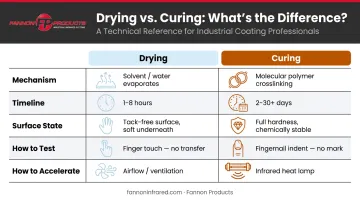
Paint Drying vs. Curing: Quick Comparison
| Factor | Drying | Curing |
|---|---|---|
| Mechanism | Physical evaporation of water or solvents | Chemical cross-linking and polymerization |
| Timeline | 1–8 hours (varies by paint type) | 2 days to 30+ days |
| Surface State | Touch-safe, not structurally stable | Full hardness, scratch resistance, adhesion |
| How to Test | Touch test — no tackiness | Fingernail test — no indent left on surface |
| How to Accelerate | Airflow, lower humidity, moderate warmth | Controlled dry heat, reduced humidity, IR heating |
What Is Paint Drying?
Drying is the first stage after application. Water or solvents in the paint formulation evaporate from the surface, leaving behind a film that feels stable to the touch. The paint isn't structurally bonded yet—it's simply lost enough surface moisture to stop feeling wet.
Typical touch-dry times by paint type:
- Latex/water-based paint: ~1 hour (Behr Premium Plus, Sherwin-Williams ProClassic)
- Oil-based enamel: 2–4 hours touch-dry; fully dry in 24 hours (Rust-Oleum Stops Rust)
- Chalk/mineral paint: 15–30 minutes touch-dry (Rust-Oleum Chalked, Dixie Belle)
These figures assume conditions around 77°F / 50% relative humidity. Cooler temperatures or higher humidity extend every one of these windows.
The Recoat Timing Trap
Dry to touch and ready to recoat are different thresholds—and confusing them is one of the most common painting mistakes.
- Behr Premium Plus: touch-dry in 1 hour, recoat after 2 hours
- Sherwin-Williams ProClassic: touch-dry in 1 hour, recoat after 4 hours
- Benjamin Moore ADVANCE: touch-dry in 4–6 hours, recoat after 16 hours
Applying a second coat before the first has properly dried causes streaking, lifting, and poor adhesion between coats. One more thing to keep in mind: paint can labels display dry time, not cure time—which is why so many projects end up with adhesion problems down the line.
What Is Paint Curing?
Curing is the deeper chemical process that happens after drying. As Benjamin Moore defines it, cure time is the amount of time a coating needs to reach optimum performance—and paint cannot cure until it has first dried.
During curing, residual solvents continue evaporating while polymers in the paint cross-link and chemically bond to the substrate. This is what creates final hardness, scratch resistance, and adhesion strength.
Typical cure times by paint type:
- Latex/water-based: 2–3 weeks (Benjamin Moore); 2 weeks before mild cleaning (Behr)
- Oil-based: approximately 5 days for full cure (Benjamin Moore)
- Chalk/mineral paint: 21–30 days (Dixie Belle)
- Enamel/cabinet paint: heavy use restricted for 5–7 days; optimum hardness up to 30 days (Benjamin Moore ADVANCE)
What Uncured Paint Looks Like in Practice
A surface can be touch-dry for days while remaining vulnerable. Common damage scenarios:
- Pushing a sofa against a freshly painted wall and pulling it away to find the paint has lifted
- Opening newly painted cabinet doors and hearing them stick, or finding the paint has transferred
- Applying painter's tape before the 24-hour minimum and tearing the finish when removing it
- Cleaning a painted surface too soon and leaving streaks or dull patches
Benjamin Moore ADVANCE explicitly warns against returning shelves and tabletops to service for at least 5–7 days. ScotchBlue and FrogTape both specify waiting at least 24 hours before applying tape to fresh paint.
Why Industrial Environments Care More About This
Those household examples illustrate the principle — but in automotive refinishing, metal coating, and plastics manufacturing, the stakes scale up considerably. Incomplete curing is a production problem, not just a cosmetic one.
Research on automotive repair workflows found defect-rate reductions of 63–68% after standardizing procedures that included proper flash time and baking protocols. Blistering, adhesion failure, and crater defects in cured film are direct consequences of shortcuts in the curing stage.
To verify full cure, the standard professional methods are ASTM D3363 (pencil hardness test) and ASTM D5402 (solvent-rub test). An informal field check — pressing a fingernail firmly into an inconspicuous area — can indicate whether curing is still in progress. It's a useful quick read, but not a substitute for formal testing.
How to Speed Up the Curing Process
Environmental Conditions
The baseline matters before anything else. Most manufacturer test data is based on 77°F / 50% RH. Deviating from this range stretches cure times significantly:
- Temperature below 50°F: Dramatically slows or stalls curing
- Humidity above 85%: Exceeds the maximum threshold for most coating applications per DeFelsko and PPG product documentation
- Poor ventilation: Slows solvent escape, prolonging the cure window
Good airflow—fans, ventilation systems, air make-up units—accelerates solvent removal and supports more consistent curing throughout the film, not just at the surface.
Convection Ovens and Drying Rooms
Circulating hot air in a controlled environment maintains consistent temperatures throughout the curing cycle. This is the established method for industrial powder coating and automotive finishing, where bake cycles are engineered to specific coating and substrate combinations. The limitation is efficiency: convection relies on heated air soaking into the substrate from the outside, which takes time.
Infrared (IR) Curing
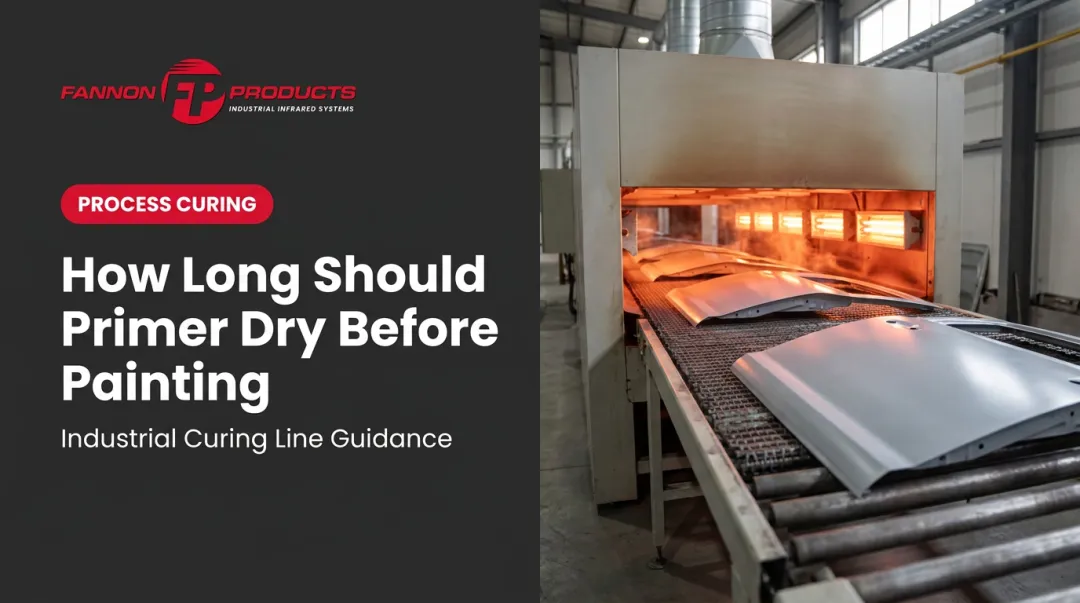
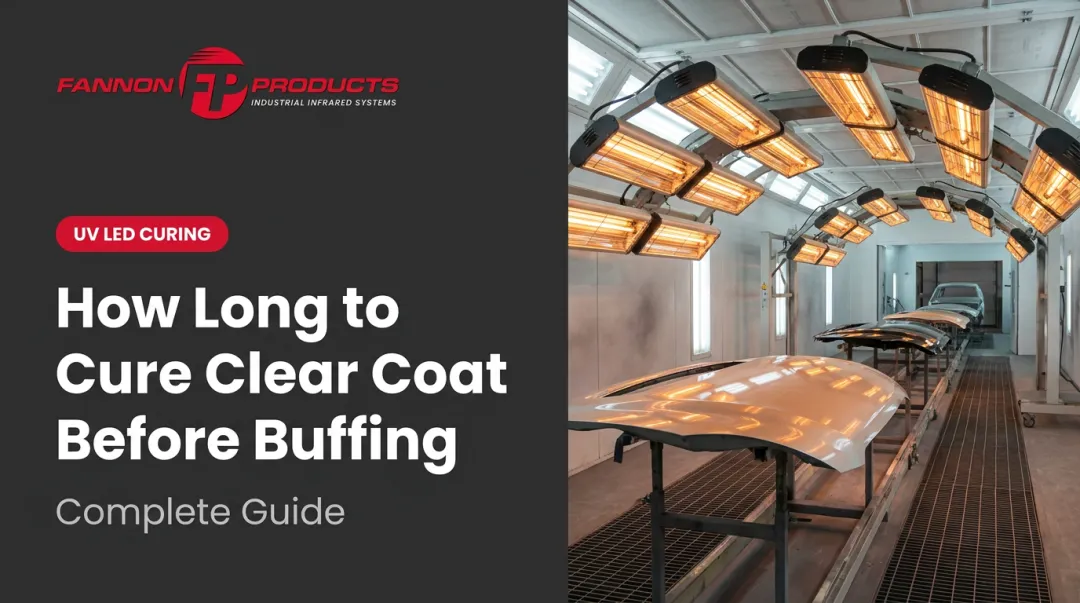
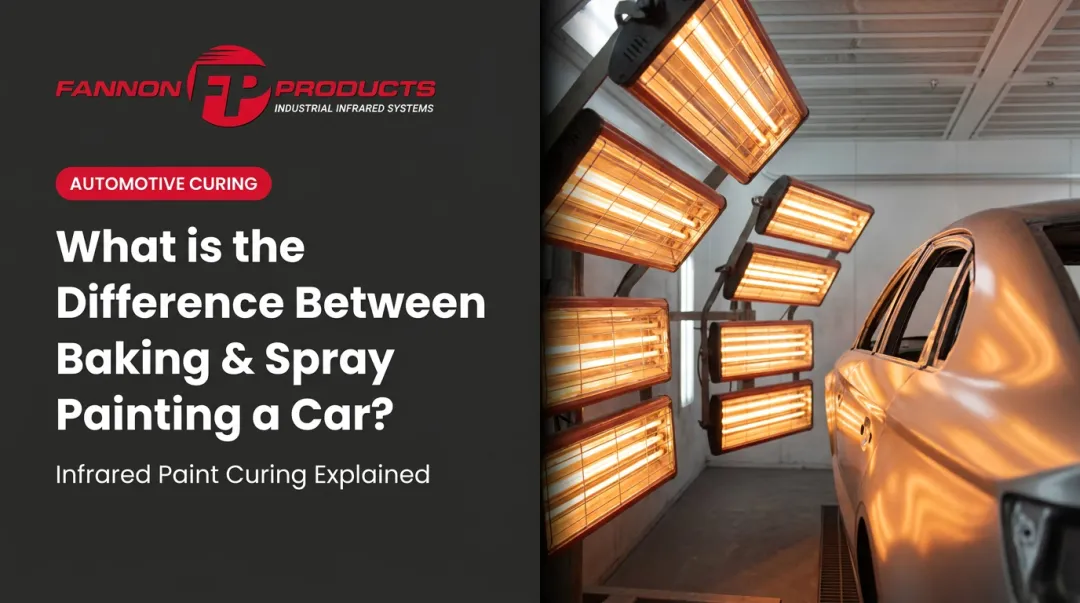
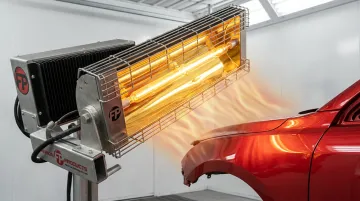
IR is the most efficient industrial method available. Rather than heating surrounding air, infrared lamps emit targeted radiant heat that penetrates the coating and drives the curing reaction from within. The results are documented: IR ovens are typically 2–4 times faster than convection and can reduce total cure time by 60–90%. One production example reduced conveyor line length from 250 feet to 110 feet—a 56% footprint reduction—at the same throughput speed.
Fannon Products manufactures short-wave IR lamps engineered for automotive paint curing, achieving 96% radiant efficiency with instant on/off response. Their Goldenrod lamps—built with an integral 24K gold reflector—direct energy precisely toward the work surface and use 23.5% less energy than standard lamps by eliminating the need for a secondary reflector.
What Not to Do
More heat is not better heat. Unmanaged IR emitters can burn coatings, causing the surface to skin over before the body of the film has cured—trapping solvents that later expand into bubbles or blisters. KTA documents osmotic pressures inside coating blisters that can exceed 15,000 psi, enough to overcome adhesion entirely.
Avoid these curing shortcuts:
- Applying heat too aggressively or without surface-temperature monitoring
- Covering freshly painted surfaces, which prevents solvent off-gassing
- Recoating before the previous coat has properly dried
- Using heaters or heat guns near paints sensitive to temperature shifts (an 11°C change can affect color, per Benjamin Moore)
Practical Cure Timeline
| Stage | Timeline |
|---|---|
| Touch-safe | 1–2 hours (latex); 2–4 hours (oil-based) |
| Safe to recoat | 2–4 hours (latex); 24 hours (oil-based) |
| Safe for light use | 48–72 hours |
| Safe to clean or apply pressure | 2–3 weeks (consumer paints, standard conditions) |
| Industrial IR curing | Hours, not weeks—compressed by 60–90% with controlled systems |
Conclusion
Drying and curing describe two fundamentally different states. One means a surface won't transfer paint onto your finger. The other means the coating has reached its designed hardness, adhesion, and chemical stability. Treating a dried surface as a cured one is the most common cause of avoidable paint damage—in homes, shops, and production facilities alike.
For manufacturers, automotive operations, and industrial coating lines, controlling the curing environment isn't a finishing touch—it's a production variable. Infrared heating technology can compress cure cycles from weeks to hours, cutting defect rates and giving production lines tighter control over throughput. That's the practical payoff of knowing the difference—and building your process around it.
Frequently Asked Questions
Frequently Asked Questions
Is 2 hours enough for paint to dry?
Most latex paints are touch-dry within about 1 hour, but that only confirms surface evaporation has occurred. For recoating, manufacturers typically recommend waiting 2–4 hours minimum. "Dry" at 2 hours does not mean ready for use or close to cured.
How long until paint is fully cured?
Latex and water-based paints cure in 2–3 weeks; oil-based paints reach full cure in about 5 days; chalk paints typically need 21–30 days. Industrial IR curing systems compress all of these timelines significantly.
Does paint look better after it cures?
Yes. As chemical bonding completes, colors often deepen slightly and sheen levels even out. Poorly cured films can appear hazy or uneven due to micro-voids in the coating, which resolves as curing progresses.
What happens if you use a surface before paint is fully cured?
Uncured paint is soft and chemically reactive. Contact, pressure, or cleaning can leave marks, indentations, fabric impressions, or cause peeling and adhesion failure. The surface can look fine while the damage sets in beneath it.
Can infrared heat speed up paint curing?
Yes. IR lamps emit radiant heat that penetrates the coating and accelerates chemical cross-linking from within, unlike convection methods that heat the surrounding air first. In industrial settings, IR systems reduce cure times by 60–90% compared to convection methods.
How do you test if paint is fully cured?
Press a fingernail firmly into an inconspicuous area: an indent means curing isn't complete; no mark means it likely is. For formal verification, ASTM D3363 (pencil hardness) and ASTM D5402 (solvent-rub) are the accepted professional standards.