Whether you're specifying upholstery for a commercial space, sourcing workwear for a hazardous environment, or running a textile production line, understanding finish types — and how they're applied — determines whether the end product succeeds or fails.
This guide covers the three main categories of fabric finishes, how each is applied, and how to match the right finish to your specific application.
Key Takeaways
- Fabric finishes are treatments applied after construction to change how a textile looks, feels, or performs
- The three main categories are aesthetic, functional/protective, and structural finishes
- Finish selection depends on end-use environment, regulatory requirements, and treatment compatibility
- Heat drives curing, heat-setting, and drying — making thermal application method a critical process variable
- Mismatched or missing finishes risk product failure, safety hazards, and regulatory non-compliance
What Are Fabric Finishes?
CottonWorks defines finishing as any chemical process — other than preparation or color application — that imparts useful or desired properties to a textile product. It's the final step in textile production, applied after the fabric has been woven, knitted, dyed, and prepared.
The starting point is what the industry calls greige goods — raw, unfinished fabric in its loom state, not yet dyed or finished. According to the ACT Contract Textile Glossary, dyeing, printing, and finishing are all distinct conversion steps applied to greige goods. They're sequential, not interchangeable.
The distinction matters because a fabric's inherent properties — the natural softness of cotton, the stretch of a knit — only take you so far. Applied finishes are where performance is actually engineered. A cotton canvas may be perfectly functional as a raw material, but without a water-repellent finish, it fails immediately in an outdoor application.
Inherent Properties vs. Applied Finishes
| Property Type | Examples | Changed by Finishing? |
|---|---|---|
| Inherent | Natural softness, fiber strength, base weight | No |
| Applied | Water repellency, flame resistance, dimensional stability | Yes |
The same base fabric can serve dozens of end uses depending on what finishing treatments are applied — which is why understanding the full range of finish types is the practical starting point for any fabric specification decision.
Why Fabric Finishes Matter in Textile Processing
Unfinished fabric fails quickly in real-world conditions. It stretches out of shape, frays at cut edges, absorbs spills, fades under UV exposure, and can support microbial growth. In certain applications, an unfinished textile isn't just a performance problem — it's a regulatory one.
Industries with the Highest Finish Stakes
- Children's sleepwear — CPSC regulations (16 CFR Parts 1615/1616) require fabric and garments to pass flammability tests. A June 2026 CPSC recall of children's pajamas for flammability violations shows the real cost of finish failure.
- Automotive interiors — FMVSS 302 requires occupant-compartment materials to not transmit a flame front at more than 102 mm/min
- Commercial upholstery — California TB 117-2013 governs smolder resistance in upholstered furniture
- Public-space draperies — NFPA 701 covers flame propagation of textiles and films
- Industrial workwear — OSHA FR guidance covers flame-resistant clothing for electric-power and arc-flash hazards
- Healthcare and food service — Antimicrobial finishes are subject to EPA treated-article rules governing what claims can be made
In high-hazard environments, finish selection isn't a specification detail — it determines whether a product can legally ship at all.
Types of Fabric Finishes
Fabric finishes fall into three distinct categories based on what they're designed to achieve. Choosing the wrong category — applying a structural finish when you need performance, for example — creates problems no amount of product layering will fix.
Aesthetic and Decorative Finishes
Aesthetic finishes alter how a fabric looks or feels without adding protective properties. The goal is consumer experience — texture, sheen, softness, or visual pattern.
Common examples:
- Softening (chemical or mechanical): improves hand feel, often applied via padding or exhaust
- Mercerization: cotton-specific chemical treatment that permanently increases luster, strength, and dye affinity
- Calendering: fabric passes through heated, pressurized rollers to produce smoothness, sheen, or embossed patterns
- Napping/brushing: wire rollers raise surface fibers to create a soft, raised texture
Best suited for: Apparel (fashion, athleisure, intimate wear), home textiles (bed linens, drapes, upholstery), and anywhere tactile quality drives purchase decisions.
Key limitation: Most aesthetic finishes don't add durability. Some, like softeners, can actively interfere with functional finishes. AATCC notes that fabric softeners are enemies of many performance finishes, with negative effects on stain and water repellency performance — a critical consideration when layering treatments.
Functional and Protective Finishes
Functional finishes give fabric performance properties it wouldn't otherwise have. They're applied through chemical processes — padding, spraying, or coating — and address specific environmental threats.
Key finish types and their applications:
| Finish | Primary Use Case | Regulatory Relevance |
|---|---|---|
| Durable Water Repellent (DWR) | Outdoor textiles, activewear | PFAS restrictions (EU, US) |
| Flame Retardant (FR) | Children's products, commercial interiors, workwear | CPSC, NFPA 701, FMVSS 302 |
| Antimicrobial | Healthcare, food service, odor control | EPA treated-article rules |
| UV Resistance | Outdoor canopies, awnings, automotive | — |
| Anti-static | Electronics assembly environments, workwear | — |
| Stain-resistant | High-traffic upholstery, hospitality | — |
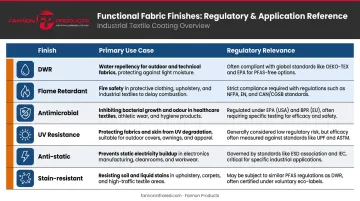
On PFAS-based DWR: The European Environment Agency identifies PFAS as persistent chemicals used in textiles for water, oil, and dirt repellency. Regulatory pressure is mounting across the EU and, increasingly, in the US. PFAS-free DWR alternatives exist, but none currently match PFAS performance across all applications — selection depends on end-use requirements.
Compatibility note: Combining functional finishes requires testing. DWR and FR treatments can conflict; softeners can undermine both. Don't assume layered finishes will coexist without validation.
Structural Finishes
Structural finishes improve the physical stability and dimensional integrity of a fabric. They're often invisible to the consumer but have the most direct impact on how long a textile lasts under mechanical stress.
Common structural finishes:
- Heat setting: fixes fibers within yarns and fabrics in their final shape; especially important for nylon and polyester to prevent distortion
- Sanforizing (compressive pre-shrinking): mechanically compresses fabric structure to reduce length shrinkage after washing
- Backing (knit, acrylic foam, or latex): adds a support layer to the back of upholstery or technical fabrics
- Lamination: bonds a fabric layer to a film, foam, or other substrate using heat, pressure, or adhesive
- Calendering (structural application): uses heat and pressure to compact and stabilize surface structure — distinct from its use as an aesthetic finish
Best suited for: Upholstery, automotive textiles, outdoor canopies and awnings, any application involving repeated mechanical stress or dimensional precision.
Backing and lamination add weight and stiffness, which reduces drape and flexibility. Where soft hand or free movement is a design requirement, these finishes are the wrong tool.
How Fabric Finishes Are Applied
Finishing operations use wet, dry, mechanical, and thermal processes — often in combination on the same production line.
Wet (Chemical) Application Methods
CottonWorks documents several chemical application methods, each suited to different chemistries and add-on control requirements:
- Padding — fabric passes through a chemical bath and rubber squeeze rolls; delivers uniform wet pickup across the full width
- Spraying — liquid chemistry pumped through nozzles onto one or both fabric surfaces; lower wet pickup than padding, reduced energy for drying
- Knife-over-roll / doctor knife — thickened chemistry or foam spread under a stationary blade; standard for coating applications
- Dip / immersion — full fabric immersion followed by drying and oven curing; used for garment-level finishing
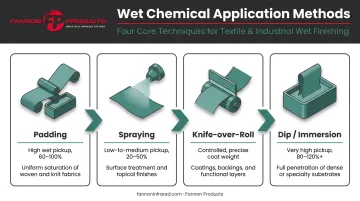
For a finish to be durable, the chemistry must bond to or penetrate the fiber structure — application method directly affects how well that bonding occurs.
Mechanical Application
Mechanical finishes change a fabric's physical structure without chemicals:
- Calendering passes fabric through heated, pressurized rollers to smooth the surface, add sheen, or create embossed patterns
- Brushing and napping use wire rollers to raise surface fibers, creating softer, more textured hand feel
- Compressive shrinkage (sanforizing) mechanically compacts the fabric lengthwise to pre-stabilize dimensions
Thermal and Infrared Heat Application
Heat is not optional in most finishing operations — it's what makes finishes permanent. Heat setting stabilizes synthetic fiber structure. Curing bonds chemical finishes to the fiber. Drying removes moisture after wet application.
Infrared heating technology is widely used in industrial textile finishing lines for precision curing and drying. Unlike convection ovens, which heat surrounding air before transferring energy to the fabric, infrared systems transfer heat directly to the substrate via electromagnetic radiation. The result: faster cycle times, more precise control, and a smaller equipment footprint.
Fannon Products, a Michigan-based manufacturer with nearly 70 years in infrared technology, designs and builds custom infrared systems for textile applications including web drying, finishing, and pre-shrinking. Their systems offer 96% radiant efficiency and instant on/off response, which is particularly valuable in continuous finishing lines where line speed and heat delivery need to stay in sync.
For screen printing operations, Fannon also supplies replacement infrared lamps for M&R flash dryers. These use medium-wave technology that's less color-sensitive to light and dark plastisols, reducing color bleed risk on multicolor garment printing runs.
Surface Modification (Advanced Applications)
For technical and industrial textiles, plasma, corona, and flame surface treatments modify a fabric's surface energy before coating or lamination. These processes improve adhesion without applying a coating themselves — they prepare the surface to accept one more effectively. These treatments apply primarily to technical textile manufacturing, not standard commercial finishing lines.
How to Choose the Right Fabric Finish
The right finish is determined by end use — a simpler finish applied correctly will outperform a premium one chosen for the wrong reasons.
The Selection Decision Chain
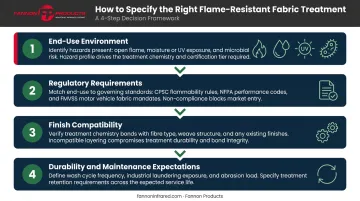
Work through these factors in order:
End-use environment — Identify the dominant hazard. Moisture? UV? Flame risk? Bacteria? Mechanical stress? The hazard determines the finish category before anything else.
Regulatory requirements — Before considering aesthetics or preference, confirm whether the application is subject to mandatory standards: CPSC sleepwear rules, CAL TB 117-2013, NFPA 701, FMVSS 302, OSHA FR guidance, EPA antimicrobial claim rules, or OEKO-TEX Standard 100 chemical limits. These aren't optional — they're the floor.
Finish compatibility — Determine whether your required finishes can coexist. Softeners and FR treatments may conflict. DWR and FR combinations require careful formulation. Test combinations before committing to a production specification.
Durability and maintenance expectations — Structural finishes like heat setting and mercerization are permanent under normal commercial washing conditions. Many functional finishes — DWR, antimicrobial — are durable but diminish with washing and may require reapplication. Match durability to the product's expected service life and washing conditions.
Common Selection Mistakes
Getting the decision chain right still leaves room for predictable errors. Watch for these three:
- Cost without benefit: A premium DWR spec on a casual outdoor umbrella adds expense without matching the performance demands of technical outerwear. Match the finish tier to the actual use case.
- Untested combinations: Layering finishes without testing them together is one of the most common sources of unexpected performance failure. Compatibility testing before production specification is non-negotiable.
- Availability bias: Defaulting to what your current supplier stocks rather than what your application actually needs can compromise performance from the start.
Frequently Asked Questions
What are the types of fabric finishes?
Fabric finishes fall into three main categories: aesthetic/decorative (softening, glazing, mercerization, calendering), functional/protective (DWR, flame retardant, antimicrobial, UV resistance, stain-resistant), and structural (backing, lamination, heat setting, sanforizing). Each category addresses a different aspect of fabric performance.
What is the difference between a mechanical and a chemical fabric finish?
Mechanical finishes alter fabric structure using physical force, heat, or machinery — calendering and brushing are examples. Chemical finishes apply substances to the fiber to add protective or functional properties, such as water repellents or flame retardants. Many finishing operations use both in sequence.
Is fabric finish permanent or does it wear off over time?
Structural finishes like heat setting and mercerization are generally permanent. Functional finishes — DWR, antimicrobial treatments — are durable but diminish with repeated washing and may need periodic reapplication.
What is the difference between fabric finishing and fabric dyeing?
Dyeing adds color to the fabric. Finishing improves or alters the fabric's functional and aesthetic properties after it has been constructed and dyed. They are sequential steps — industry bodies like CottonWorks and ACT treat them as distinct conversion processes applied to greige goods.
What fabric finishes are most important for industrial and technical applications?
Industrial applications typically prioritize structural finishes (backing, lamination, calendering) for dimensional stability and functional finishes (FR, chemical resistance, UV resistance, anti-static) for safety and environmental durability. Regulatory compliance — FMVSS 302, NFPA 701, OSHA FR standards — often dictates which finishes are mandatory.
How does heat treatment play a role in fabric finishing?
Heat is used in heat setting (to lock synthetic fiber structure), calendering (to smooth and add sheen), and curing (to permanently bond chemical finishes to the fabric). In industrial finishing lines, controlled infrared heat is valued for its precision — it transfers energy directly to the substrate rather than heating the surrounding air, which supports faster cycle times and tighter process control.