The problem is that the wrong removal method for the wrong coating type doesn't just fail to work — it damages traces, lifts pads, and stresses solder joints. According to IPC-7711/7721, which governs conformal coating removal and replacement procedures, coatings must be removed in almost all assembly repair cases, making a systematic approach non-negotiable.
This guide covers how to identify your coating type, match it to the correct removal method, execute the process step by step, and avoid the mistakes that cause irreversible board damage.
Key Takeaways
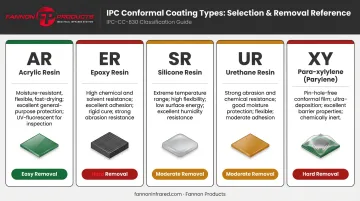
- There are five IPC-designated coating types — AR, ER, SR, UR, and XY — each requiring a different removal approach
- Coating identification must happen before any removal attempt; mismatched methods damage boards
- Five removal methods exist: chemical solvent, thermal, mechanical peeling, grinding/scraping, and micro-sandblasting
- Epoxy (ER) and parylene (XY) resist solvents and require physical or thermal methods
- UV inspection at 320–380 nm is the standard post-removal verification method
What Is Conformal Coating and When Does It Need to Be Removed?
Per IPC-CC-830C, conformal coating is a protective insulating film designed to shield PCB assemblies from moisture and contamination. Its job is protection only — it adds no mechanical strength to the assembly.
The Five IPC-Designated Coating Types
| IPC Code | Coating Type | Characteristics |
|---|---|---|
| AR | Acrylic | Glossy; easiest to remove; solvent-responsive |
| ER | Epoxy | Hard, glossy; solvent-resistant; difficult to remove |
| SR | Silicone | Semi-gloss, rubbery; flexible; moderate removal difficulty |
| UR | Urethane | Glossy, hard; moderate solvent resistance |
| XY | Parylene | Matte, ultra-conformal; insoluble in most solvents; hardest to remove |
When Removal Becomes Necessary
Removal is typically required when:
- Defective application — bubbles, pinholes, incomplete coverage, or improper thickness
- Component repair or replacement — access to a specific area of the board is needed
- Circuit rework — modifications require unobstructed access beneath the coating
- Failure analysis — unobstructed substrate inspection is needed to determine root cause
Removal difficulty tracks closely with coating resilience. Parylene and epoxy resist heat, abrasion, and chemical attack simultaneously — making them far more demanding to remove than acrylic, which responds readily to common solvents.
How to Identify Which Conformal Coating Is on Your PCB
Choosing the wrong removal method is the single most preventable cause of board damage during rework. IPC-7711B/7721B is explicit: the purpose of coating identification is to select the appropriate removal method. It is not optional.
Checking for IPC or JEDEC Labels
The fastest and most reliable method is locating the IPC/JEDEC designation stamped or labeled on the board. IPC/JEDEC J-STD-609 provides a marking and labeling system specifically to identify the conformal coating type on PCB assemblies — aiding assembly, rework, repair, and recycling.
Look for the two-letter codes: AR, ER, SR, UR, or XY. If the code is present, use it. Everything else is a fallback.
Material Testing When No Label Is Present
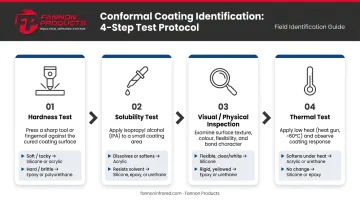
When no label exists, use these localized tests — in a non-critical board area only.
Run each test and cross-reference results to narrow the coating type:
- Hardness: Press gently with a non-conductive tool. Soft yield (silicone, thin acrylic) suits solvent or brush removal; no yield (epoxy, parylene) requires abrasive or thermal approaches.
- Solubility: Brush a small amount of isopropyl alcohol on the test area. Dissolution suggests acrylic; no reaction narrows it to epoxy, silicone, urethane, or parylene. Never immerse the board in harsh solvents during testing — components can be attacked.
- Visual/physical: Glossy surface points to acrylic or epoxy; rubbery and flexible indicates silicone; matte, ultra-thin film with sharp component outlines is parylene; thick coating with visible fillets suggests epoxy or urethane.
- Thermal: Using a controlled tool starting at 100°C (per IPC guidance), observe the coating's response. Softening at low temperature indicates acrylic or thin urethane; no response points toward epoxy or parylene.
Conformal Coating Removal Methods: Which Works Best for Each Type
Most real-world removals combine two methods : solvent softening followed by mechanical scraping is the standard approach for harder coatings. Each method has an optimal coating match, and using the wrong one risks board damage without achieving complete removal.
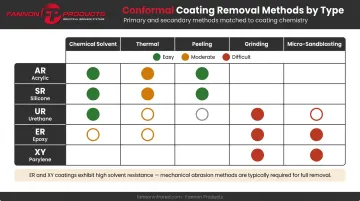
| Coating Type | Recommended Method(s) |
|---|---|
| Acrylic (AR) | Chemical solvent (primary); thermal |
| Silicone (SR) | Chemical solvent; peeling (thick RTV) |
| Urethane (UR) | Chemical solvent; thermal; grinding |
| Epoxy (ER) | Micro-sandblasting (primary); grinding |
| Parylene (XY) | Micro-sandblasting (primary); grinding |
| Thick silicone / RTV | Peeling; grinding |
Chemical Solvent Method
The most widely used removal method, and the strongest fit for acrylic (AR) coatings. Silicone (SR) and urethane (UR) also respond, but typically need longer soak times and active agitation.
Standard IPA is not sufficient for removing cured conformal coating resins. Aromatic solvents such as toluene or xylene, or purpose-formulated coating removers, are required. Some formulated strippers can handle select epoxies, though this is chemistry-dependent.
Important: OSHA warns that toluene exposure without proper ventilation can cause eye, nose, and throat irritation, headache, and dizziness, with vapor concentrations capable of forming explosive air mixtures. NIOSH similarly classifies xylene as a flammable liquid with irritant properties. Ventilation and appropriate PPE are required at all times.
Thermal (Infrared/Heat) Method
Controlled low-temperature heating softens or granulates coating material, making it effective for acrylic, urethane, thin silicone, and epoxy. The IPC-supported starting point is 100°C ; increase only as needed based on observed coating response.
A soldering iron is the wrong tool here. It delivers highly localized point heat, risks overheating components, and creates uneven thermal stress across the board. Purpose-built infrared heat sources provide more uniform, controllable heat distribution across the target area , which is what board-level thermal removal requires.
Fannon Products manufactures medium-wave infrared process-heating systems used in electronics manufacturing for reflow soldering and PCB dry-off. These systems provide instant on/off response and 0–100% output adjustment, giving operators direct control over heat delivery without the point-contact risk of a soldering iron.
Peeling Method
Limited to thick RTV silicone or flexible rubber coatings. A dull blade slits the material, and the coating peels away in sections. This method carries a real risk of lifting pads or leads if the coating has strong adhesion to the substrate ; use it only when the coating is clearly thick, rubbery, and showing no adhesion to copper features.
Grinding and Scraping Method
Rotary tools with rubber abrasive tips (hard coatings) or rotary brushes (soft coatings) abrade the coating mechanically. Applicable to parylene, epoxy, urethane, and thick silicone. The significant risk here is electrostatic discharge ; ESD-safe tooling is essential whenever abrasive methods contact static-sensitive boards.
Micro-Sandblasting Method
The preferred primary method for parylene (XY) and epoxy (ER), both of which resist solvents and may not respond sufficiently to low-temperature heat. A concentrated stream of fine abrasive powder (wheat starch or sodium bicarbonate are documented media choices) flakes the coating away with minimal thermal input.
The sandblasting system must carry ESD-rated capabilities. Ionized work chambers and point ionizers reduce electrostatic risk during abrasive operations on sensitive components.
Step-by-Step: How to Remove Conformal Coating from a PCB
Jumping straight to removal without completing identification and method selection is how boards get damaged. Work through each step in sequence.
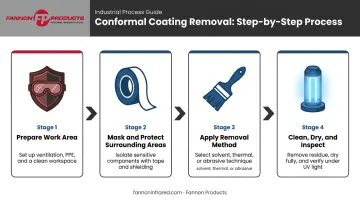
Step 1: Prepare Your Work Area and Safety Equipment
Gather before you start:
- Dedicated ventilated workspace or explosion-proof ventilation hood for solvent work
- PPE: nitrile gloves, safety glasses, and a face shield for heavy scrubbing or abrasive work
- Stainless steel containers for solvent soaking — not aluminum or plastic, which can be attacked by aromatic solvents
- UV inspection lamp (320–380 nm wavelength) for post-removal verification
- ESD-safe mat and wrist strap if working with abrasive methods
Step 2: Mask and Protect Surrounding Areas
Apply high-temperature polyimide (Kapton) tape or a peelable solder mask to define the removal boundary. This protects components and board areas that should not be exposed to solvent, heat, or abrasion during the process.
Step 3: Apply the Selected Removal Method
Spot solvent removal:
- Saturate a solvent-compatible swab or brush with the appropriate remover
- Apply to the masked area; allow dwell time for the coating to soften
- Scrub gently with a brush or wooden stick to lift the resin
- Wipe away dissolved buildup and re-saturate as needed
- Repeat until the area is clear
Full-board solvent soak:
- Immerse the board in solvent for at least one hour
- Lift and rinse with fresh solvent; scrub where needed
- Discard contaminated solvent — do not return the board to it
- Repeat until the board is clear
For thermal, abrasive, or micro-sandblasting methods: Apply the same masking from Step 2 and use the appropriate controlled heat source or ESD-safe equipment. Work in passes — multiple light passes outperform one aggressive application every time.
Step 4: Clean, Dry, and Inspect
Rinse or neutralize the stripped area. Allow the board to dry fully before reconnecting power, since residual solvent near energized connections is a fire risk.
Inspect under a UV black light at 320–380 nm. Most conformal coatings contain a UV tracer that fluoresces under ultraviolet light, revealing residual coating invisible to the naked eye. Any areas that still glow need additional treatment before the board goes back into service.
Common Mistakes to Avoid
Using the Wrong Removal Method for the Coating Type
Defaulting to the most convenient method — rather than the one matched to the identified coating — is the most common mistake. Aromatic solvents applied to parylene accomplish nothing except component exposure to harsh chemistry. A grinding tool applied to acrylic is overkill that risks trace damage. Always identify the coating type before choosing a removal approach.
Skipping Post-Removal UV Inspection
Visual inspection under normal light is not sufficient. Residual coating can be nearly invisible to the naked eye but will fluoresce under UV. Returning a board to service without UV verification risks hidden moisture ingress and field failure at the exact location you thought was repaired.
Using Incompatible Tools and Containers
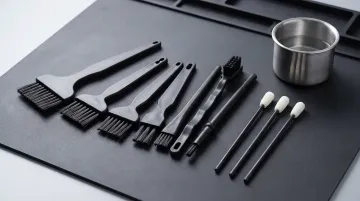
- Cotton swabs fray in harsh solvents and leave fibers on the board
- Nylon brushes generate static near sensitive components — use ESD-safe brushes instead
- Aluminum or plastic containers can be attacked by aromatic solvents; use stainless steel
- Foam swabs vary in solvent compatibility — verify any foam swab is rated for your specific solvent chemistry
Ignoring Ventilation and ESD Precautions
Two separate risks demand attention here:
- Solvent fumes: Aromatic solvents in unventilated spaces are both a health hazard and a fire risk
- Static discharge: Abrasive methods on static-sensitive boards without ESD-rated equipment cause invisible damage that only surfaces as field failure weeks or months later
Frequently Asked Questions
Can all conformal coatings be removed with chemical solvents?
No. Acrylic (AR) is the strongest candidate for solvent removal. Silicone and urethane respond with longer soak times and agitation. Epoxy and parylene resist most organic solvents — parylene remains insoluble in common organic solvents even at elevated temperatures — and require physical or thermal methods instead.
How do I identify which type of conformal coating is on my PCB?
The fastest method is locating an IPC/JEDEC label on the board showing the two-letter code: AR, ER, SR, UR, or XY. Without a label, material testing for hardness, IPA solubility, surface gloss, and flexibility per IPC guidelines can identify the coating without risking board damage.
Is the thermal method safe for all PCB components?
Not universally. Thermal removal requires a controlled low-temperature tool starting at 100°C — a soldering iron is not a substitute. Temperature-sensitive components in the removal zone may rule out this method entirely.
What is the best way to verify that conformal coating has been fully removed?
UV inspection using a 320–380 nm black light is the standard method. Most conformal coatings contain a UV tracer or brightener that fluoresces under ultraviolet light, making residue visible even when it looks clear under normal light.
Can I remove conformal coating from just one area without affecting the rest of the board?
Yes — spot removal is common for component replacement or rework. Mask the boundary with Kapton tape or a peelable solder mask to isolate the area, then use a conformal coating remover pen or a solvent-compatible swab for precise application.
Why isn't isopropyl alcohol (IPA) sufficient for removing conformal coating?
IPA is too mild to dissolve cured conformal coating resins. It works for localized solubility testing during coating identification, but effective removal requires purpose-formulated coating removers or stronger aromatic solvents capable of breaking down the cured polymer film.