Introduction
Workplace heat injuries are more common than most industrial operators realize. According to OSHA and BLS data, approximately 33,890 work-related heat injuries and illnesses resulted in days away from work between 2011 and 2020. In 2020 alone, roughly 10,790 private-industry cases involved contact with hot objects or substances — the closest public category to lamp housings, heated fixtures, and process surfaces.
For sectors like automotive paint curing, commercial printing, and food service, where infrared heat lamps run for hours at high wattage near workers and flammable materials, those numbers carry real weight. A single incident means worker injury, equipment downtime, production delays, and potential regulatory exposure.
Infrared heat lamps are well-understood tools with decades of proven industrial use. The risk comes from misuse:
- Wrong lamp specifications for the application
- Ignored clearance distances between lamp and substrate
- Inadequate eye and skin protection for workers
- Environments that concentrate heat beyond manageable levels
What follows is a practical breakdown of IR radiation's effects on the body, safe installation and operating practices, and the specific mistakes that turn routine operation into a preventable incident.
Key Takeaways
- Overexposure to IR heat lamps causes eye damage, skin burns, and thermal injury — often with no immediate pain to signal the harm
- IR-A (short wave) penetrates deepest into tissue and carries the highest risk for eye and subcutaneous damage
- Electrical hazards (overloaded circuits, undersized wiring, damaged cords) pose as serious a risk as the radiation itself
- Flammable materials, prolonged worker exposure, and high-wattage systems in confined spaces multiply risk in industrial settings
- PPE, manufacturer clearance distances, and regular inspections are the difference between safe operation and preventable injury
Health Effects of Infrared Heat Lamp Exposure
The Three IR Wave Bands
Not all infrared radiation behaves the same way in human tissue. ICNIRP defines the three bands as:
| Band | Wavelength | Tissue Penetration | Primary Hazards |
|---|---|---|---|
| IR-A | 780–1,400 nm | Up to ~5 mm (hypodermis) | Retinal injury, cataracts, deep skin burns |
| IR-B | 1,400–3,000 nm | Epidermis/upper dermis | Corneal burns, IR cataracts, surface skin burns |
| IR-C | 3,000 nm–1 mm | Superficial skin/cornea | Corneal burns, epidermal burns |
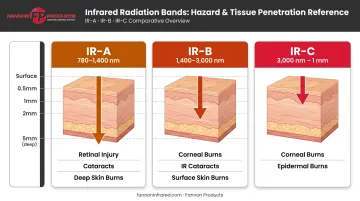
IR-A is the primary concern in most industrial lamp applications because ocular media transmit wavelengths up to approximately 1,350–1,400 nm directly to the retina. Short-wave quartz lamps (including Fannon Products' tungsten-filament models operating at up to 4,000°F) operate squarely in IR-A territory.
Eye Injury: The Silent Hazard
That IR-A penetration depth makes the eyes the most vulnerable target. OSHA's Technical Manual links IR-A exposure to retinal thermal injury and cataracts, and IR-B to corneal burns and lens opacity. What makes ocular injury particularly dangerous is that the eye absorbs IR energy before the body perceives pain — there's no aversion reflex fast enough to prevent damage at close range.
The numbers reflect the risk. ICNIRP sets an anterior-eye IR irradiance limit of 100 W/m² for exposures exceeding 1,000 seconds. Chronic occupational exposures of 800–4,000 W/m² have been associated with lenticular opacities developing over 10–15 years. For workers near high-wattage comfort heating lamps or operating screen printing flash dryers (where 1,000–2,000W lamps run continuously), these exposure levels are routine — not edge cases.
Skin Burns and the "No Pain" Problem
IR-A radiation can cause thermal burns beneath the skin surface without producing surface redness as an early warning. IR-B causes more superficial heating, but both can injure tissue before operators realize anything is wrong.
ICNIRP is clear that the absence of pain does not mean the absence of injury. Aversion responses typically limit single exposures to 0.25–10 seconds, but workers on extended shifts near high-power process lamps don't experience brief, isolated exposures — thermal injury builds over time.
Who Faces Elevated Risk
Some workers need additional precautions beyond standard protocols:
- Workers with heart disease, high blood pressure, or diabetes — OSHA identifies these as heat-illness risk factors
- Pregnant workers, who are more likely to experience heat stroke or exhaustion because cooling becomes harder during pregnancy
- Workers on extended shifts near high-wattage industrial arrays
- Anyone taking medications that affect temperature regulation
Safety Guidelines for Infrared Heat Lamps
Safe IR lamp operation depends on three things working together: a correctly specified lamp, a properly designed installation, and disciplined operator behavior. None of the three compensates for failures in the others.
General Safety Precautions
These measures apply across all IR lamp applications:
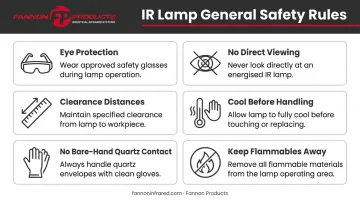
- Wear IR-rated eye protection when working near high-wattage lamps — OSHA 1910.133 requires appropriate eye and face protection for potentially injurious light radiation, with ANSI/ISEA Z87.1 as the referenced standard
- Never stare directly at an operating lamp, regardless of wattage
- Maintain manufacturer-specified minimum clearance distances from people and materials — post these distances visibly, don't rely on memory
- Allow lamps to cool fully before handling or replacement
- Never handle quartz lamps with bare hands — skin oils contaminate the quartz envelope, causing hot spots that shorten lamp life or cause premature failure
- Keep flammable materials (paper, textiles, solvents) outside the lamp's heat zone
Safety During Installation
Installation errors create layered risks that often go undetected until a failure occurs — and some can't be corrected without a full rewire. Cover these before energizing any system:
- Verify circuit capacity against the lamp's voltage and wattage — undersized wiring or overloaded circuits cause insulation failure and fire risk, not just tripped breakers
- Isolate the circuit completely before installation
- Never bypass manufacturer-specified mounting brackets or reflector housings
- Use purpose-designed fixtures, not improvised setups
For high-wattage industrial systems — automotive drying arrays, multi-lamp printing configurations, ceiling-mounted commercial heating — professional electrical installation is required. Improper mounting changes the thermal and electrical behavior of the entire assembly, not just the lamp itself.
This is why Fannon Products' custom infrared systems include engineered mounting brackets, ceramic block assemblies, and purpose-designed connectors — each component is specified for the system it serves.
Safety While Operating
Day-to-day operation carries its own risk profile, particularly in industrial settings where lamps run for extended cycles:
- Do not exceed rated wattage or duty cycle
- Monitor for warning signs: unusual odors, housing discoloration, flickering, or heat spread outside the target zone — these precede lamp failure
- Never bypass timer controls or thermal cutoffs for convenience; OSHA requires ventilation interlocks in spray-finishing drying operations for exactly this reason
- Don't assume comfort-heating wattages carry no risk — the same lamp type used at higher power in process applications can cause injury at close range
Environmental and System Safety Considerations
The operating environment can turn a well-specified lamp into a hazard. Four conditions deserve particular attention.
Poor ventilation accelerates heat buildup around lamp housings. In enclosed spaces, heat accumulates around fixtures and nearby materials — and in manufacturing environments running continuous process cycles, ambient temperature rise is a real operational hazard, not just a comfort issue.
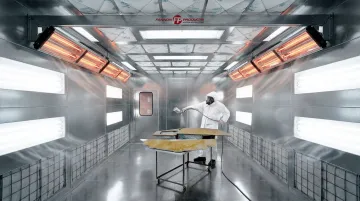
Flammable materials near IR drying and curing systems create fire and explosion risk. In automotive refinishing, printing, and coating operations, inks, solvents, and flammable finishes may be present while lamps operate. OSHA 1910.107 requires that drying and curing apparatus used with flammable or combustible spray finishes meet oven/furnace requirements, maintain ventilation, and use interlocks. For automotive refinishing specifically, a minimum 3-minute purge of spray vapors is required before lamps are energized, and the dryer must interlock to shut off if ventilation fails. This is a regulatory requirement, not a best practice.
Combustible dust turns lamp surfaces into ignition sources. OSHA's combustible dust guidance is clear: dust adjacent to processing equipment can ignite when exposed to sufficient heat. Plastics, textiles, food processing, and general manufacturing all carry this risk. Clean lamp surfaces and reflectors regularly to prevent accumulation from becoming a hazard.
Using indoor-rated fixtures in wet or outdoor environments raises both failure and electrical hazard risk. Moisture ingress into an unrated fixture, or condensation on electrical connections, accelerates lamp failure and creates shock risk. Outdoor and semi-outdoor comfort heating installations require IP-rated fixtures matched to the exposure conditions; IEC 60529 provides the rating framework.
Common Safety Mistakes to Avoid
These errors come up repeatedly in industrial IR lamp environments. The consequences, not the intent, are what matter.
Assuming low-wattage lamps need no precautions. Comfort heating lamps at 1,500–2,000W still require clearance distances and eye protection at close range. "It's just for warmth" is not a risk assessment.
Skipping the cool-down period. Touching a lamp before it has cooled causes burns and — with quartz lamps — transfers skin oils that create failure points in the envelope. Both consequences are avoidable with one habit.
Using non-specification replacement lamps. A lamp of the wrong wattage, voltage, or type in an incompatible fixture can:
- Overload the circuit
- Generate excess heat in the housing
- Produce radiation the fixture wasn't built to handle
Fannon Products makes direct replacement lamps to exact OEM specs for Heidelberg, Solaira, Fostoria, and M&R systems. Using the correct specification keeps the system within its designed safety parameters — not just performing correctly, but operating safely.

Ignoring early warning signs. Housing discoloration, unusual odors, flickering, or unexpected heat spread are not nuisances — they're indicators of pending lamp failure or a wiring problem. Addressing them immediately is far less costly than the alternative.
Treating safety as a one-time setup task. IR lamp safety requires ongoing attention — periodic inspection of wiring condition, lamp integrity, reflector cleanliness, and clearance distances. In industrial environments with high operating hours and changing conditions, what was safe six months ago may not be safe today.
Conclusion
Infrared heat lamp safety depends on four things working together consistently: a correctly specified lamp, a properly engineered installation, an environment matched to the lamp's design, and operator behavior that respects clearance requirements and PPE standards.
Any one of those four failing is enough to cause injury, equipment damage, or a fire. The 2015 OSHA citation involving an employee sustaining third-degree burns near an infrared heater came down to one enforcement gap — no physical barrier preventing workers from standing within the manufacturer's 60-inch clearance. The hazard wasn't the lamp itself — it was the missing barrier that let a worker enter a zone the system was never designed to be occupied.
For industrial and commercial buyers specifying infrared lamps, the starting point is getting the lamp selection right. Fannon Products has been manufacturing infrared lamps for nearly 70 years, supplying direct replacement lamps to exact OEM specifications for Heidelberg presses, Solaira and Fostoria heaters, M&R flash dryers, and HP systems.
The team also engineers custom infrared solutions for automotive, printing, plastics, and food service applications. Reach them at 810-794-2000 or sales@fannonir.com for guidance on correct specifications, replacement lamp compatibility, and system design before problems occur.
Frequently Asked Questions
Are infrared heat lamps safe for humans?
Yes, when used correctly — keep them at proper distances, within rated wattage, and with basic precautions like eye protection. The risk comes from overexposure, incorrect setup, or ignoring manufacturer guidelines, not from the technology itself.
Can infrared heat lamps cause eye damage?
Yes, particularly IR-A (short-wave) radiation, which can cause corneal burns, cataracts, and lens damage even after brief close-range exposure. The eye absorbs IR before pain registers. Never stare directly at an operating lamp, and wear IR-rated eye protection in industrial settings.
What is a safe distance from an infrared heat lamp?
Safe distance depends on wattage and wave type — no single universal figure applies across all lamps. Guidance for comfort heating lamps differs from high-wattage industrial units, so always consult the manufacturer's spec sheet for your specific lamp.
Can infrared heat lamps cause skin burns?
Yes. Prolonged or close-range exposure, especially from IR-A radiation, can cause thermal burns beneath the skin surface, sometimes without surface redness as a warning. Risk increases significantly with higher wattage and longer exposure duration.
Are infrared heat lamps a fire hazard?
They can be if flammable materials enter the heat zone, the wrong wattage lamp is used for the fixture, or wiring is damaged or overloaded. Maintaining proper clearance, using the correct lamp specification, and scheduling regular electrical inspections keeps those risks in check.
Is it safe to use infrared heat lamps in industrial workplaces?
Yes. Industrial IR lamp use has a strong safety record when systems are engineered for the application, workers follow safe distance guidelines and wear appropriate PPE, and lamps are specified and installed correctly. Meet those conditions and the technology performs reliably.