With U.S. electricity costs continuing to climb, that mismatch has real financial consequences. Whether you're managing a production floor, outfitting a restaurant patio, or sourcing replacement lamps for industrial drying systems, this guide cuts through the noise.
Here's what we cover: how each heater works, where each performs best, and a clear decision framework so you can match the right technology to your specific space and use case.
Key Takeaways
- Infrared heaters warm objects and people directly — no air circulation required
- Convection heaters heat ambient air — best suited for enclosed, well-insulated spaces
- Infrared wins in open, drafty, or industrial environments — and delivers heat almost instantly
- Convection suits continuous, all-day heating in sealed, occupied rooms
- Match the heater type to your space — open or industrial favors infrared, sealed occupied rooms favor convection
Infrared vs. Convection Heaters: Quick Comparison
| Category | Infrared | Convection |
|---|---|---|
| Heating Mechanism | Emits electromagnetic radiation that directly warms objects, surfaces, and people in its path | Heats air through contact with a heating element, then distributes warmth via natural air currents or a fan |
| Heat-Up Speed | Reaches full output almost instantly — short-wave lamps in under a second | Requires time to warm surrounding air before occupants feel the effect |
| Best Environment | Open, semi-open, outdoor, or drafty industrial spaces | Enclosed, well-insulated rooms with consistent occupancy |
| Energy Efficiency | Delivers energy directly to the target with minimal waste | Efficiency drops sharply when heated air escapes through open doors, high ceilings, or ventilated spaces |
| Air Quality Impact | Doesn't circulate air, so it won't disturb dust, allergens, or contaminants | Relies on air movement, which can recirculate airborne particles throughout a space |
| Typical Applications | Automotive paint curing, inkjet drying, outdoor patio heating, warehouse spot-heating, stadium seating, food warming | Offices, enclosed server rooms, climate-controlled production floors, cold storage entry areas |
What Are Infrared Heaters?
Infrared heaters emit electromagnetic radiation in the infrared spectrum that travels directly to objects, surfaces, and people — warming them without heating the surrounding air first. Standing in sunlight on a cold day captures this effect: the air is frigid, but the sun's radiation warms your skin directly, bypassing the air entirely.
The Three Main Subtypes
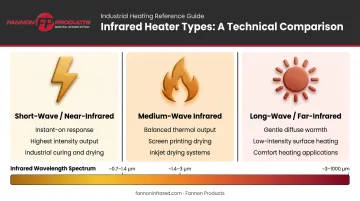
Infrared heaters aren't a single technology. There are three distinct categories, each suited to different applications:
- Short-wave (near-infrared): High-intensity output, near-instant response. Used in industrial process heating like automotive paint curing, thermoforming, and high-speed drying lines. Fannon Products' short-wave quartz lamps achieve 96% radiant efficiency with an instant-on response time — no warm-up lag.
- Medium-wave: Balanced performance for drying and curing operations. Less color-sensitive than short-wave, making them particularly valuable in screen printing and inkjet drying. Fannon's medium-wave lamps are available in standard and fast-response configurations.
- Long-wave (far-infrared/ceramic): Lower surface temperature, gentler output. Suited for comfort heating where a softer, more diffuse warmth is preferred over intense directional heat.
Why Infrared Matters in Industrial Contexts
In manufacturing and process heating, the key advantage is that infrared heats the material — not the room. This translates directly into faster process cycles and better temperature control, with no energy wasted heating air that serves no production purpose.
Applications where this matters most:
- Automotive primer, color coat, and clear coat drying
- Inkjet and screen printing ink drying
- Plastics thermoforming and welding
- Food processing (baking, browning, dehydrating)
- Electronics re-flow soldering and water dry-off
Those efficiency gains are measurable in practice. Fannon Products, based in Algonac, Michigan, has manufactured infrared lamps for nearly 70 years across every major industrial vertical. Their Goldenrod lamps — built with an integral 24K gold reflector — direct virtually 100% of infrared energy at the target and are documented to save 23.5% in energy expense compared to standard lamps.
Comfort and Commercial Applications
Environments where infrared is the dominant choice:
- Outdoor restaurant patios and terraces
- Open warehouse bays and aircraft hangars
- Stadium seating areas and event venues
- Automotive spray booths and drying tunnels
- Inkjet and screen printing drying systems
- Spot-heating in manufacturing facilities
- HP 3D printing systems (for precise layer-fusion thermal control)
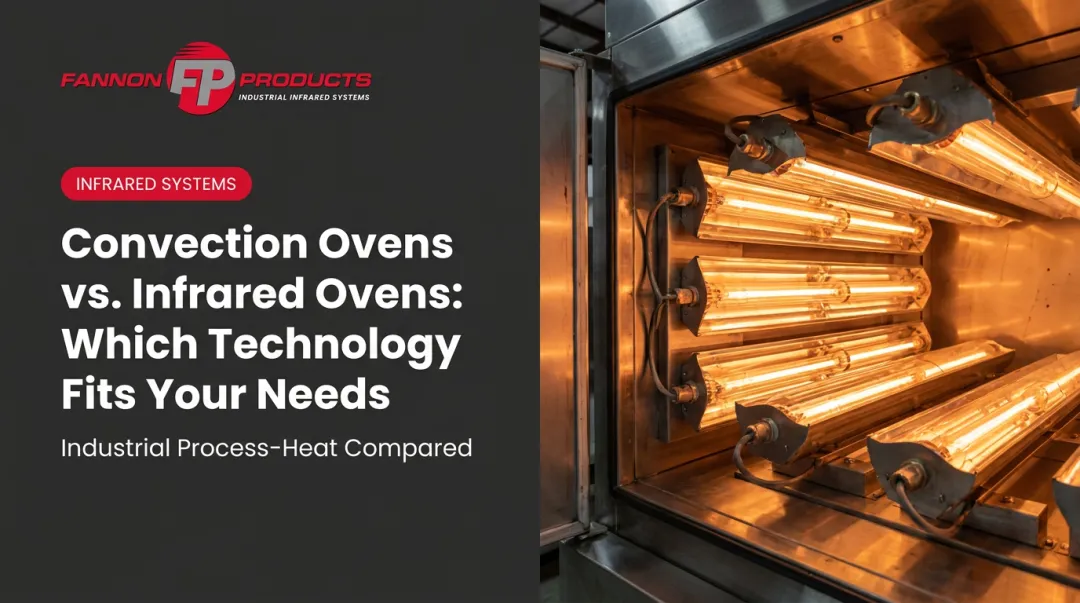
In industrial drying, infrared process heating consistently cuts cure and drying cycle times compared to convection ovens, precisely because energy transfers directly into the substrate rather than the surrounding air.
What Are Convection Heaters?
Convection heaters work by passing air over or through a heating element — a coil, finned tube, or ceramic plate — and then circulating the warmed air throughout a space. Some rely on natural convection currents; others use a fan to accelerate distribution. The key distinction from infrared: convection heats the air, not the objects or people in the space.
Where Convection Works Well
Convection is a reasonable choice when:
- The space is well-insulated and enclosed
- Heating needs are continuous (all-day occupancy)
- Uniform ambient temperature throughout the room is the priority
- The space doesn't lose heated air through open doors, drafts, or frequent ventilation
Good convection environments include enclosed offices, insulated warehouses needing sustained background warmth, server rooms with consistent thermal loads, and climate-controlled production floors where uniform air temperature is process-critical.
Key Limitations
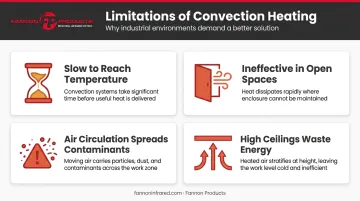
Convection heating struggles in several common industrial scenarios:
- Slow to reach temperature: The room needs to warm before occupants benefit
- Ineffective in open spaces: Heated air escapes immediately through doors, vents, or large openings
- Air circulation spreads contaminants: Dust, allergens, and airborne particles recirculate throughout the space — a real issue in food production, cleanrooms, or health-sensitive environments
- High ceilings waste energy: Hot air rises; in tall industrial spaces, convection heating often warms the ceiling before it warms workers at floor level
Infrared vs. Convection: Which Is Better for Your Needs?
The right heater depends on where it's going, how it's used, and what's at stake if it underperforms. Here's how to read your situation.
Space Type
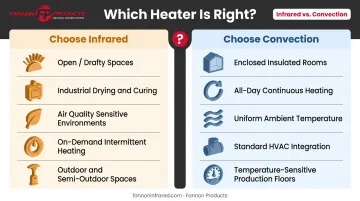
Open or semi-open spaces — loading docks, outdoor patios, warehouse bays, construction sites — strongly favor infrared. Heated air from convection units simply escapes. You'd be paying to heat the outdoors.
Enclosed, well-insulated rooms with consistent occupancy are where convection can be cost-competitive. The air stays in, the temperature builds, and the heater maintains it efficiently.
Usage Pattern
Intermittent or on-demand heating (stadium events, shift-based production areas, outdoor restaurant seating) favors infrared because it reaches full output almost instantly and stops immediately when switched off — no wasted energy warming an empty space between uses.
Continuous all-day heating in occupied enclosed rooms is where convection holds its ground. The slow warm-up matters less when the heater runs all day anyway.
Air Quality and Health
Infrared heaters don't circulate air — which makes them the better option for:
- Environments with allergy or asthma sufferers
- Food production facilities where airborne contamination is a concern
- Cleanrooms and precision manufacturing environments
- Any space where dust or particulate matter is present
Convection systems recirculate whatever is in the air. In industrial settings, that can mean spreading contaminants that belong on the floor back into the breathing zone.
Energy Cost and Efficiency
According to the U.S. Energy Information Administration, the average U.S. commercial electricity rate sits around $0.12–$0.14 per kWh — and it's been trending upward. In open or semi-open environments, convection heaters waste a disproportionate share of that spend heating air that escapes the space. Infrared delivers energy directly to the target, so less input wattage achieves the same comfort or process outcome.
Decision Summary
| If you need... | Choose... |
|---|---|
| Fast, targeted heat in an open/drafty space | Infrared |
| Heating during industrial drying or curing | Infrared |
| Better air quality (allergens, contaminants) | Infrared |
| Even, sustained warmth in a sealed room | Convection |
| All-day background heat in an insulated building | Convection |
Real-World Applications: Where Each Heater Shines
Industrial: Printing and Automotive Drying
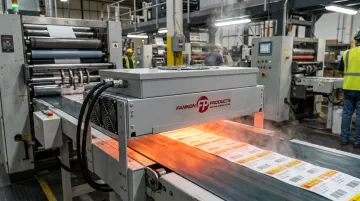
On a printing production line, the challenge is drying ink — fast, consistently, without damaging the substrate. A convection oven approach would require heating the entire oven chamber before the material benefits. Infrared targets the ink layer directly.
Fannon Products manufactures inkjet drying systems specifically for this problem. Their LightSpeed and Near Infrared drying systems use short-wave lamps with 24K gold reflectors to direct energy precisely at the paper — enabling faster line speeds, reduced electrical consumption, and cooler surrounding equipment temperatures compared to conventional drying methods.
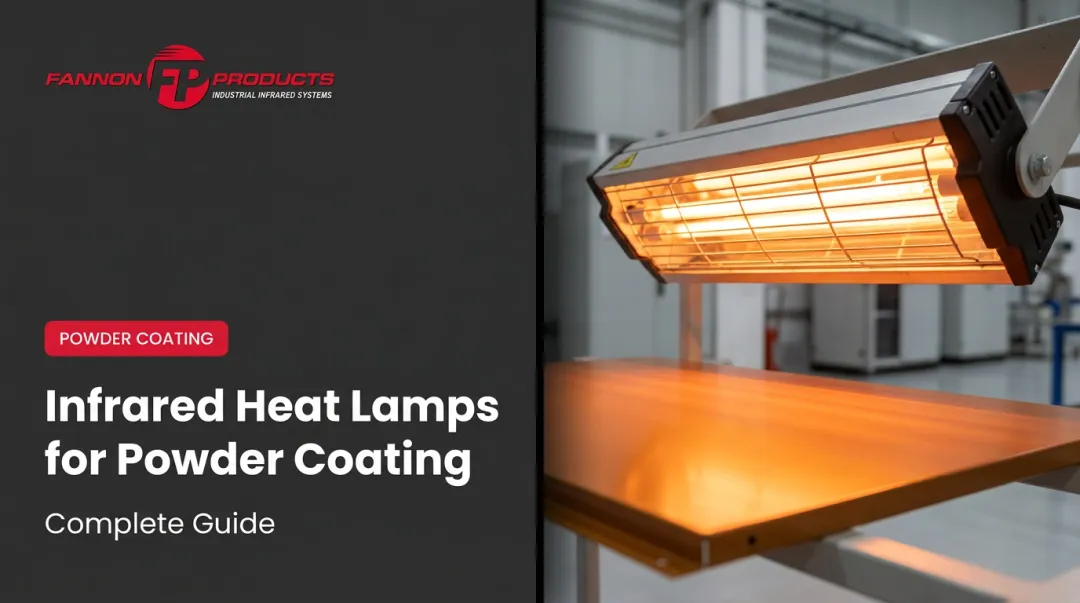
The same principle applies in automotive paint curing. Infrared lamps heat the coating on the panel — not the entire spray booth. Fannon supplies custom automotive infrared systems covering primer, color coat, clear coat, and powder coat applications, built to the standards of modern vehicle manufacturing.
Commercial Comfort: Outdoor and Semi-Outdoor Spaces
Restaurants, stadiums, and event venues can't effectively heat open-air spaces with convection. Warm air dissipates the moment it's produced. Infrared heaters solve this by warming guests directly — like portable sunlight.
Fannon supplies replacement lamps for major comfort heating brands including Solaira and Fostoria, engineered specifically for guest-facing environments. Key specifications include:
- Gold glare-reduction coatings for comfortable, low-glare output
- 96% radiant efficiency for maximum heat delivery
- 5,000+ hour life expectancy for reduced maintenance intervals
Enclosed Spaces: Where Convection Earns Its Place
Not every environment benefits from directional heat. Two common cases where convection is the better fit:
- Office spaces running standard business hours need steady, economical ambient warmth — not instant on-demand heat
- Temperature-sensitive production floors require uniform air temperature; directional radiant heat risks creating hot spots that compromise product quality
In both cases, convection's even heat distribution and compatibility with standard HVAC infrastructure makes it the practical choice.
The right heater is always the one matched to the environment. If you're working through an industrial or commercial infrared application, contact Fannon Products at sales@fannonir.com or 810-794-2000. With nearly 70 years of experience designing and manufacturing infrared lamps and custom systems, they can spec the right lamp type, wattage, and configuration for what you actually need.
Conclusion
Infrared wins on speed, efficiency, and versatility in open, outdoor, or process-heating environments. Convection holds its ground for sustained ambient heating in enclosed, well-insulated spaces. Neither is universally superior.
The right choice depends entirely on your environment and application. A quick reference:
Choose infrared when:
- Heating open, outdoor, or drafty spaces where warm air would escape
- Speed matters — instant heat-up with no warm-up lag
- Process heating requires direct, targeted energy (paint curing, drying, forming)
- Energy efficiency is a priority in spot or zone heating
Choose convection when:
- Maintaining consistent ambient temperature in a sealed, insulated room
- Gradual, even heat distribution is more important than fast response
- The space has minimal airflow disruption
For industrial operators, getting the selection right means faster cycle times, less wasted energy, and consistent output quality. For commercial users, it means lower operating costs and spaces that stay comfortable without constant adjustment. If your application involves infrared — whether replacement lamps for existing equipment or a custom heating system — Fannon Products has nearly 70 years of experience helping industrial and commercial buyers find the right solution.
Frequently Asked Questions
How much does it cost to run a 1,500-watt infrared heater for 24 hours?
Multiply watts × hours ÷ 1,000 × your local kWh rate: 1.5 kW × 24 hours × $0.13 = roughly $4.68 per day at average U.S. rates. In practice, infrared's instant-on response means most installations run far fewer than 24 continuous hours, cutting real-world costs well below that figure.
What's better, an infrared or convection heater?
It depends entirely on the environment. Infrared is better for open, outdoor, or industrial heating where targeted, fast heat is needed. Convection is better for sustained ambient heating in well-insulated, enclosed spaces with consistent daily occupancy.
Which room heater is best for asthma patients?
Infrared heaters are the better choice. They don't circulate air, so they don't stir up dust, allergens, or airborne particles the way convection heaters do, making them far more suitable for anyone with respiratory sensitivities.
Can infrared heaters be used effectively in open or outdoor industrial spaces?
Yes. Infrared heats objects and people directly rather than warming the surrounding air, so heat isn't lost when air moves or escapes. That makes it far more efficient than convection in any space that isn't fully enclosed.
Are infrared heaters suitable for industrial process heating like drying or curing?
Infrared heaters are widely used across automotive, printing, plastics, and food processing industries for exactly this purpose. They deliver targeted, controllable heat directly to the material — enabling faster drying and curing cycles with more consistent results than convection-based methods.