The frustrating part is that the "right" drying time isn't a single number. It shifts based on primer type, surface material, temperature, humidity, and how thick you applied the coat. "Dry to the touch" and "ready for topcoat" are two very different things, and confusing them is one of the most common causes of paint failure.
This article covers drying times by primer type and surface, the environmental factors that speed up or slow down the process, how to test whether primer is genuinely ready, and what happens when you jump the gun.
Key Takeaways
- Water-based (latex) primers are typically topcoat-ready in 1–3 hours; oil-based primers can require up to 24 hours
- "Dry to the touch" isn't the same as ready to paint; always check the recoat time on the product label
- Humidity above 85% RH and temperatures below 50°F can dramatically extend or stall drying
- Use the touch test, scratch test, or tape test to confirm primer is ready before topcoat
- Thin, even coats dry faster and produce better adhesion than one heavy layer
Why Primer Drying Time Matters Before Painting
Primer drying has two stages — and confusing them is the most common reason paint jobs fail.
| Stage | What It Means | Ready to Topcoat? |
|---|---|---|
| Dry to the touch | Surface film has formed; primer won't transfer to your finger. ASTM D5895 calls this "set-to-touch" — the first of four measurable drying stages. | No |
| Recoat-ready | The full film thickness has hardened enough to accept topcoat without trapping solvents or moisture. | Yes |
| Fully cured | Final hardness and adhesion are achieved. Can take days beyond recoat-ready. | Yes (optimal) |
Benjamin Moore's Fresh Start 032 alkyd primer illustrates the gap: touch-dry in one hour, but it requires 3–4 days to fully develop maximum adhesion and hardness.
What Happens When You Paint Too Early
Applying topcoat before primer is recoat-ready seals residual solvents or moisture beneath the paint film. Those trapped volatiles create internal vapor pressure, producing:
- Bubbles and blisters as trapped moisture vaporizes through the topcoat
- Peeling and delamination at the primer-to-topcoat interface
- Uneven sheen and blotching where solvents escape inconsistently
These failures aren't always immediate. Some surface defects develop weeks or months after application, making the root cause difficult to diagnose. Sanding down and recoating costs far more in time and materials than simply waiting for proper drying.
How Long Should Primer Dry Before Painting
Manufacturer instructions on the product's Technical Data Sheet (TDS) are always the authoritative reference. The timelines below are general guidelines based on industry data.
By Primer Type
All times assume approximately 70–77°F and 50% relative humidity.
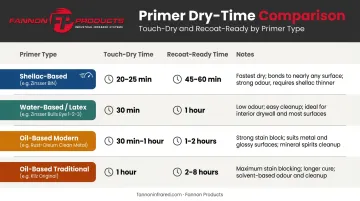
| Primer Type | Touch-Dry | Recoat-Ready | Notes |
|---|---|---|---|
| Shellac-based (e.g., Zinsser B-I-N) | 20–25 min | 45–60 min | Fastest-drying category |
| Water-based / latex (e.g., KILZ 2, Behr Drywall Plus) | 30 min | 1 hour | Most predictable same-day workflow |
| Oil-based / alkyd — modern formulas (e.g., Zinsser Cover Stain, KILZ Original) | 30 min–1 hour | 1–2 hours | Faster than legacy oil-based |
| Oil-based / alkyd — traditional (e.g., Benjamin Moore Fresh Start 032) | 1 hour | 2–8 hours | Up to 24 hours in cold or tinted formulas |
Why oil-based primers dry more slowly: Alkyd primers go through two stages — solvent evaporation first, then oxidative polymerization, where the resin hardens by reacting with atmospheric oxygen. Water-based primers skip that second stage entirely, which is why they cure so much faster.
When to use oil-based despite the wait: Bare wood, heavy stains, and bleed-through from tannin-rich woods like cedar or redwood. The penetrating bond is worth the longer window.
By Surface Type
Drywall: New drywall absorbs primer quickly. Water-based primers like Behr Drywall Plus are touch-dry in 30 minutes and topcoat-ready in 1 hour under standard conditions. Previously painted surfaces follow the same label times.
Wood: Bare wood requires longer drying — especially with oil-based primers — because the primer must penetrate the grain before surface drying begins. Sherwin-Williams' Exterior Latex Wood Primer specifies a 4-hour recoat time at 77°F, extending to 24–48 hours at 35°F. For oil-based primers on wood, plan on at least 6 hours as a minimum.
Metal: Rust-inhibiting metal primers often have unusual overcoat windows. Rust-Oleum Stops Rust products require topcoating within 1 hour or waiting at least 48 hours. That gap exists because the intermediate curing stage creates a surface condition that actively inhibits adhesion of additional coats. Always check the specific product TDS for metal primers before proceeding.
Factors That Affect How Long Primer Takes to Dry
Even with the right primer applied correctly, drying time can shift dramatically based on conditions.
Humidity and Temperature
Temperature is a bigger variable than most people expect. Sherwin-Williams Pro-Cryl primer data shows this clearly:
| Condition | Touch-Dry | Recoat Time | Full Cure |
|---|---|---|---|
| 77°F, 50% RH | 40 min | 4 hours | 30 days |
| 40°F, 50% RH | 2 hours | 16 hours | 45 days |
That's a 4x increase in recoat time from a temperature drop most contractors encounter in fall or early spring.
For humidity, the hard ceiling is 85% RH — both Zinsser Cover Stain and Sherwin-Williams Pro-Cryl cap application there. Above that threshold, bonding chemistry is compromised and blistering becomes likely. The ideal range for most primers is around 50% RH.
Flash-drying risk: Direct sunlight can push substrate temperatures more than 20°F above ambient air temperature, according to Behr Pro's guidelines — skinning the surface over while the interior stays wet. The primer looks dry. It isn't.
Ventilation, Coating Thickness, and Surface Porosity
Temperature and humidity set the baseline, but three more variables can push drying time further in either direction:
- Good airflow moves evaporating solvents away from the surface. Point interior fans away from the wet primer — not directly at it — to avoid dust contamination
- Thick coats take longer to dry. Sherwin-Williams explicitly notes that "drying and recoat times are temperature, humidity, and film thickness dependent." One thin coat dries faster and adheres better than one heavy coat
- Porous substrates — fresh drywall, raw concrete, unsealed wood — absorb primer differently than previously painted surfaces, sometimes requiring a second coat and extending the project timeline by a day or more
How to Tell When Primer Is Ready to Paint
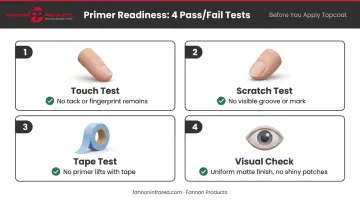
Don't rely on elapsed time alone. Use one of these field tests to confirm readiness.
Touch test: Press a fingertip lightly against the primed surface. A ready surface won't feel tacky or leave a fingerprint mark. Keep in mind: the outer film can pass this test while the layer beneath is still wet — passing means you're at set-to-touch stage, not necessarily recoat-ready.
Scratch test: Draw a fingernail lightly across the surface. No visible mark or groove means the primer has sufficient hardness for topcoating. Any marking means it needs more time.
Tape test: Press a strip of painter's tape firmly onto the primed surface, then peel it back at a consistent angle. If primer lifts with the tape, the film hasn't bonded fully to the substrate yet.
Visual check: Fresh primer looks slightly shiny or wet. As it dries, it transitions to a uniform matte finish. Patches of uneven sheen or soft spots signal it needs more time — though a matte appearance alone isn't confirmation of recoat-readiness. When in doubt, combine this with the scratch test before committing to a topcoat.
How to Speed Up Primer Drying Time
When the project timeline is tight, these methods reduce drying time without sacrificing finish quality.
Environmental controls:
- Run a dehumidifier before and during priming to pull ambient humidity toward 50% RH
- Keep room temperature near 70°F — the middle of the ideal 50–85°F range
- Open windows or run fans to promote air circulation and move saturated air away from the surface
Apply thin, even coats. This single adjustment has the largest practical impact on drying time — and it also produces better adhesion and a smoother final finish. Two thin coats will outperform one heavy coat in every measurable way.
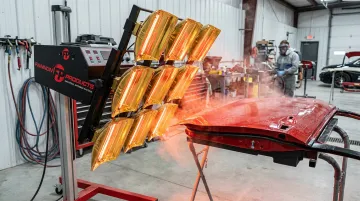
Infrared heat lamps take a different approach entirely. In professional automotive body shops and industrial coating environments, they reduce primer cure cycles from hours down to minutes. According to BodyShop Business, short-wave IR systems can cure two door panels in 10 minutes or less compared to conventional booth bake cycles.
The mechanism is different from conventional heat: infrared energy penetrates directly into the coating film, curing from the inside out rather than heating the surrounding air. This approach eliminates the trapped-solvent risk associated with surface-only flash-drying.
Fannon Products has been manufacturing infrared lamps for automotive paint-cure and industrial coating applications for nearly 70 years, producing both complete custom infrared systems and replacement lamps for existing equipment. Their systems cover primer coat, color coat, clear coat, and powder coat curing.
Their Goldenrod lamp design features an integral 24K gold reflector that directs virtually 100% of infrared energy toward the target surface, delivering up to 23.5% in energy savings compared to standard configurations. For shops where every cycle counts, that combination of speed and efficiency adds up fast.
Frequently Asked Questions
How long should I let primer cure before painting?
Water-based primers are touch-dry in about 30 minutes but recoat-ready in 1 hour under good conditions. Oil-based primers vary widely: modern formulas allow recoating in 1–2 hours, while traditional alkyds may need up to 8–24 hours. Always follow the manufacturer's TDS recoat time, not the touch-dry time.
How can I tell when primer is cured?
Three reliable tests help confirm cure:
- Touch test: no tack, no fingerprint under slight pressure
- Scratch test: fingernail leaves no mark on the surface
- Visual check: surface shifts from shiny to uniform matte
If any test is inconclusive, wait longer. There's no downside to extra drying time.
Can I paint over primer the same day?
Yes, for water-based primers in good conditions. Recoat windows of 1–3 hours make same-day painting entirely practical. Oil-based primers generally require an overnight wait, and tinted deep-base formulas can push that to 6–8 hours minimum. Skipping adequate dry time risks adhesion failure.
Does primer dry faster in heat or cold?
Heat accelerates drying by aiding solvent and water evaporation; cold temperatures slow or halt it. The practical impact is significant: a drop from 77°F to 40°F can quadruple recoat time. Ideal conditions fall between 50–85°F with moderate humidity around 50% RH.
What happens if I paint over wet primer?
Topcoat applied over undried primer traps moisture or solvent beneath the film. The result is peeling, bubbling, or delamination, often appearing weeks after the paint job looks fine. The surface typically needs to be sanded back and recoated from the primer stage.
How long is too long to wait before painting over primer?
Most primers should be topcoated within 30 days of application. Waiting beyond that risks dust accumulation, degraded adhesion, or primer breakdown. If you've missed the window, lightly sand the primed surface and apply a fresh coat before painting.