But infrared heaters work differently. They transfer heat through radiant energy directed at objects and people, not by heating the surrounding air. That distinction has real consequences for indoor humidity and comfort — consequences that most people don't know about until they've made the switch.
This article covers why conventional heaters dry indoor air, how infrared heating sidesteps that problem, what it means for your health and building materials, and how to maintain an optimal indoor environment year-round.
Key Takeaways
- Infrared heaters warm objects and people via radiant energy — air is not the heat transfer medium
- Because air isn't heated and circulated, indoor relative humidity stays stable
- Conventional forced-air systems lower humidity as a direct byproduct of heating and moving air
- Stable humidity benefits respiratory comfort, limits static electricity buildup, and shields building materials from drying out
- A basic hygrometer and light humidification, when needed, are enough to maintain comfortable indoor conditions
Why Conventional Heaters Dry the Air
EPA moisture-control guidance defines relative humidity as the ratio of actual moisture in the air to the maximum moisture that air can hold at a given temperature. When you heat air, its capacity to hold water increases — but if no additional water vapor enters the room, the relative humidity drops. No moisture is physically removed. It simply becomes a smaller fraction of what the warmer air could theoretically carry.
That's the core mechanism behind why heated rooms feel dry.
Forced-Air Furnaces Make It Worse
Forced-air furnaces don't just heat air — they circulate it aggressively through ductwork, pulling cool air in and blasting heated air out in a continuous cycle. This constant air movement amplifies the dryness effect in two ways:
- Rapid temperature changes push relative humidity down with each heating cycle
- Continuous duct circulation redistributes dust, pet dander, and allergens throughout the building
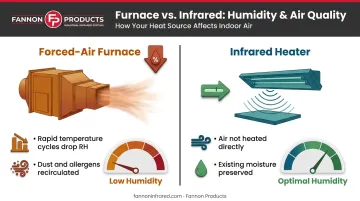
Many homeowners end up running a separate whole-home humidifier just to recover basic comfort — an added expense that represents a direct workaround for a design limitation.
Electric Baseboard and Convection Heaters
These systems create stratified air layers — hot air rises to the ceiling while cooler air settles at floor level. The result is uneven temperature and moisture distribution. Rooms can feel simultaneously stuffy near the ceiling and dry near where people actually sit.
When air is both dry and in constant motion, the body registers it quickly: dry skin, irritated eyes, inflamed sinuses, and greater vulnerability to respiratory infections. Research published in Environmental Research found that low relative humidity is directly associated with dryness and irritation of the respiratory tract, raising susceptibility to infection.
These effects aren't incidental — they're built into how air-based heating works.
Infrared heating sidesteps this entirely by warming surfaces and objects directly, without relying on heated air as the delivery medium.
How Infrared Heating Works: Warming Objects, Not Air
Infrared heaters emit electromagnetic waves in the infrared spectrum. Those waves travel through air without meaningfully heating it, then get absorbed by solid surfaces — floors, walls, furniture, and people — which warm up and gradually re-release that energy into the surrounding space.
The sun analogy captures it well. On a clear winter day, you feel genuinely warm standing in direct sunlight even when the air temperature is near freezing. Step into shadow and that warmth disappears immediately. Infrared heaters replicate that direct-transfer effect indoors.
Air Is Not the Medium
Because infrared waves bypass the air, there's no need to blast or rapidly circulate the air mass in a room. Air warms gradually and indirectly from the surfaces around it — and critically, the existing moisture content of that air remains intact.
Shortwave vs. Longwave IR
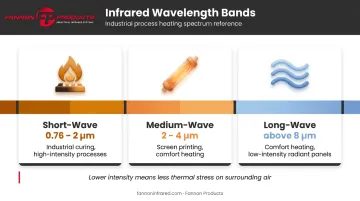
Not all infrared heaters are identical. Superior Radiant categorizes infrared emitters into three main bands:
| IR Category | Wavelength Range | Typical Application |
|---|---|---|
| Short-wave | 0.76–2 microns | Industrial curing, high-intensity process heating |
| Medium-wave | 2–4 microns | Screen printing, comfort heating, color-sensitive processes |
| Long-wave | Above 8 microns | Comfort heating, low-intensity radiant panels |
Short-wave emitters run at extremely high temperatures with near-instant response, ideal for industrial processes. Medium-wave and long-wave emitters operate at lower temperatures and produce gentler, more even warmth, common in residential and commercial comfort heating. That distinction matters for the moisture question: the lower the operating intensity, the less thermal stress on the surrounding air.
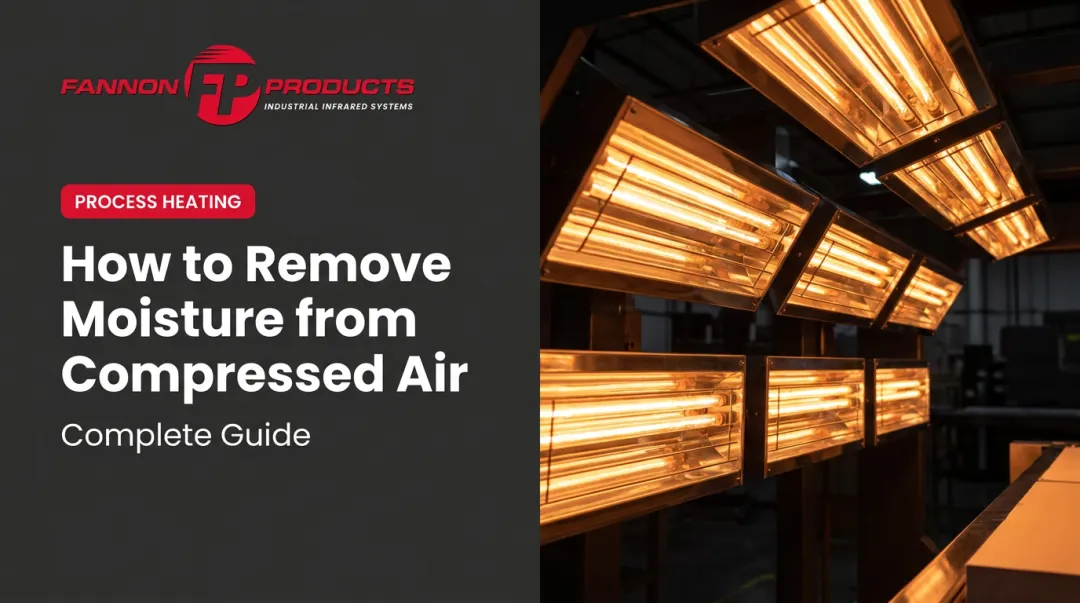
Fannon Products (Algonac, Michigan) has manufactured infrared lamps across this entire wavelength spectrum for nearly 70 years. Their catalog includes short-wave, medium-wave, twin-tube, and proprietary Goldenrod directional lamp designs used in automotive paint curing, food processing, electronics, screen printing, and more — each environment where moisture control is a real operational concern.
Do Infrared Heaters Really Preserve Indoor Humidity?
The direct answer: no, infrared heaters do not dry out the air.
Because they don't use air as a heat transfer medium and don't rely on fans or ductwork to distribute warmth, the relative humidity in a room stays stable while the space still feels warm and comfortable.
An Important Nuance
Infrared heaters preserve existing humidity — they don't strip it. But they also don't add moisture. In very dry climates or during harsh winters, ambient humidity may already be low due to outdoor conditions and building infiltration, not because of the heater. Blaming the heater for dry-air symptoms, when the cause is actually outdoor conditions or building envelope leakage, leads to the wrong solution.
Heating System Comparison: Effect on Indoor Humidity
| Heating System | Effect on Indoor Humidity |
|---|---|
| Forced-air furnace | Reduces RH through heating cycles and air circulation |
| Electric baseboard / convection | Reduces RH through air stratification and temperature swings |
| Gas fireplace | Reduces RH and consumes oxygen in the combustion process |
| Infrared / radiant heater | Preserves existing RH; no direct moisture removal |
Note: No single authoritative study provides precise RH-drop percentages by heater type. The table reflects the mechanisms each system uses, supported by EPA psychrometric guidance and radiant heating research.
Static Electricity: A Practical Indicator
That humidity-preservation difference has real downstream consequences — static electricity being one of the most immediate. Dry air is the primary driver of static electricity buildup indoors. ASHRAE humidity guidance notes that low relative humidity promotes static discharge, and research in the Journal of Electrostatics warns that conditions below 20–30% RH require special care in electronics and manufacturing environments. Because infrared heating keeps humidity stable, users typically experience fewer static shocks — a direct benefit in electronics production and other precision manufacturing settings where static discharge can damage components or disrupt processes.
Health and Comfort Benefits of Moisture-Stable Heating
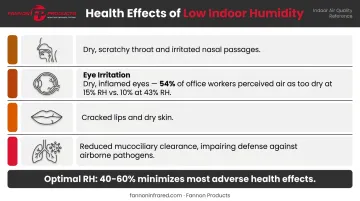
Maintaining adequate indoor humidity isn't just a comfort issue. Research by Arundel et al., published in Environmental Health Perspectives, concluded that most adverse health effects from relative humidity would be minimized at 40–60% RH.
The common symptoms of low-humidity heating are well documented:
- Dry, scratchy throat and irritated nasal passages
- Inflamed or dry eyes — one study found 54% of office workers perceived air as too dry at 15% RH, versus just 10% at 43% RH
- Cracked lips and dry skin
- Reduced mucociliary clearance, which impairs the body's natural defense against airborne pathogens
Beyond humidity, the absence of forced air circulation matters. Radiant systems that don't use fans or ducts simply don't redistribute dust, pet dander, or airborne particulates the way forced-air systems do. For people sensitive to drafts or airborne irritants, that's a real day-to-day difference in comfort — though infrared heating is not a clinical treatment for asthma or allergies.
There's also a thermal efficiency angle: infrared's penetrating warmth often lets occupants feel comfortable at a lower thermostat setting. Fewer heating cycles mean less temperature fluctuation — and less of the humidity dip each cycle creates.
How Infrared Heating Benefits Buildings and Materials
Humidity stability doesn't just protect people — it protects the building itself.
Wood floors, door frames, furniture, paint, and artwork are all vulnerable to expansion and contraction caused by humidity swings. The Canadian Conservation Institute identifies incorrect relative humidity as a primary agent of material deterioration. Humidity fluctuations create dimensional stress in organic materials and cause lasting damage to wood-based objects and paintings.
The Anti-Condensation Effect
Infrared heaters warm surfaces directly. Warmer surfaces are less likely to drop below dew point — which is exactly when condensation forms. EPA moisture-control data illustrates the relationship clearly: at 50% RH, a surface must be roughly 20°F cooler than room air for condensation to occur. At 90% RH, that gap shrinks to just 3°F.
By keeping surfaces warm, infrared heating raises that condensation threshold — reducing the conditions that lead to:
- Mold growth on walls and ceilings
- Wood rot in framing and flooring
- Damp-related damage to finishes and structural materials
This is why infrared heating is frequently recommended for older buildings, churches, heritage structures, and basements — environments where cold surfaces and intermittent occupancy create persistent condensation risk.
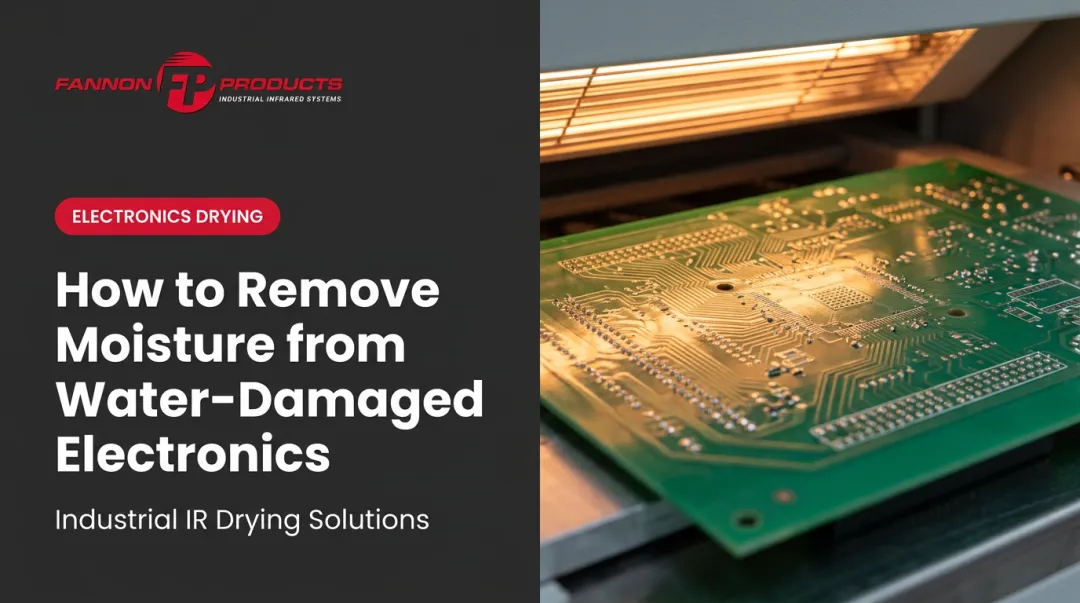
That same principle extends into industrial settings. Infrared's ability to warm specific materials and substrates makes it effective for targeted moisture removal — Fannon Products builds process-heating systems for water dry-off in electronics manufacturing and dehydration in food processing, where precision drying of a specific material matters far more than changing the humidity of an entire room.
Tips for Maintaining Ideal Indoor Humidity Alongside Infrared Heating
Infrared heating doesn't remove moisture from the air, but ambient humidity still matters — particularly in industrial facilities where process quality depends on controlled conditions.
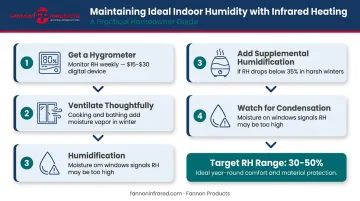
Target range: For occupied industrial workspaces, the EPA recommends 30–50% RH. Process-sensitive environments — screen printing shops, food handling areas, electronics assembly — often benefit from tighter control in the 40–60% RH range to protect both product quality and worker comfort.
Practical steps:
- Get a hygrometer — an inexpensive digital humidity monitor ($15–$30) gives you real-time RH readings. Check it weekly during winter months or in dry climates
- Ventilate thoughtfully — brief ventilation during cooking or bathing can actually raise indoor humidity in winter, since those activities add moisture vapor to the air
- Consider supplemental humidification if needed — in harsh winters or arid climates, a light-duty humidifier can boost ambient moisture without affecting infrared heating efficiency. A simple seasonal measure when RH drops below 35%
- Watch for condensation signals — if you see moisture on windows or walls, that indicates RH may be too high for your surface temperatures, not too low
Frequently Asked Questions
What type of heater does not dry the air?
Infrared (radiant) heaters are the best option for preserving indoor humidity. They heat objects directly rather than heating and circulating air — and it's that air-heating mechanism that lowers relative humidity in conventional systems. No air movement, no RH drop.
Are infrared heaters safe to leave on all night?
Most fixed infrared heaters are designed for extended operation and include safety features such as overheat protection. However, the CPSC advises against leaving portable electric heaters on while sleeping. Always follow the manufacturer's installation guidelines and use only listed equipment for unattended operation.
Do infrared heaters reduce humidity in the room?
No — infrared heaters don't remove water vapor from the air. They preserve existing moisture levels by heating surfaces rather than the air itself. That said, they don't add moisture either, so very dry climates or cold winters may still call for supplemental humidification based on actual humidity readings.
How do infrared heaters compare to forced-air heating for indoor air quality?
Infrared outperforms forced-air systems on air quality. It doesn't circulate dust or allergens, doesn't reduce relative humidity, and avoids the dry, stuffy atmosphere that furnaces and air handlers typically produce.
Can infrared heaters help with condensation and mold problems?
Yes, in part. By warming surfaces directly, infrared heaters raise the temperature of walls and floors, making them less likely to drop below dew point and form condensation. This reduces the damp conditions that mold requires. However, infrared alone doesn't address underlying moisture sources — ventilation and moisture control still matter.
Are infrared heaters good for people with allergies or asthma?
Infrared heaters are a solid choice for occupants sensitive to drafts or forced air. They don't circulate dust or allergens, and they maintain stable humidity levels — avoiding the mucous membrane dryness common in low-RH environments. Infrared is not a medical treatment for respiratory conditions.